The Modi government could steer through Parliament 59 out of 75 Bills.

Additionally, the Lower House will have 442 candidates, who have assets running into the crores. Vicky Nanjappa reports.
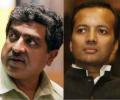
Self-proclaimed heir of Rani Rashmoni, lottery baron join businessmen in the list of MP-aspirants with assets worth over Rs 100 cr, reports Abhineet Kumar.

'The BJP doesn't have to do anything except nudge the AIADMK in one direction.'

Aam Aadmi Party on Saturday challenged Congress and the Bharatiya Janata Party to disclose the names of the people from whom they have got more than 80 per cent of their funds being spent in the Lok Sabha election campaign.
On the eve of the sixth and penultimate phase of the marathon Uttar Pradesh elections, Rediff.com's Aslam Hunani reports on what's at stake.

The Association for Democratic Reforms has stated in its report that 87 percent of the contributions or donations made to political parties in the past eight years were from business houses. The corporate houses contributed Rs 378.89 crore, constituting 87 per cent of the total contribution from known sources of political parties.

Setting a new bench mark in transparency in politics, the Central Information Commission has held that political parties are answerable under the Right to Information Act.
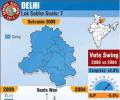
Out of the 150 candidates analysed in Delhi, where Lok Sabha elections will be held on April 10, 23 candidates (15 per cent) have declared cases against themselves.

Amidst barbs flying back and forth, Rediff.com's Aslam Hunani lists all that you need to know about the fourth phase of the UP assembly elections, which will take place on February 23.

"When it comes to economic matters, state governments have a far bigger role to play. Whether it is acquiring land for a major project or issuing a licence to a private university, the role of the state government has become very important. MLAs are bound to be natural beneficiaries of this heightened economic activity."

At least 36 people were injured on Friday when a blast hit an anti-government protest march in Bangkok demanding the ouster of Thai premier Yingluck Shinawatra, raising fears of violence in the run up to the February 2 snap polls.

Asserting that there was growing scourge of terrorism in view of fast growing linkages of terrorist groups across the globe, India on Tuesday strongly advocated stepped up cooperation through intelligence exchange and training with 54 African countries.

A weak and troubled United Progressive Alliance government has stumbled badly by issuing the ordinance to counter the fine judgment by the Supreme Court that forces the disqualification of lawmakers convicted for a criminal offence punishable with a jail term of over two years.

Political parties in India have received funds to the tune of Rs 4,895.6 crore between 2004 and 2012, and the irony is that 75 per cent of these funds cannot be traced.

How does the country's civilian government reclaim legitimacy after the names of many Pakistanis, including the family members of PM Nawaz Sharif, figured in the leaked documents.

According to a document by the Association for Democratic Reforms, the average number of years a case against a member of Parliament or a member of Legislative Assembly is pending is seven years. Vicky Nanjappa reports
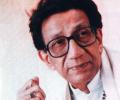
The Shiv Sena is leading currently in terms of criminal candidates. Out of the 14 declared by them in the first list 12 have a criminal background, as per the Association for Democratic Reforms.

The middle class's long push to force the state to retreat from the economy may be reversing, says Ajit Balakrishnan.

If Han Kang wrote only about cruelty and suffering, readers might respect her writings and her conscience, but her novels would not be as loved as they are by readers across the world, says Nilanjana Roy

'The BJP has been wooing him for quite some time.' 'But he didn't join the BJP; he started his own party.' 'Remember he has Hindus, Muslims and Christians as his fans.' 'He will never antagonise any of his fans.'

'As the financier, she controls the party.'
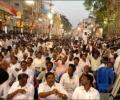
The election commission had upped the expense limit for Lok Sabha elections from Rs 40 lakh to Rs 70 lakh per candidate in big states but a new report states that 537 MPs declared expenses of less than 50 per cent of the limit. Vicky Nanjappa/Rediff.com reports

An Association of Democratic Reforms report states that 161 out of 230 MLAs in the newly-formed Madhya Pradesh Vidhan Sabha are crorepatis, while 73 MLAs have criminal cases filed against them.

Sri Lankans on Thursday voted in large numbers in the bitterly contested presidential election in which incumbent Mahinda Rajapaksa is seeking a record third term against his friend-turned-foe Maithripala Sirisena, with an unusually high voter turnout in Tamil and Muslim areas.

The question we must ask is how do politicians get that wealth disclosed in the affidavits, says Mahesh Vijapurkar.

Is politics gaining at the expense of civil society?
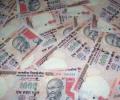
With GDP down by 2 per cent, while 99 per cent of banned notes make way back to the banking system, whom did demonetisation benefit?

If Afghanistan is going to make any gains through democratic reforms, the newly elected president must start with addressing corruption at all levels of government and developing a comprehensive government financing plan independent of American support.

As per the election affidavit of Dr Harsh Vardhan of the Bharatiya Janata Party, which is listed on the Election Commission of India website, a first information report (number 519/2013, in Madhu Vihar police station) has been filed against him under Sections 34, 323, 509 and 506 of the Indian Penal Code.

Biggest contribution came from Bharti group-led Satya Electoral Trust.
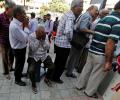
The ADR report states that 222 out of the total 1295 candidates in the fray in the 7th phase of polls have criminal records. There are also 341 crorepati candidates in the list.
The list of candidates contesting elections in the current round of assembly polls shows that not much has changed with regard to political parties' approach to candidates with a criminal track record. A K Bhattacharya explains

In his massive election rallies, Prime Minister Narendra Modi often caught voters fancy promising that each individual would get Rs 15-20 lakh in his bank account if he came to power.

There is speculation that China released the White Paper on Tibet in a hurry after a Spanish court agreed to hear charges of genocide against former Chinese president Hu Jintao. Ajai Shukla reports


Imagine being a part of a country, but being discriminated against by the majority community and atrocities being committed against you by the state. This is the deplorable conditions that the Rohingyas of Myanmar live in where they are cut off from their livelihoods and sources of income, unable to access markets, hospitals and schools, and have little or no access to relief aid. In order to understand the situation and the genesis of the tragedy unfolding, Rediff.com's Archana Masih speaks to Ambassador Vijay Nambiar, the United Nations' Chef de Cabinet (Chief of Staff), who had served a long stint with the UN in New York on the issue.

After weighing all the costs and benefits, the next administration is likely to reduce and restructure assistance to Pakistan but not to end it altogether, says Daniel S Markey.
 © 2026 Rediff.com - Advertise with us - Disclaimer - Privacy Policy - Sitemap - Feedback - About us - Terms of use - Grievances