
Anybody who is saying that in five years the Sensex will go to 60,000 is only saying that in the next five, years the Sensex will generate a CAGR of around 19 per cent, says U R Bhat, managing director of Dalton Capital Advisors.

Only 10 per cent of stocks account for 93 per cent of investments.

Thus far in FY21, BSE, NSE have rallied 70 per cent and 71 per cent, respectively.

BSE-listed companies' market capitalisation reached Rs 197.7 trillion on January 21, against India's nominal GDP of Rs 190 trillion during 12 months ended December 2020.

China is the world's second-largest - both in terms of GDP and m-cap. At $10 trillion, its m-cap is second only to the US at $38 trillion.

Given the impact Covid-19 pandemic had over the world economy, analysts expect global central banks, especially the US Fed, to keep the liquidity tap open, which, in turn, is likely to keep the equity markets, especially those in the emerging markets, buoyant.

The V-shaped rebound has been aided by a gush of liquidity flooding the global financial system, thanks to balance sheet expansion.

While a coordinated aggressive monetary easing from the central banks is most likely to offer some respite in the near-term, it is unlikely to improve the sentiments.

The markets have been unable to sustain at higher levels as a rise in bond yields globally, especially in the US have dented sentiment. Surging commodity prices, especially crude oil that have now hit $70 a barrel (Brent) coupled with inflation woes and fear of sporadic lockdown across major economic hubs back home as Covid cases rise have chased the bulls away. In the short-term, analysts expect the markets to remain volatile as they react to news flow - both from overseas and developments back home. Investors, they say, need to keep a tab on how the US treasury yields move, which in turn will have a ripple effect on how big money moves across developed (DMs) and emerging markets (EMs), including India.
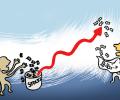
So far in 2019, India has been one of the highest recipients of foreign flows among Asian and Emerging Market (EM) economies

In the past four months, $7.5 billion has flowed back into domestic stocks, helping the benchmark indices bounce back more than 40 per cent from their 2020 lows.
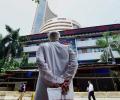
In three of the past four years, 10-year returns have been 10 per cent or lower, making equity unattractive, compared to other asset classes.

Indian equities are no longer cheap vis-a-vis global markets, and only a short distance away from being the most expensive they have ever been.

Given the developments, analysts expect fiscal and monetary support from the government and RBI to revive sentiment. However, recovery, they say, from these levels will be slow and painful.

The polls are being viewed as a run-up to the general elections scheduled for May 2019 and will test the popularity of the government and its policies amid rising crude oil prices

The Sensex is on course to ending calendar year (CY) 2019 at a price-earnings (P/E) multiple of 29x, the highest in 25 years. Current valuations are, however, lower than those seen in the early 1990s. The Sensex has risen close to 14 per cent in the last 12 months, while the index underlying EPS dropped 6.7 per cent during the period.

They have been on an unbroken selling streak since the Union Budget, spooked by increase in income-tax surcharge, taxes on buybacks, and lack of stimulus to prop up the economy.

Despite the 3 per cent gain in September 2019, the FPI sell-off during the quarter has seen the benchmark indices - the S&P BSE Sensex and the Nifty 50 register negative returns in Q3CY19.

The Street was hoping that investors will lap up shares of high-dividend companies on optimism that their payouts will increase further, thanks to the 20 per cent tax saving. However, the trade failed to materialise as wealthy investors stayed away fearing high tax outgo, and experts raised doubts on whether companies would actually increase cash dole outs.

Market players say following the tax cuts, the market mood had changed from bearish to positive, which should help sustain the rally.

Market cap of government companies has remained unchanged in the past 8 years.

Liquidity issues post the crisis at DHFL, progress of monsoon, rupee trajectory at the domestic level and oil prices are some factors that will keep markets choppy, analysts say.

Experts say foreign investor sentiment was bolstered by the US Federal Reserve's decision to go slow with interest rate hikes and hopes of political stability.

India's macro finances are getting into good shape.

Even though stocks may remain volatile in the run-up to the polls, as political parties stitch up alliances, the long-term trajectory for the markets remains bullish.

Equity investors should thank cash-rich biggies such as TCS, ITC, HUL, Nestl, and Bajaj Auto for this.

Foreign investors, according to them, will now wait-and-watch how the economy takes shape in the backdrop of doubts over monsoon, interest rate trajectory and other global events such as the US - China trade war.

'The news about the new virus strain in the UK provided them with an opportunity to take money off the table.'

While three of the top five FPIs - Capital, Government of Singapore, and Vanguard - have seen their investment value more than triple, India's benchmark indices have risen just 70%.

The government needs to take positive action to reaffirm that story.

The Karnataka election is being seen as the semi-final to the 2019 general elections and appears to be heading towards a close fight

MF investors may not be able to support markets fall if selling intensifies

Finance Minister Arun Jaitley sought parliament's approval on Friday to increase the spending budget for this fiscal year by $4 billion, with almost half to be used to inject extra capital into state banks struggling with bad loans.

"The shift is gradually happening more on account of favourable risk-reward for stocks in these sectors and the shift would be more pronounced as investors roll over their targets to 2017," the head of research at a foreign brokerage said.

Modi, who was elected in May with a mandate to provide jobs and economic growth, has seen his reform agenda stymied by controversial statements by lawmakers in his party

A tally around 150 in Gujarat can see the index hit 10,700 levels going ahead
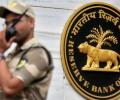
There is a near consensus that at least a 25 basis points cut, if not 50, can be expected in the June policy.
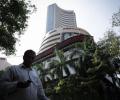
Turnover on exchanges dips to pre-Modi levels

'Unless India Inc's earnings offer promise in March 2017 quarter, sentiment may not reverse in a hurry.'

Experts say the stock market correction in recent times increases the risk-reward in favour of large-cap stocks.
 © 2026 Rediff.com - Advertise with us - Disclaimer - Privacy Policy - Sitemap - Feedback - About us - Terms of use - Grievances