
Opposition candidate B Sudershan Reddy appeals to MPs to vote with conscience in the upcoming vice presidential polls, urging them to prioritize the spirit of India and parliamentary traditions over party loyalty.
'They mean business, but business as usual is unacceptable to them'

The move comes a few days after the Yunus-led government dropped the portrait of the country's founding father and deposed prime minister Sheikh Hasina's father Mujibur Rahman from new currency notes.
'The quality of justice is directly linked to the quality of judges -- if that suffers, justice delivery suffers.'

Bangladesh's interim government on Wednesday dismissed as 'completely baseless' and 'misleading' the media reports that claimed it has dropped the 'Father of the Nation' title for Sheikh Mujibur Rahman and revised the definition of freedom fighter.
'The largest listenership for Vividh Bharati outside the country is in Spain.' 'The labourers who go there for the tomato-picking season feel cut off from their country and listen to Vividh Bharati to overcome their loneliness.'

Prem Bihari Narain Raizada wrote 145,000 words in flowing italic styles. It took him 6 months and hundreds of nibs.
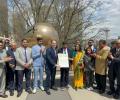
Deputy Commissioner for the New York City Mayor's Office for International Affairs Dilip Chauhan made the announcement in the presence of Minister of State for Social Justice and Empowerment Dr Ramdas Athawale, who delivered the keynote address at a special event organised at the UN headquarters on Monday to commemorate Dr Ambedkar's 134th birth anniversary.

'I don't have a film background at all. This was the first I was presented on camera.'

A lot of frauds have been committed on the people of the country, and one of them was a wrong interpretation of secularism, he said addressing an event in Kanyakumari district on Sunday.
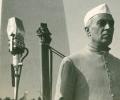
On Jawaharlal Nehru's 61st death anniversary, Utkarsh Mishra recalls how India's first prime minister cultivated a unique role for the newly independent country on the world stage.

The Supreme Court of India has ruled that the secular nature of the state does not prevent it from interfering with religious practices and attitudes when they impede development and the right to equality in the larger public interest. The court dismissed pleas challenging the 1976 amendment to the Constitution, which added the terms "socialist", "secular", and "integrity" to the Preamble, stating that Parliament's amending power extends to the Preamble as well.

Congress leader Rahul Gandhi has criticized the government's decision to appoint Gyanesh Kumar as the new Chief Election Commissioner (CEC) in the middle of the night, arguing that it is "disrespectful" and "discourteous" given the ongoing Supreme Court challenge to the selection process. Gandhi presented a dissent note to the selection committee, stating that the process violates the Supreme Court order and undermines the integrity of the electoral process.

Shah alleged that Congress was "hell-bent on snatching reservations from OBCs, tribals and Dalits and "planned to give it to minorities".
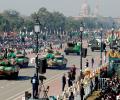
India's rich cultural diversity, military prowess, economic progress and the strides it has taken in sectors, such as science and technology, were on full display at the 76th Republic-Day celebrations on Kartavya Path on Sunday, in the presence of Indonesian President Prabowo Subianto.
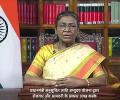
'Today, let us reaffirm our commitment to strive to realise Gandhiji's dreams. His watchwords, truth and nonviolence, will continue to remain relevant for the whole world. He also taught us that rights and duties are but the two sides of the coin - indeed, the true source of rights is duty. Today we recall his lessons in compassion too - compassion not only for our human neighbours but also for our other neighbours, namely, flora and fauna, rivers and mountains.'
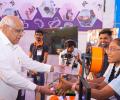
The BJP government in Gujarat has formed a five-member committee, headed by a retired Supreme Court judge, to assess the need for the Uniform Civil Code (UCC) in the state and to draft a bill for the same. The committee will submit its report within 45 days. The decision has sparked debate with the Opposition claiming it is an attempt to divert attention from pressing issues ahead of the upcoming local body polls, while the government insists the UCC will protect the rights of tribal communities. The committee will consult with religious leaders, including those from the Muslim community.
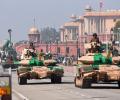
India will showcase its military prowess and rich cultural heritage on Kartavya Path in New Delhi on January 26 to mark the 76th Republic Day. Indonesian President Prabowo Subianto will be the chief guest at the event, which will also see the participation of a marching contingent and a band contingent from Indonesia. The theme of the parade is 'Swarnim Bharat: Virasat aur Vikas', focusing on the platinum jubilee of the enactment of the Constitution. The parade will feature a number of cutting-edge defense platforms, including BrahMos, Pinaka and Akash, as well as the Army's Battle Surveillance System 'Sanjay' and DRDO's surface-to-surface tactical missile 'Pralay'.

A special website has also been created to mark the year-long celebrations, Union Culture Secretary Arunish Chawla told reporters during a briefing at the National Media Centre in New Delhi.
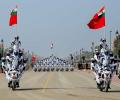
India as a sovereign democratic republic completed 75 years of its eventful journey on Sunday, with the stage set at the Kartavya Path in New Delhi for the ceremonial parade during which the country will showcase its military prowess and rich cultural heritage.

Addressing a rally in Mhow on Monday, Gandhi said Dalits, backwards and tribals had no rights before Independence, when "only maharajas and rajas enjoyed rights".
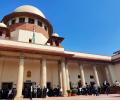
A five-judge bench headed by Chief Justice DY Chandrachud considered the pleas in chambers and dismissed applications for listing of the review petition in open Court.

Abul Kalam Azad chose not to contest Congress Presidency and to throw his weight behind Nehru, instead of Patel, a decision he would come to regret. Patel would have seen his plan through, while Nehru, in Azad's opinion 'gave Jinnah the opportunity to sabotage' it, notes Aakar Patel.
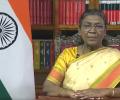
President Droupadi Murmu, in her address to the nation on Republic Day, advocated for the "One Nation One Election" initiative, emphasizing its potential to enhance governance and reduce financial burdens. She highlighted the government's efforts to eliminate remnants of colonialism, citing the replacement of British-era criminal laws with modern alternatives. Murmu also lauded India's economic progress, stressing the importance of inclusive growth and social welfare. She urged citizens to remember the sacrifices of freedom fighters and reaffirmed the significance of the Constitution in guiding India's journey towards a prosperous and equitable future.

The government and opposition parties on Monday reached an agreement to break the impasse in Parliament with dates announced for discussions on the Constitution in the Lok Sabha and the Rajya Sabha.
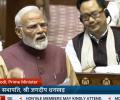
Prime Minister Narendra Modi on Thursday accused the Congress of practicing appeasement politics, saying the party's priority was "family first." He asserted that the BJP-led government operates on the principle of 'Sabka Saath, Sabka Vikas' (development for all) and prioritizes "nation first." Modi further criticized the Congress's approach to reservations, claiming it was aimed at creating divisions within the country. He highlighted the BJP's initiatives to empower marginalized communities, including the constitutional status to the OBC commission and the introduction of 10% reservation for economically backward groups.
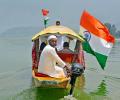
The Supreme Court on Tuesday termed as "unacceptable" the submission that Article 370 of the Constitution ceased to operate once the term of the constituent assembly of Jammu and Kashmir ended in 1957 after drafting the state's constitution.
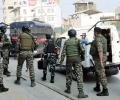
Union Home Minister Amit Shah asserted that the abrogation of Article 370 in 2019 was crucial in ending terrorism in Kashmir. He stated that the provision fostered separatism among Kashmiri youth and impeded the region's full integration into India. Shah also highlighted the development initiatives undertaken in Jammu and Kashmir post-Article 370, including a reduction in terrorism, successful local body elections, and an increase in tourism and film production. He emphasized the significance of writing India's history with facts and evidence, countering narratives that had obscured the country's rich heritage.
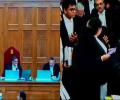
Who can recommend the revocation of Article 370 in Jammu and Kashmir when no constituent assembly exists there? The Supreme Court on Wednesday put this question to the petitioners who have challenged the abrogation of the constitutional provision that bestowed special status on the erstwhile state.
The fresh application has been filed by Zahoor Ahmad Bhat, an academician, and Khurshaid Ahmad Malik, a socio-political activist, in Jammu and Kashmir seeking restoration of statehood.

According to the cause list for December 11, Monday, uploaded on the apex court website, a five-judge constitution bench headed by Chief Justice D Y Chandrachud would deliver the verdict.
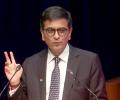
"The doctrinal error in the Krishna Iyer approach was, postulating a rigid economic theory, which advocates for greater State control over private resources, as the exclusive basis for constitutional governance," the CJI wrote in the 193-page judgment.

The bench posed questions to senior advocate Gopal Sankaranarayanan, appearing for one of the petitioners Soayib Qureshi, who has challenged the Centre's August 5, 2019 decision to abrogate the provision.
The Supreme Court of India has dismissed petitions challenging the 1976 amendment to the Constitution that added the terms "socialist", "secular", and "integrity" to the Preamble. The court ruled that the inclusion of these terms, made through amendments, is valid and does not affect the original adoption of the Constitution in 1949.
The Supreme Court on Friday observed the 1976 amendment to the Constitution adding terms 'socialist', 'secular' and 'integrity' to the Preamble underwent judicial reviews and it cannot say whatever Parliament did during the emergency period was all nullity.

Justice BV Nagarathna also partially agreed with the majority verdict but criticised the CJI's views on Justice Iyer's judicial approach in dealing with "material resources" and state's power over them.
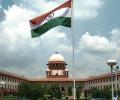
Is there no mechanism to abrogate Article 370 even when the people of Jammu and Kashmir want it, the Supreme Court asked on Thursday and wondered if the now repealed provision can't be touched, will it not amount to creating a "new category" beyond the basic structure of the Constitution.

Dhankhar said every Indian outside the country has to be an ambassador of the nation.
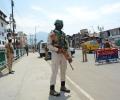
The central government's response was conveyed to the court by Solicitor General Tushar Mehta, after a five-judge constitution bench headed by Chief Justice DY Chandrachud, hearing the pleas challenging the abrogation of Article 370, asked it to set a specific time frame for restoration of electoral democracy in the erstwhile state.

The ministry of defence in September 2021 signed a Rs 21,935-crore contract with Airbus Defense and Space SA, Spain for supply of 56 aircraft.
