
The PM said Japan and the Indian diaspora has a big role to play in India's growth story.

Addressing the students of the Royal University of Bhutan in Thimphu, Modi asked them to work hard and take the Himalayan nation to great heights.

The primary goal of HysIS, whose mission life is five years, is to study the earth's surface in visible near infrared and shortwave infrared regions of the electromagnetic spectrum.

Advocating the move, home ministry officials said most of the developed countries change the security features of their currency notes every 3-4 years and therefore, it is absolutely necessary for India to follow this policy.

"The Resourcesat-1 launched today was equal to half a dozen people in space for a period\n\nof five to six years," ISRO chief Dr Madhavan Nair said.

'How will someone who has stood on Mars and looked at Earth, only a tiny blue dot in space, then see the idea of nations and religions and all of our divisions?' says Aakar Patel.
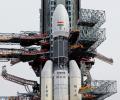
'It is time we Indians learnt to believe in ourselves, and stopped questioning our own capabilities every time a space launch is not a glorious success,' says M D Riti.

He also sought to know if Modi, during his recent meeting with Chinese President Xi Jinping, asked the latter about the 2017 Doklam standoff.

ISRO needs next generation launchers and new facilities to manufacture and launch them.

India scripted history by successfully launching EMISAT, a military satellite, and 28 foreign nano satellites on-board its polar rocket from Sriharikota on Monday, in a complex mission which marked many a first for Indian Space Research Organisation.

With the Indian Space Research Organisation set to launch the Mars Mission on November 5, Chairman K Radhakrishnan, in an interview with Praveen Bose, talks about the complexities, the challenges and the benefits of the Rs 450-crore mission.
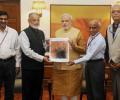
There were nervous moments...we knew we were taking a risk, but in the end we succeeded and I'm extremely happy, says S Arunan, project director, Mars Orbiter Mission in an interview with Rediff.com.

Indian Space Research Organisation's Mars Orbiter, which was placed in inter-Mars trajectory in the early hours on Sunday, has crossed Moon's orbit and is travelling beyond Earth's natural satellite.

The mission life of the 2,250kg GSAT-7A, built by ISRO, is eight years. It will provide communication capability to users in Ku-band over the Indian region.

We sorted through countless photographs taken around the world to come up with the top photos of 2019. Together these images tell the story of the year -- capturing moments of hope and heartbreak, triumph and tragedy.

Heralding a new era, India on Friday night launched its heaviest commercial space mission ever with its polar rocket successfully putting five British satellites into the intended orbit after a flawless takeoff.

The year is coming to an end and overall, it's been one hell of a year! We have had our share of ups and downs and we look forward to a better 2020. While we count down the days to the new year, let's also reflect on those who gave us strength to stand up in what we believe, the courageous who didn't bow down and the ones with gumption who inspired us to be better. We, Rediff.com, have selected 26 personalities, who we think are worthy of the title -- HERO OF THE YEAR -- and we want you, dear readers, to choose your hero!
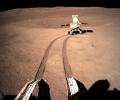
'China pumps in a lot more money than what we do. China's space budget is close to $5 billion while it is hardly $1 billion for us.' 'We manage the programmes within the constraints of our budget. The main difference is we prioritise.'

The Mars mission is overwhelmingly irrelevant to space science and won't advance the frontiers of knowledge. It will divert attention from the real technological challenges facing the Indian space programme, and will further distort our science and technology priorities, says Praful Bidwai.

Akash Banerjee is posing tough questions to the establishment -- and getting away with them.

It has already tasted success with the moon mission and Mangalyaan. Is man in space the next frontier for ISRO?

The stage is set for the launch of India's satellite IRNSS-1D on Saturday from Sriharikota onboard workhorse PSLV-C27 that would pave the way for the country's own navigation system on par with the GPS of United States.
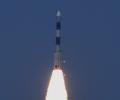
Prime Minister Narendra Modi lauded the scientists saying, "with this successful launch, we will determine our own paths powered by our technology".

Ahead of the G20 Summit, Prime Minister Narendra Modi met his Japanese counterpart Shinzo Abe in Osaka, Japan and discussed a range of issues of mutual interest.

The Announcement of Opportunity (AO) is for space experiments by institutions in the country, and the last date for receiving the proposals is May 19, 2017, the Bengaluru-headquartered ISRO said.

The space agency launched 104 satellites, breaking the previous record of 37 by Russia.

Defence Research Development and Organisation Director General Avinash Chander on Saturday said that India's missile programme is purely aimed at peace in the country.

An industrial house bred in old-school manufacturing values, Godrej & Boyce has displayed unusual agility to become a trusted builder of advanced weaponry, discovers Ajai Shukla.

Using data collected by India's Chandrayan mission, NASA has detected magmatic water locked under the surface of the Moon.

India is set to operationalise its own navigational system with the successful launch of IRNSS-1D, the fourth in the series of seven navigational satellites, onboard PSLV-C27 from Sriharikota on Saturday.

This demonstration of technology is exciting, as is the fact that it has been done with so little expense, says M N Vahia

Following is the full text of Prime Minister Narendra Modi's address from the ramparts of the Red Fort on the 73rd Independence Day.
In his first interview, after the launch of MOM in Mars orbit, ISRO chief K Radhakrishnan spoke to T E Narasimhan about the mission and the way forward.

When the universe is your workspace, the sky is the limit, and there's no such thing as a glass ceiling. Divia Thani Daswani meets the women behind Mangalyaan

In a landmark late Monday night journey into a new era of space application, India successfully launched its first dedicated navigation satellite using the Polar Satellite Launch Vehicle which blasted off from the Satish Dhawan Space Centre.

Both India and South Korea will use President Park Geun-hye's visit to unveil a comprehensive programme for mutual benefit and impacting on regional security environment, says Srikanth Kondapalli.

ISRO chairman A S Kiran Kumar talks of what's on and what lies ahead for the Indian space agency.

Some time before December 31, 2017, Bengaluru based Team Indus aims to land a vehicle on the moon.

'My wife was asked to get out of an autorickshaw because she was married to me. My children were targeted and branded a traitor's children. In spite of the Supreme Court and the NHRC having cleared my case, the state government is yet to close it. Local politicians are behind this. Why can't they close the case, give me compensation, accepting gracefully that they have wronged me?' Dr S Nambi Narayanan, the scientist who was accused and then exonerated in the 1994 ISRO spying case, speaks to Rediff.com's Shobha Warrier about his continuing travails and his recent meeting with Narendra Modi.
 © 2026 Rediff.com - Investor Information - Advertise with us - Disclaimer - Privacy Policy - Sitemap - Feedback - About us - Terms of use - Grievances