
Ranade was earlier removed from the position on September 14 by the then chancellor Bibek Debroy, after a fact-finding committee concluded that his appointment as the GIPE's VC did not conform to the UGC regulations on minimum qualifications for the appointment of teachers and other academic staff.
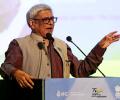
Debroy's economic interests and research work covered numerous areas such as economic theory, income inequality, and infrastructure financing.
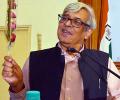
Economic Advisory Council to the Prime Minister (EAC-PM) chairman Bibek Debroy passed away this morning, a senior EAC-PM official said. He was admitted to AIIMS. Debroy (69) was educated in Ramakrishna Mission School, Narendrapur; Presidency College, Kolkata; Delhi School of Economics; and Trinity College, Cambridge.

To propel demand, one should concentrate on indirect taxes and bring down the goods and services tax (GST) rates to a uniform 12 per cent as the Vijay Kelkar panel had recommended, said Ajit Ranade, chief economist at Aditya Birla Group.

A large part of the current slowdown can be attributed to the execution bottlenecks and falling investor sentiment in the country, says Ajit Ranade, Chief Economist, Aditya Birla Group.
Economist Ajit Ranade chatted with our readers on March 1, and explained how the Budget affects us all.

The economists who signed the letter included Jean Drze , Abhijit Banerjee, Ajit Ranade, Jayati Ghosh, Kirit Parikh, Mihir Shah, Rohini Pande, and Vijay Joshi
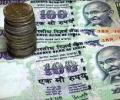
As the rupee continues its downward slide it could have some unpalatable consequences.
Pragmatism, perseverance, patience, persistence -- and a lot of detailed work.

Overall, this is a budget with a pro growth stance with an attempt at fiscal restraint and some initiatives with major long term implications. It stays within mid-on and mid-off but does score boundaries.

This is not a new or unknown problem, but every time it crops up, our policy-makers have tried to wish it away. In the present circumstances too, the government has stopgap arrangements. It is borrowing from the World Bank (that's window-dressing fiscal deficit), says Ajit Ranade.

Dr Ajit Ranade discussed economic slowdown with rediff readers on Tuesday.

The event took off with an introductory speech by Dr Ajit Ranade appreciating the achievements of IIT Bombay. Among the other speakers were Dr Anil Kakodkar, chairman of the board of governors, IIT-B, Infosys chief Nandan Nilekani and Prof. R K Shevgaonkar, deputy director of finance and external affairs and the co-chairman of the IITBAA.
This also shows that there are other skills that go into a success story than mere ideas.

What effect will the Budget have on food prices? And on prices of other things? Has the FM given with one hand and taken away from the other? During a chat on rediff.com on Wednesday, economist Ajit Ranade replied to many such queries.
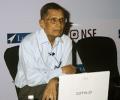
One of the finest minds on foreign exchange management, monetary and fiscal policies, on debt and currency markets, on bank management and governance, and indeed on almost every aspect of modern finance and banking passes into the ages.
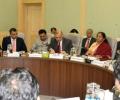
At a pre-Budget meeting, the FM was asked to ensure that NBFCs come out of the liquidity crisis they are facing with the help of RBI. They also spoke about the futility of trying to achieve a 3 per cent fiscal deficit target over the medium term.

Concerned by GDP slowdown and unrealistic tax targets, the economists urged Finance Minister Nirmala Sitharaman to implement long-term structural steps like land and labour reforms. Warning against any off-Budget financing the economists said the government should prepare a statement of intent for its social, rural and welfare sector expenditure.

Some experts had said the Budget did not have much in terms of big ideas.

Economists have asked Finance Minister Arun Jaitley to lower interest rate, rationalise subsidies, remove all cess and surcharge, do away with the retrospective tax amendments and scrap dividend distribution tax to revive investment cycle and promote growth.

'They want (the ownership and management of PSU banks) to pass into the hands of a private sector entity.' 'Ownership of these banks will go from the public sector to private sector.'

As US businessmen and investors await Prime Minister Narendra Modi's US visit, the investor community and the industry leaders said the success of 'Mangalyaan' goes on to prove India's growth story based on 'frugal innovations'.

Should NOTA ever get the maximum number of votes (which makes it the 'winner'), then a re-election should be held and all the candidates should be disqualified.'

Double tax exemption on wages paid to women can encourage companies to hire, retain and compensate women better, argues Nitin Pai.

Assocham told Modi policy makers needed to act fast to "bullet proof" India from global jitters.
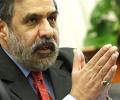
In a meeting with the commerce minister, India Inc hammered Sharma on the collapse of investments, structural nature of the current account deficit and stagnant growth in agriculture.
.jpg)
Depreciating rupee a silver lining for some businesses amid the economic downturn.

We must see New Delhi's position as a signal of competition to the Chinese grand design for the 21st century world, says Nitin Pai.
.jpg)
The trade deficit makes up an important part of the current account deficit, which had touched an all-time high of 4.8 per cent in 2012-13.

Senior bureaucrats say the government has planned a 'feel-good' Budget after the 'pain' of demonetisation.

The perfunctory management of external affairs has left India's foreign policy establishment largely unprepared to manage the consequences of dramatic international developments, says Nitin Pai.

New Delhi can strengthen its leverage by having better relations with the two than they have with each other.
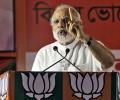
While many promises remain unrealised, power reforms and the creation of tens of millions of new bank accounts have helped Modi maintain his popularity
 © 2026 Rediff.com - Investor Information - Advertise with us - Disclaimer - Privacy Policy - Sitemap - Feedback - About us - Terms of use - Grievances