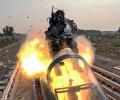
On Tuesday, December 2, 2025, the Defence Research and Development Organisation successfully conducted a high-speed rocket-sled test of a fighter aircraft escape system at the Rail Track Rocket Sled facility at the Terminal Ballistics Research Laboratory in Chandigarh.
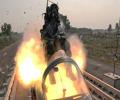
The DRDO conducted the test in collaboration with the Aeronautical Development Agency and Hindustan Aeronautics Limited.
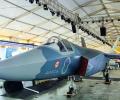
This is seen as the first concrete opportunity to break HAL's monopoly in combat aircraft manufacturing, potentially opening the door to a private-sector fighter jet producer.
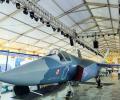
Private and public defence players can bid to participate in the stealth fighter development programme independently, as a joint venture, or as consortia.
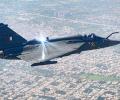
'The aircraft is expected to be ready for rollout between January and March 2026, and to fly by the end of the year.'

Defence Minister Rajnath Singh has approved the "execution model" for the indigenous development of a fifth-generation deep penetration advanced medium combat aircraft (AMCA) for the Indian Air Force. The Aeronautical Development Agency (ADA) will execute the programme through industry partnership, with equal opportunities for both private and public sectors. The project is a major step towards "Aatmanirbharta" (self-reliance) in the aerospace sector and is expected to cost around Rs 15,000 crore.
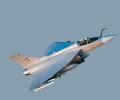
'An HAL-private sector tieup is a possibility.'
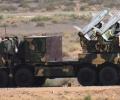
India's indigenously developed 'Akashteer' air defense system performed exceedingly well during 'Operation Sindoor,' according to Defence Research and Development Organisation (DRDO) chief Samir V Kamat. The fully automated system, deployed against terror sites in Pakistan and Pakistan-occupied Kashmir, integrates various radar systems, sensors, and communication technologies. Kamat expressed confidence in the system's success drawing international interest, highlighting India's progress toward self-reliance in the defense sector. He also addressed the future of warfare, emphasizing the need for a blend of traditional and emerging technologies, and outlined the development timeline for the indigenous 5.5-generation stealth fighter aircraft, the Advanced Medium Combat Aircraft (AMCA).
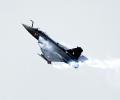
Air Chief Marshal A P Singh and Chief of the Army Staff General Upendra Dwivedi on Sunday set the tone for the grand Aero India-2025 by flying in the Light Combat Aircraft (LCA) Tejas in Bengaluru at Yelahanka based Air Force Station.
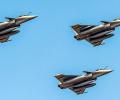
The Indian Air Force (IAF) has seen a reduction in fighter squadrons due to the phasing out of ageing MiG-21, MiG-23 and MiG-27 aircraft. The Parliamentary Standing Committee on Defence acknowledged the "shortage" and highlighted the multi-pronged approach being taken to address it. This includes the induction of indigenous Tejas fighters and the procurement of additional LCA Mk-1A aircraft. The report also addresses concerns over "incidences of spying" within the IAF and details the action taken against those involved.

The Mark-1A will be more sophisticated and capable than the Tejas Mark-1.

The HAL and GE from the US would be producing these engines jointly in a facility in India.

In the event of a war with China, AMCA deep strikes would target China's rail and road links with Tibet, isolating PLA divisions there.
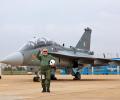
"The experience was incredibly enriching, significantly bolstering my confidence in our country's indigenous capabilities, and leaving me with a renewed sense of pride and optimism about our national potential," he said.
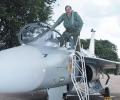
Indian Air Force chief Air Chief Marshal RKS Bhadauria flew a Tejas single-seater light combat aircraft MK1 FOC fighter during his visit to IAF and flight test establishments and facilities of Defence Research and Development Organisation (DRDO) and Hindustan Aeronautics Limited (HAL) in Bengaluru.

The real value of the Tejas Mark 1 is the role it will now play in the development of India's next generation of fighter aircraft that will be more technologically advanced and lethal.
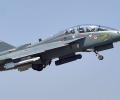
According to HAL, "this is the biggest ever order that HAL has placed on any Indian company boosting 'Atmanirbhar Bharat' campaign."
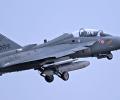
The Tejas is a fourth generation combat aircraft developed by Aeronautical Development Agency and the Hindustan Aeronautics Ltd. It is equipped with fly-by-wire flight control system, integrated digital avionics and multimode radar.

Python-5 missile live firing was conducted to validate target engagement from all aspects as well as beyond visual ranges. In all the live firings, missile hit the aerial target.
'The JF-17 is the aircraft of today and the Tejas is the aircraft of tomorrow.'
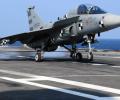
The naval version of Tejas light combat aircraft is in development stage. Officials said the successful "arrested landing" of the prototype of the naval version of Tejas on the deck of INS Vikramaditya is expected to speed up development of the jet for the Indian Navy.
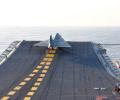
On Saturday, the aircraft made its first landing on the deck of INS Vikramaditya which was also a major milestone. Both the landing and take off by the aircraft put India among a select group of nations having the capability to design such a jet which can operate from an aircraft carrier.

IAF feels DRDO fronting for French engine, citing 'joint development'.
Interestingly, the decision to develop an indigenous MCA comes alongside the overseas procurement of 126 Medium Multi-Role Combat Aircraft (MMRCA) for an estimated Rs 50,000 crore.

Officially named Tejas, the aircraft has undergone over 1,000 hours of test flights.
The National Association of Software and Services Companies on Tuesday urged the Centre to provide the software industry access to the national laboratories like Aeronautical Development Agency for taking up research and development
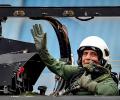
Wearing a G suit, the minister buckled himself in the seat behind the pilot in the aircraft.
Experts feel there is scope for a trainer beyond AJT and many countries are looking to develop one.

The Sri Lanka Air Force and Egypt has also shown some interest in procuring the Tejas.
The Indian Air Force will soon place orders for the first batch of 20 Light Combat Aircraft with the Hindustan Aeronautics Limited, Defence Minister Pranab Mukherjee said on Thursday. \n\n
The development contract calls for GE Aircraft Engines to provide 17 F40 4-GE-IN20 engines, as well as logistics support, the company announced from Lynn, Massachusetts.

India's ODI cricket captain Mahendra Singh Dhoni, Congratulated the induction of first squadron of the indigenously made Light Combat Aircraft (LCA) Tejas into the Indian Air Force, on Friday.

HAL is also integrating the Advanced Short Range Air-to-Air Missile onto the Mark 1A. Each Tejas will carry two of these missiles.
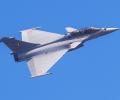
The delivery of the Tejas Light Combat Aircraft (LCA) to the Indian Air Force under a Rs 48,000-crore deal will begin from March 2024 and around 16 aircraft will be rolled out annually till the completion of the total supply of 83 jets, Chairman and Managing Director of Hindustan Aeronautics Limited R Madhavan said on Sunday.

The feat was achieved days after the Indian Air Force successfully did a dry run of mid-air refuelling using the Russian-built IL-78 MKI tanker.
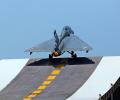
The Indian Navy has ruled out deploying indigenously built light combat aircraft Tejas on its aircraft carriers, saying it is "not being able to meet the requirements".
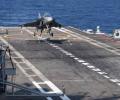
Landing on an aircraft carrier deck is the ultimate and most daunting challenge for a fighter pilot. This takes India into a select group of nations -- the US, the UK, Russia, France, and China -- that have developed such jets.
The Tejas Mark 1A outperforms the Sino-Pakistan JF-17 Thunder in avionics and weaponry, but the finance ministry's tax burden makes the Indian LCA costlier and hurts it in the export market.
 © 2026 Rediff.com - Investor Information - Advertise with us - Disclaimer - Privacy Policy - Sitemap - Feedback - About us - Terms of use - Grievances