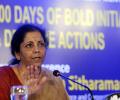
Finance Minister Nirmala Sitharaman announced that India's real GDP grew by 7.8 per cent in the April-June quarter, surpassing the RBI's forecast. She attributed this strong performance to government reforms and agile economic management, reaffirming the government's commitment to expanding economic opportunities.
India's eway bill generation reached 139.08 million in August, marking the third-highest monthly count on record and indicating sustained momentum in goods movement and formal economic activity, according to official data.

Arundhati Bhattacharyya, Salesforce President and CEO for South Asia, highlighted how cloud and AI are democratising capabilities, offering India a unique opportunity to leapfrog in the technology revolution. Speaking at the IMC Chamber of Commerce, she emphasised that AI will create more jobs by addressing unmet business demands and could significantly boost India's GDP, with NITI Aayog estimating a USD 500-600 billion addition by 2035. She urged Indian businesses to transform using technology, focus on data, redesign work, and invest in skills, stressing that AI is not just for large corporations.

'The day we start making rules purely along caste lines, we only divide society further. That's the conversation the government needs to have, and soon.'

US President Donald Trump has declared an 'economic D-Day' against Iran, unveiling what he terms the 'most crushing economic operation ever taken' and warning global entities against providing any support to Tehran.

US President Donald Trump has threatened the European Union with "very heavy tariffs" if he perceives their actions as hostile, specifically in response to Canada's efforts to deepen economic and strategic ties with the EU. This comes as European Commission President Ursula von der Leyen invited Canada to become the EU's first "associate member" to strengthen resilience amid global trade uncertainties and US trade policies.

India has stated its commitment to protecting its economic interests and ensuring energy security after the US House of Representatives passed a bill allowing the US President to impose tariffs of up to 100 per cent on countries, including India and China, for purchasing Russian crude oil. The Ministry of External Affairs affirmed India's resolve to maintain diversified energy sourcing and has articulated its concerns to US interlocutors regarding the bill's potential implications.

South African President Cyril Ramaphosa on Friday described BRICS as an important global forum, highlighting the grouping's growing demographic and economic weight and noting that its members account for around half of the world's population and 40 percent of global GDP.

Iranian President Masoud Pezeshkian urged BRICS nations to expand trade in national currencies and build an inclusive global economic framework. He criticised "unilateral sanctions" by Western powers, stating they make emerging economies vulnerable and impact global food security. Pezeshkian emphasised BRICS' role in creating a balanced world order and highlighted Iran's geopolitical and energy capacities for cooperation.

China has strongly rejected a US bill that would impose tariffs on countries, including India, for purchasing Russian oil and gas. Beijing views the "Lindsey O Graham Sanctioning Russia and Iran Act 2026" as an act of "long-arm jurisdiction" and interference in its sovereign trade relations, asserting that its economic cooperation with other nations is based on equality and mutual benefit.

'It is not about a place with fewer incidents of violence but a city where women have real agency in planning their daily lives.'

A new Merchant Discount Rate (MDR) on UPI transactions above Rs 2,000, effective October 15, could force small merchants and price-sensitive consumers to revert to cash, according to economic think tank GTRI. The move, which introduces a 0.4 per cent MDR with a Rs 300 cap and concessional rates for specific categories, is questioned by GTRI founder Ajay Srivastava, who suggests it's not a revenue issue for the government but potentially a response to US pressure regarding UPI and RuPay's preferential market position.

Russian President Vladimir Putin has proposed a new investment platform, based on the New Development Bank (NDB), to fund projects in trade, infrastructure, logistics, and technology across BRICS nations, emphasising that the grouping's expanding economic cooperation is not 'against anyone' but aims to advance members' national interests.

Iranian President Masoud Pezeshkian arrived in New Delhi for the BRICS summit, where he is scheduled to hold bilateral talks with Prime Minister Narendra Modi to enhance trade and strengthen overall relations. His visit is particularly significant given the heightened tensions in West Asia and recent US economic sanctions against Iran. Pezeshkian highlighted BRICS' role in fostering economic resilience and reducing dependence on the US dollar, while the summit itself aims to address global challenges and bolster collective resilience in critical sectors.

Moody's Ratings has sharply increased India's GDP growth forecast for fiscal 2026-27 to 7 per cent, making it the fastest among G20 economies, driven by economic resilience despite the Middle East conflict. However, the agency flagged significant inflation risks stemming from elevated oil prices and potential El Nino disruptions.

A live demonstration of Muay Thai was held in New Delhi to popularise the traditional Thai martial art in India. Thai officials highlighted Muay Thai's role as a national soft-power asset, aiming to foster closer ties between India and Thailand through cultural exchange and economic potential.

India has expressed serious concern over Houthi attacks on Saudi Arabia's civilian infrastructure and economic assets, stating that such actions threaten regional stability and freedom of navigation through the Bab-el-Mandeb strait. External Affairs Minister S Jaishankar discussed the issue with his Saudi counterpart. India also condemned the targeting of commercial shipping after an Indian national went missing following an attack on a Panama-flagged ship off Oman.
IIT-Kanpur has developed an AI-powered "Family Score" system to identify households needing welfare support using existing government data. This system, demonstrated in collaboration with the Andhra Pradesh government, aims to provide a faster and more cost-effective alternative to traditional surveys for assessing socio-economic conditions and ensuring targeted welfare delivery.

'It is a blunt and dangerous attempt to pressure India to sign BTA on one-sided terms.'

India needs to move beyond ease and cost of doing business and focus on the "speed of doing business" as the next leg of reforms to sustain economic growth and private investment, Confederation of Indian Industry (CII) President R Mukundan said.

The ongoing police investigation into the POCSO case against granite baron R Veeramani has led to the identification of multiple survivors, many of whom were minors and from economically underprivileged backgrounds when allegedly assaulted. Charges under the SC/ST (Prevention of Atrocities) Act have been added, and Veeramani has been granted three days police custody for questioning within the prison due to his age and health.
BRICS leaders, in their New Delhi Declaration 2026, have called for wider access to Artificial Intelligence resources and stronger international cooperation to ensure the technology is safe, secure, inclusive, and reliable. The declaration outlines a broad technology agenda covering AI, cybersecurity, digital public infrastructure, telecom, quantum technologies, and advanced manufacturing, committing to implement the grouping's statement on 'Global Governance of Artificial Intelligence'.
The Ministry of External Affairs (MEA) has issued a warning against 'malicious' and 'misleading' social media posts concerning the health of world leaders, specifically Chinese President Xi Jinping and South African President Cyril Ramaphosa, who attended the recent BRICS Summit in New Delhi. The warning comes amidst unverified claims about Xi's health and an official statement from Ramaphosa's office confirming his withdrawal from public engagements due to ill health.

New photographic evidence and a Pentagon inspector general's report confirm extensive damage to US military installations across the Middle East due to Iranian missile and drone strikes. The report details billions in financial costs, structural losses to hundreds of buildings, and damage to dozens of aircraft, contradicting previous assertions about US military readiness and ordnance stockpiles. The conflict also led to disruptions in the Strait of Hormuz, impacting global oil prices.

'I don't really expect the August increase in food prices, which was close to 6 per cent, to persist as we go close to the end of this year.'

For India, the goal is not simply to host another grand diplomatic gathering. It is to prove that a diverse coalition of emerging powers can still deliver.

This article details the quarter-century journey of BRICS, from its inception as an economic acronym by a Goldman Sachs economist to its current status as an expanded eleven-member international bloc. It highlights its growth, key historical moments, and the significance of its upcoming summit, particularly with Iran's renewed importance in discussions.

Prime Minister Narendra Modi hosted Iranian President Masoud Pezeshkian in New Delhi for talks focusing on the West Asia situation, bilateral relations, and BRICS cooperation. The meeting, Pezeshkian's first visit to India as president, comes amidst heightened tensions in West Asia due to new US sanctions on Iran and concerns over global oil supplies from the Strait of Hormuz. Both leaders emphasised regional stability and economic resilience.

Union Finance Minister Nirmala Sitharaman called upon 'Gen Z' and 'Gen Alpha' to assume leadership, prioritise the nation, and contribute to its growth, rather than questioning what the country has done for them.

The BRICS summit in New Delhi brings together leaders from major emerging economies to address global challenges like trade disputes, geopolitical upheavals, and the economic impact of conflicts in Ukraine and West Asia. India, as chair, aims to position BRICS as an economic growth engine, focusing on the Global South's food, energy, and supply chain security. The summit also highlights the grouping's expansion and its growing influence in global governance.

Fintech firm BharatPe has publicly supported the government's new Merchant Discount Rate (MDR) framework for UPI merchant transactions, which introduces a 0.4% fee on transfers over Rs 2,000. The company has also distanced itself from its former co-founder Ashneer Grover's strong criticism of these changes, stating his remarks are personal and do not reflect BharatPe's official position. BharatPe believes the new framework will strengthen digital payment economics while protecting consumers and small merchants.
Fintech company BharatPe has expressed strong support for the government's new Merchant Discount Rate (MDR) framework for UPI merchant transactions, which introduces a 0.4% fee on transfers exceeding Rs 2,000. The company explicitly distanced itself from critical remarks made by its former co-founder Ashneer Grover, clarifying that his views do not represent BharatPe's stance. BharatPe CEO Nalin Negi highlighted that the framework aims to strengthen digital payment economics, protect consumers and small merchants, and expand adoption in underserved markets, with most transactions remaining unaffected.

Iranian President Masoud Pezeshkian declared that Iran will not succumb to "bullying" from the US and Israel, vowing to protect national interests amidst escalating West Asian hostilities. During his visit to New Delhi for the BRICS summit, Pezeshkian also discussed strengthening bilateral ties with Prime Minister Narendra Modi and advocated for local currencies in BRICS trade, positioning Iran as a strategic energy and transport partner.

The Central Board of Indirect Taxes and Customs (CBIC) is set to significantly increase its use of artificial intelligence (AI), machine learning (ML), and real-time analytics in Customs processes, aiming for a near-touchless, near-digital clearance experience, according to Chairman Vivek Chaturvedi.

Experts laud the decision to impose a 0.4 per cent Merchant Discount Rate (MDR) on UPI transactions exceeding Rs 2,000, effective October 15. This move, along with a dedicated fund for small merchants, is seen as crucial for creating a sustainable digital payments ecosystem, incentivising expansion in rural areas, and funding innovation while keeping most transactions free for users.

Prime Minister Narendra Modi, addressing the BRICS summit, called for a fundamental shift in global governance, advocating for the replacement of the current 'pyramid of privilege' with a 'platform of partnership' where the Global South becomes a 'rule shaper' rather than a 'rule follower'.

Arunachal Pradesh Chief Minister Pema Khandu and Deputy Chief Minister Chowna Mein paid rich tributes to engineers on National Engineers' Day, commemorating the birth anniversary of Sir M Visvesvaraya. They highlighted the crucial role of engineers in the state's development, infrastructure, and India's overall progress, acknowledging their contributions to nation-building and technological advancement.

The US House of Representatives is debating a bill that would authorise the President to impose sanctions on Russia and steep tariffs on its oil and gas trading partners, including India and China. The bill, aimed at pressuring Russia over the Ukraine war, has faced opposition but is expected to be put to a vote.

'The way the government behaves, sometimes I ask myself: Are not Tamils Sri Lankans too? Why do you discriminate so much?'
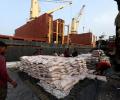
India's exports saw a significant increase of 26.12 per cent to USD 43.81 billion in August, leading to a narrowed trade deficit of USD 26.86 billion, driven by strong demand from key global markets and diverse sectors.
