
A new study reveals that India's annual gross primary productivity (GPP) increased significantly from 1985 to 2014 and is projected to continue rising until 2100, even under high-emissions scenarios. This enhancement is attributed to stronger precipitation and carbon dioxide fertilisation effects, with the Indo-Gangetic Plain, Northeastern India, and the Western Ghats expected to see the largest increases.

A new study reveals that extreme climate hazards, typically associated with higher levels of global warming, could occur even under a moderate warming of 2 degrees Celsius, posing significant threats to food production, forests, and urban areas.
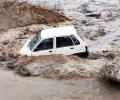
The head of the UN's climate science panel, Jim Skea, has expressed concern over the accelerating pace of climate impacts, saying scientists have been surprised by the speed of temperature rise. Skea attributed the worsening situation to inaction on climate change and highlighted the need for urgent action to reduce greenhouse gas emissions. He also addressed concerns about the scientific messaging and the perception of imposed climate policies, emphasizing the importance of involving societies and people in climate change action.

'What we are witnessing is not a freak incidence or a freak occurrence, but a new climate reality where warming oceans, monsoon variability and local geography are combining to produce extreme events.'

Pachauri, who has been under attack from various quarters over the IPCC's 2007 report on Himalayan glaciers, has already ruled out his resignation saying that the mistake was 'unfortunate' and he would go ahead to complete the Fifth IPCC Assessment Report.

Whether it is the blunder over the glaciers or the linking of natural disasters to global warming, the IPCC's credibility has been badly hit. If this encourages laxity over global warming, that will be tragic.

The 2007 report of the Intergovernmental Panel on Climate Change erroneously claimed that the Himalayan glaciers would melt away by 2035.

While United Nations climate chief Dr Rajendra Pachauri has rejected calls to step down in the wake of the Inter-governmental Panel on Climate Change's withdrawal of an erroneous warning on Himalayan glaciers, the Indian climate official has admitted that there could be more errors in the Nobel prize winning report.Dr Pachauri said he was considering whether to take action against those responsible.

Gore, who was US President Bill Clinton's deputy in 2000, made the 2006 Oscar-winning documentary An Inconvenient Truth, after which he was seen as a champion of environmental issues and climate change.

The year 2024 was the hottest year on record, with the global average temperature exceeding 1.5 degrees Celsius above pre-industrial levels for the first time, according to the European climate agency Copernicus. Every month from January to June was the warmest ever recorded, and from July to December (except August), each month was the second warmest on record. Scientists are warning that the world is entering a new climate reality, with extreme heatwaves, floods, and storms becoming more frequent and severe. The report also highlights the failure of developed nations to meet their climate finance commitments to developing countries, despite the urgency of the situation.

Apart from the human body, human food will bear direct repercussions. From staples such as wheat, to coffee, dairy, and even the great Hilsa face the threat of reduced supply due to the extreme heat.

'Keeping the global temperature below not just 1.5 degree Celsius, even 2 degree Celsius is beyond our reach now. Both are impossible.'

Heatwaves with higher humidity levels can be more perilous because the air cannot efficiently absorb excess moisture. This limitation restricts the human body's ability to evaporate sweat and affects the moisture content of certain infrastructure like evaporative coolers.

'We will have to face the effects of climate change for generations to come!'
Leading British newspaper Daily Telegraph on Friday apologised for publishing an article about United Nation's climate body chairman R K Pachauri, accusing him of making a fortune from his links with 'carbon trading' firms. The international publication had been running a campaign since last year against the chief of the Nobel Prize-winning Intergovernmental Panel on Climate Change, who has strongly rubbished the allegations and even issued several legal notices.

Severe heatwaves, responsible for thousands of deaths across India over the last few decades, are increasing with alarming frequency and soon the country could become one of the first places in the world to experience heatwaves that break the human survivability limit, according to a new report.

Buffeted by allegations of sexual harassment, R K Pachauri on Tuesday quit as chairman of United Nation's prestigious Intergovernmental Panel on Climate Change, whose meeting here he has avoided.

At a virtual press conference to launch the report, Inger Anderson, Executive Director, United Nations Environment Programme, said, "Climate change is here and now. No one is safe. Despite warnings from so many years, the world did not listen. We need to act now. Reducing greenhouse gas emissions will not only limit climate change but also reduce air pollution."
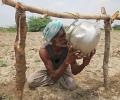
Santosh Patkar of Devgadh Taluka Sindhudurg district of Maharashtra is a worried man these days. Devgadh, which is known as the home to world famous Alphonso variety of mangoes, has seen an unusual drop in yields which is affecting farmers' income. Being one of the primary agricultural produce from the area, Santosh is not untouched by this somewhat rare phenomenon. He said in his own mango garden, yields have come down by a third from most trees.

India must be prepared to deal with climate disasters, geopolitical confrontations, and social strife linked to global events, asserts Jayant Sinha, chairman of Parliament's Standing Committee on Finance.

'If you look at the entire 60-day period of March and April, you see that temperatures were soaring more than 3.5 degrees Celsius above the maximum temperature.' 'Normally, events like this happen only for a short period.'

Politicians and Twitter warriors around the globe have a new buzzword among them: Net zero. Everyone appears to be keen to state their commitment to net zero, with India providing an outlay of Rs 35,000 crore to achieve energy transition and net-zero objectives in its Budget for FY24, even as the latest and final report by the United Nations' Intergovernmental Panel on Climate Change (IPCC) warned that current efforts are not enough to curb global warming. A number of small factory owners and businesses, however, have pointed out that the transition to net-zero emissions will cost them hugely.

The UN made it clear that it will not conduct any inquiry into accusations of sexual harassment against R K Pachauri
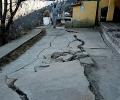
They said rampant infrastructure development without a plan is making the fragile Himalayan ecosystem even more vulnerable to the effects of climate change which acts as a force-multiplier.

The United Nations has launched an independent review of the functioning of its top climate change body IPCC, which has come under much criticism in the recent months for some errors in its reports.

'The food security along the coastal region will be severely affected.'
Asked about his initial reactions on the IPCC winning the Nobel Prize, Dr Pachauri said he was "deeply humbled by the honour that has been bestowed on me by the Nobel Committee. In any case, this is an honour that goes to all the scientists and authors who have contributed to the IPCC's work."

'All hydropower projects in the Himalayan region must be stopped.' 'Joshimath is not alone.'

It would be a tragedy if unchecked global warming destroys our habitat.
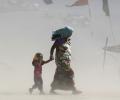
'It is high time that we act instead of just talking about how and why the climate is changing.'

The IPCC credibility has come under attack in the past few days for picking a report that Himalayan glaciers will melt by 2035 from a science magazine without peer-reviewing it, a fault later admitted and regretted by the climate body.

Surface temperatures have increased rapidly during the past century, leading to an increase in the frequency and intensity of tropical storms in the Arabian Sea, reports Sanjeeb Mukherjee.

We're aware of the allegations, said the spokesperson of UN's Ban Ki-Moon.

'Producing that set of reports was the work of hundreds of scientist, all of whom deserve honour -- and all of whom were honoured with the award of the Nobel Peace Prize on December 10,' said Nature. 'But a particular burden fell on the chair, and in that capacity Pachauri worked ceaselessly, and sometimes sleeplessly, to create compromise where necessary while refusing to dilute the key messages from the academic community he serves,' the magazine said.

So far, major emitters are far from curbs on emissions on a scale outlined by the IPCC.

Worse still, the cities ranked second, third and fourth for their poor air quality are also in India.
India is among the most vulnerable countries. It could lose 1.7 per cent of its GDP even if the annual mean temperature rises by just a degree.
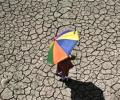
Unless we act dramatically and quickly, science tells us our climate and our way of life are literally in jeopardy, says Kerry.

The experts said that climate change is not only raising temperatures and making India's heatwaves hotter, but also changing weather patterns that further drive dangerous weather extremes.

With all the criticism over the mistake, the IPCC has decided to bring in editors and coordinating lead authors for its fifth assessment report.
