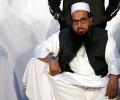
Sheikh Yousaf Afridi, a key Lashkar-e-Taiba figure and close associate of Hafiz Saeed, was shot dead by unidentified gunmen in Pakistan's Khyber Pakhtunkhwa, police said.

Lashkar-e-Taiba co-founder Amir Hamza was injured in a gun attack in Lahore. Unidentified gunmen targeted his vehicle, raising concerns about security and potential implications for the region.

Security has been increased at tourist spots across Kashmir ahead of the anniversary of the Pahalgam terror attack. New measures have been introduced to ensure tourist safety, including QR code-based identification for service providers.
Pakistan's Punjab government has warned citizens against providing charity to banned organizations such as Jaish-e-Mohammad (JeM) and Lashkar-e-Taiba (LeT), stating that those who do so will face terrorism charges.

Lashkar-e-Taiba terrorist Umer Harris, also known as 'Khargosh', is believed to be in Saudi Arabia after escaping India using a forged passport. An investigation into the inter-state LeT terror module has exposed systemic loopholes and raised concerns about passport issuance processes.
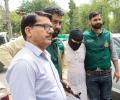
Delhi Police have arrested a suspected Lashkar-e-Taiba (LeT) handler, Shabir Ahmed Lone, in Delhi, uncovering a terror module with links to Pakistan's ISI. Lone is accused of running a network involved in pasting anti-national posters and planning terror activities across India.

The Dhurandhar movies will undoubtedly shape the minds of the audience much more than news reports, court investigations, books and documentaries. But it is worth remembering that Pakistan's irridentist claims against India's national security have succeeded due to strategic planning, diplomacy, and the unsung heroines and heroes across government agencies, not due to a single maverick leader, points out Shweta Desai.But it is worth to remember that Pakistan's irredentist claims against India's national security have succeeded due to strategic planning, diplomacy, and the unsung heroines and heroes across government agencies -- not a single maverick, points out Shweta Desai.

The National Investigation Agency (NIA) filed a chargesheet against seven accused in the Pahalgam terror attack case, including Pakistan-based Lashkar-e-Taiba (LeT) and its proxy The Resistance Front (TRF).

He said that TEA will also conduct a meeting to raise awareness among exporters and domestic manufacturers to verify the identity of workers.
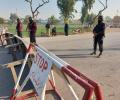
A 28-year-old man, believed to be an activist of the banned terror outfit Lashkar-e-Taiba, was shot dead in Punjab province of Pakistan. Police deny the deceased was a member of the banned LeT.

All major attacks orchestrated by the Lashkar-e-Tayiba in the near future would comprise only Indians. Vicky Nanjappa reports

According to the Daily Times, the Punjabi Taliban has broken off from LeT, and refuse to take orders from Lashkar supremo Hafiz Saeed.
Help of Central agencies to probe the hawala racket that helped Faizal transfer funds for the illegal activities will be taken
Second part of the lecture given by Mumbai-born security expert Ashley Tellis at the National Defence University's Programme on Irregular Warfare and Special Operations Studies on the grave threat posed by the Lashkar-e-Tayiba to the world.
Though the international community first began taking notice of the terrorist group Lashkar-e-Tayiba after its spectacular coordinated bombing and shooting attacks in Mumbai, India, in November 2008, the group was established in 1987 at a time when Pakistan was in the throes of Islamic ferment.
The world saw what Lashkar-e-Tayiba was capable of during the horrific 26/11 attack in Mumbai. Post this incident, many had been speaking of the manner in which the Lashkar is positioning itself to become the next Al Qaeda. It was clear when Lashkar to boss Hafiz Saeed swore that they would have their flags flying at Washington DC, New Delhi and Tel Aviv. Vicky Nanjappa reports.
Lakhvi's reported arrest, if confirmed, speaks of the intense pressure on Pakistan from the US to act against the Lashkar. India, the US and the rest of the international community should ensure that this is not a cosmetic step like similar steps in 2002 and that the LeT infrastructure in Pakistan is dismantled and those involved in the Mumbai terrorist strike against Indians, Israelis, Americans and others are brought to justice.
"I have not seen any decrease in Lashkar-e Tayiba's strength. It continues to be a matter of great concern to us, and I've spoken on many occasions about the threat to stability in South Asia that LeT poses," the Ambassador at Large and Coordinator for Counterterrorism, Daniel Benjamin, told reporters in Washington.

Jammu and Kashmir Lieutenant Governor Manoj Sinha terminated the services of five more government employees for suspected terror links, bringing the total number of employees sacked since 2020 to 85.
The Lashkar needed to strike badly using its Southern Modules since they wanted the attention for the modules down South. When Khafa was brought into the picture, he was told that the Southern module would begin with the assasination of Narendra Modi.

The missile was showcased at the recent Dubai Air Show and drew huge interest from potential buyer countries.
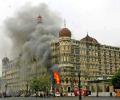
Lawyer Ujjwal Nikam says that while justice has been delivered to some victims of the 26/11 Mumbai terror attacks, their conspirators are still hiding in Pakistan. He criticizes Pakistan's handling of the trials of those arrested and calls for action against masterminds like Hafiz Saeed and Zakiur Rehman Lakhvi.
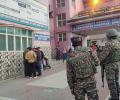
Jammu and Kashmir Lieutenant Governor Manoj Sinha dismissed two government employees, both teachers, for their alleged links with terrorists. The action is part of Sinha's zero-tolerance policy against terrorism and a broader crackdown on the terror ecosystem within Jammu and Kashmir.
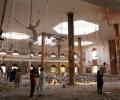
In 2025, India launched Operation Sindoor, a multi-domain combat mission against Pakistan in response to cross-border terrorism. The operation involved precision strikes, military retaliation, and diplomatic measures, marking a significant shift in India's security policy.
The trial of Abu Jundal, accused in the 26/11 Mumbai terror attacks, is set to resume after the Bombay High Court overturned a lower court order requiring authorities to hand over confidential documents to the accused.
The National Investigation Agency (NIA) has charge-sheeted eight more individuals in connection with a 2020 transnational narco-terror network case involving the smuggling of drugs from Pakistan to Gujarat, with the aim of financing the Lashkar-e-Taiba (LeT) terror group.

Sheikh Sajjad Gul, the head of Lashkar-e-Taiba proxy The Resistance Front (TRF), has been identified as the mastermind behind the Pahalgam terror attack that killed 26 people in April. Gul, who is based in Pakistan, has a history of planning terror attacks in Kashmir, including targeted killings, grenade attacks, and ambushes of police personnel. He was designated a terrorist by the NIA in 2022 and a reward of Rs 10 lakh was placed on his head. The TRF claimed responsibility for the Pahalgam attack, where tourists were shot at point-blank range after being asked their religion. Gul's history includes a 2002 arrest in Delhi for planning serial blasts and a subsequent 10-year prison sentence. After his release, he moved to Pakistan and became the leader of the TRF in 2019, a move orchestrated by the ISI to present a facade of an indigenous terror movement in Jammu and Kashmir.

The sources said that the terrorists were not expecting an action by the Indian Army and therefore were taken by surprise.

The deadly attack on the Uri garrison on September 18 nine years ago marked the end of India's policy against crossing the Line of Control to target Pakistan-based terrorists. It paved the way for the Balakot Air Strikes in 2019 and Operation Sindoor.
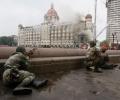
The Maharashtra government informed the Bombay High Court that Faheem Ansari, acquitted in the 26/11 terror attack case, was denied a police clearance certificate due to ongoing suspicion of being a member of a banned terror organization. Ansari sought the certificate to operate an autorickshaw.

Security agencies have released sketches of three men suspected of being involved in the terror attack near Pahalgam in south Kashmir that killed 26 people, mostly tourists. The suspects, identified as Asif Fauji, Suleman Shah and Abu Talha, were also involved in terror related incidents in Poonch. The sketches were prepared with the help of survivors. The Resistance Front (TRF), a shadow outfit of the banned Pakistan-based Lashkar-e-Taiba terror group, claimed responsibility for the attack.

Top LeT bomb expert Abdul Karim Tunda was today discharged by a Delhi court in a case lodged against him in 1994 under the stringent TADA.
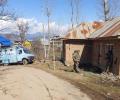
Security agencies are concerned about the increasing use of drones by terror groups in Jammu and Kashmir for surveillance and logistics, replacing human networks.

In a significant claim, Pakistani-American terrorist David Coleman Headley on Thursday said that Ishrat Jahan -- who was killed in an alleged fake encounter in 2004 in Gujarat --was actually a suicide bomber of Lashkar-e-Tayiba terror outfit.
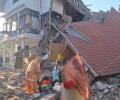
With this, the total number of houses of terrorists and their overground workers demolised since the Pahalgam attack has gone up to nine.
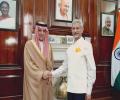
Saudi Arabia's Minister of State for Foreign Affairs Adel Aljubeir visited India on Thursday and held talks with External Affairs Minister S Jaishankar, focusing on de-escalating tensions between India and Pakistan. The visit comes as ties between India and Pakistan have further deteriorated following Indian military strikes on terror infrastructure in Pakistan. Iranian Foreign Minister Abbas Araghchi also arrived in New Delhi on a scheduled visit amidst the escalating tensions.

The Air Chief revealed information about India's damage to Pakistan's defence capabilities while addressing an event at the Hal Management Academy in Bengaluru on Saturday.
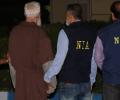
According to the chargesheet, Rana played a crucial role in supporting terrorist David Coleman Headley, a Pakistani-American operative linked to Lashkar-e-Taiba, by facilitating his reconnaissance missions across Mumbai.
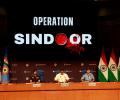
'We should not just react when a terror attack happens on our soil.' 'Our approach should be continuous and a launch pad should be destroyed the moment it comes up.'
 © 2026 Rediff.com - Advertise with us - Disclaimer - Privacy Policy - Sitemap - Feedback - About us - Terms of use - Grievances