
It was gold rush for India on the opening day of the South Asian Games with the country's wrestlers, swimmers and weightlifters showing their regional dominance by making a near clean sweep of top honours on Saturday. India clinched 14 gold and five silver medals on a highly productive day to top the medals tally with an overall count of 19.Sri Lanka, despite having a higher overall medal count of 21, occupied the second spot in the table owing to alesser tally of gold medals (4). Wrestlers were the stars for India, grabbing as many as five gold medals followed by the swimmers who clinched four gold and three silver medals. The weightlifters added three gold medals to the tally after the cyclists had opened India's account with two gold and an equal number of silver medals in the morning. Three women and two male grapplers finished on top of the podium as the proceedings went on expected lines on the opening day of the competitions.
Yudh leaves things a bit too wide open, says Raja Sen.

'Naik is an outcome of an image-centric Islam, which is linked to the technological changes introduced by new media.' 'English educated upper middle class Muslims embraced Naik's image-centric Islam in the 1990s.' 'Television converted him into a religious object.'

The growing importance of all things culinary and the hunt for credible faces as brand ambassadors are adding more power to the chefs' elbow.

R Madhavan has a flair for playing unlikeable characters well and he achieves that here too, writes Sukanya Verma.
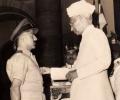
Claude Arpi reveals how Wing Commander Jag Mohan Nath won a second Maha Vir Chakra in the 1965 War.

'The majority community needs to accept that the Indian Muslim is peace loving, not communal and treat them accordingly.'
'The biggest success of Andhadhun is that viewers are thinking and debating about it. I didn't expect it,' Sriram Raghavan tells Ronjita Kulkarni/Rediff.com.

A look at the top 10 tweets from your favourite Bollywood celebrities.

'Sriram Raghavan is mainstream Hindi cinema's greatest gift to us,' declares Sreehari Nair after watching the director's latest movie caper.
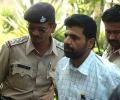
Paving the way for his execution, the Supreme Court on Thursday rejected the review plea of Yakub Abdul Razak Memon, sole death row convict and a co-conspirator of fugitive Dawood Ibrahim in the 1993 Mumbai serial blasts case.

It was never the quality of the CV that defined an incumbent's performance or legacy.

'People want to blacken my face for showing "leaders in a bad light".' 'People want to show loyalty to the party.' 'There's no end to it.' 'How many people should I show the film to?' 'Where do we draw the line?'

A look at the top tweets from your favourite Bollywood celebrities.

'We could crack IM modules in the country because one arrested member would spill beans on the other.' 'With ISIS, every module is different and is possibly being handled by different operators abroad.'

The dairy has no plans of a sale

Singham Returns offers quite a bit to whistle about with its steady supply of straightforward action and a hot-headed hero who delivers a punch with a fist and a line, writes Sukanya Verma

Five persons, including founder of local terror group Tehreek-Ghalba-e-Islam Viqaruddin Ahmed, were on Tuesday killed in an encounter with the police in Telangana's Warangal district.
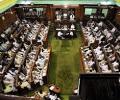
A total of 126 votes, including four of Congress and one of CPI, were cast in favour of the confidence motion while 24, including 22 of Lalu Prasad led RJD, voted against the motion as BJP members staged a walkout before the vote.

Regulator's nod assumed more importance after the Maggi issue.

John Lang represented Rani Laxmibai in her legal battle against the East India Company to prevent the British from annexing her kingdom of Jhansi. Rediff.com's Archana Masih on a maverick Aussie who spent 22 years in India and became a friend in its dark days of bondage.
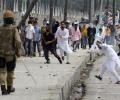
'There is a problem with the rise of a popular view that sees Kashmir through the prism of the larger, chronic Hindu-Muslim tensions.' 'By redefining the Kashmir problem simplistically in Hindu-Muslim terms could end up keeping Kashmir but losing most Kashmiris,' says Shekhar Gupta.
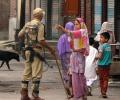
Slamming the government over the situation in Kashmir, Opposition in the Rajya Sabha on Monday pressed for holding an all-party meet to discuss the issue and pitched for a political solution rather than using "barrel of the gun" while dealing with the unrest.

'An operation such as the Mumbai attacks, which needed expert technical assessment, money and time to prepare, could not have been carried out without the knowledge of the ISI's leadership.'

'15, 17 years back we were not even in existence in the US. Today nearly 1/3 of prescriptions written comes from India.' 'India is showing that in a very competitive environment -- like the US and Europe -- our industry is doing very well.'

Regardless of Phata Poster Nikhla Hero's uneven pace and indecisive disposition, Shahid Kapoor, armed with a kooky grin, gives it his best shot.

India garnered most of the gold medals on offer for the fourth successive day at the 12th South Asian Games, as their swimmers, archers and track-and-field athletes ensured the top position on the medals tally remained unchallenged, in Guwahati, on Tuesday.
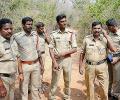
'If 25 black men had been executed illegally in the US in one day, the government would have fallen and the population would have rallied to the victims. In India, those of us who did not applaud the police only yawned,' says Aakar Patel.

As we celebrate the spirit of childhood, here are some children who've made India proud.

Maharashtra's beef ban has led to heated arguments on social media, but when a protest against the ban was held in Mumbai, only a few thousands turned up. Perhaps it is easier to outrage online than join an actual protest, says Syed Firdaus Ashraf.

Yudh has really rubbished my expectations, rants Raja Sen.

'This has been an ongoing process,' says Ambassador B S Prakash, India's former consul general in San Francisco, 'but I believe a Modi visit to the West Coast can be a force-multiplier.'
The real danger in India is not majoritarianism but minorityism, a bane we have already experienced. Majoritarianism in the India context means plurality and tolerance. No one needs to fear, says Vivek Gumaste


With the images of Rajendra Babu, Radhakrishnan, K R Narayanan, V V Giri and Kalam in my mind, the image of my beloved hero dancing ungainly to 'Merey angney main tumharra kya kaam hai', doesn't make a smooth transition, says Sudhir Bisht.

'This is not the handiwork of ordinary sub inspectors and constables.' 'If the police claim there was a scuffle between them and these five men, then how come none of the policemen were killed, or even hit by a bullet?'

'Patel was more in tune with the popular mood than Jawaharlal Nehru. While the principle that Hindus and Muslims should be able to live together remained central to Nehru's vision for India, the Sardar was less sentimental.' 'Nehru would angrily face down mobs himself, rushing from trouble spot to trouble spot. A veritable tent city, filled with Muslim refugees, sprouted on the lawns of his bungalow... Mountbatten feared Nehru's impulsiveness would get him killed, and assigned soldiers to watch over him.' Nisid Hajari's Midnight's Furies: The Deadly Legacy of India's Partition casts fresh light on the events and personalities behind the horrific division of the subcontinent which haunts the India and Pakistan to this day.

'By resorting to divisive issues, the BJP is giving the impression that even if it is voted to power it won't do anything new to give Bihar a facelift. It will repel voters with the belief that the BJP can't do anything without communal polarisation as its core ideology. This is sad and unfortunate,' says Mohammad Sajjad.

'Badlapur,' says Sreehari Nair, 'proves that sometimes there are more personal truths to be discovered in our trash cans than in our neatly arranged book-shelves.'

'I sat down and asked them what they would want in their new school. One student said a football field, another one asked for computers. One little girl came and sat next to me and said, "A separate toilet for the girls." I think these small things make a huge difference in the future of education in India,' Nita Ambani tells Aseem Chhabra/Rediff.com
