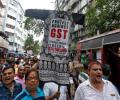
After 17 tumultuous years, a nationwide Goods and Services Tax (GST) will rollout from midnight of June 30, overhauling India's convoluted indirect taxation system and unifying the $2 trillion economy with 1.3 billion people into a single market.

The ones who came more recently were clutching the green cards that gave them an escape hatch through which to return to green pastures: Arvind Panagariya, Raghuram Rajan, Arvind Subramanian and other perfectly honourable gentlemen like them, points out T N Ninan.

Listening -- really listening -- to advisers in the government and outside would help. India has plenty of wise economists who have worked within the bureaucracy during previous crises, points out Rahul Jacob.

The old India was economically fragmented. New India will create one tax, one market, one nation, said Jaitley.

Starting April 1, a non-executive director of 75 years or more can be appointed or re-appointed only by way of a special resolution, which requires 75 per cent 'for' votes.
A well-functioning GST will enhance tax compliance and boost growth: IMF
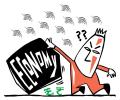
How do we get back to higher trend growth? The heart of the problem lies in private corporate investment, recommends Ajay Shah.

The pipeline for well-qualified and experienced policy economists at senior levels of government has broken, leading to a growing dearth of suitable candidates for top economist positions.
Invests $50 mn in 11 entities in just over a year, commits $25 mn more; prefers putting money in firms trying to solve India-specific problems

'We are not able to manufacture even low-end products as cheaply as China.' 'We are not buying Chinese goods today out of any love for China.'
Experts will give their inputs for Budget.

'Mr Modi would compliment a Nobel Prize winner, but members of his party or the government would not be restrained from either making unfair comments or criticising him for having offered advice to an Opposition political party,' says A K Bhattacharya.

Does India's most valued company give hope to its investors that they, too, might drive a Jaguar some day?

'Defence does not new 'planning commissions'; it needs an implementation commission.'
Suggestions made by the different experts have been noted and would be forwarded to Prime Minister Narendra Modi.

It was better to first build a single-rate GST with a low rate, achieve full mastery of this, and then consider more complex possibilities such as high rates and multiple rates.

While markets are upbeat over the government decision to nearly double the price of domestically produced natural gas, industry wants it to clearly lay the roadmap for free market pricing regime.

The shift from 'one country, one tax' to four tax rates could dilute possible gains on GDP, warns T N Ninan.

A more effective promotion of domestic manufacturing and mining could significantly reduce the trade deficit in key sectors, says T N Ninan.

The Rajya Sabha on Wednesday approved the biggest tax reform since Independence.
'The much-awaited decision could be a welcome change at a time when the Indian armed forces are crying for self-reliance and the defence industry is looking forward to more indigenisation,' notes Nitin A Gokhale.

Ahead of his government's first full year budget, Prime Minister Narendra Modi on Friday sought ideas from economists to attract investments, create jobs and finance infrastructure to put India back on high growth path.

'While the GST is structured to be an all-encompassing tax and to create a vastly expanded digital network of recorded transactions, no one knows how traders long used to avoiding taxes will apply their ingenuity,' says T N Ninan.

While the PM sees zero tax on long-term capital gains and dividend income as unfair since the beneficiaries are not poor, he is silent on the fact that rich farmers too don't pay taxes, since farm income is tax-free, a loophole exploited by many netas and babus, says Debashis Basu.
However, independent economists are not as gung-ho as the finance ministry over the likelihood of deficit target being met this time around, says Indivjal Dhasmana.

Reform ideas do not occur overnight and evolve over the years.

Will Arundhati Bhattacharya be the RBI's first woman governor? Or will Urjit Patel succeed Raghuram Rajanas RBI governor when his term ends on September 4?

One hopes that the government will act on the Kelkar panel recommendations.

India's economy is not like Western ones, and thus needs restrained fiscal policy even during a recession, says Ajay Shah.

FinCom prescribes scrapping of effective revenue deficit.
Private sector firms need to be re-engaged for better infra planning.
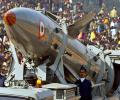
Will private firms really boost Make in India in the defence sector? Ajai Shukla seeks answers.

It has been said that by 2025, India could become among the top five economies in the world. If India does become a $5 trillion economy but gets all its rivers polluted, food chain poisoned and genetic pool depleted and biometric database of Indians sold or stolen at the behest of commercial czars, will it not be a pyrrhic economic victory, asks Gopal Krishna.
 © 2026 Rediff.com - Investor Information - Advertise with us - Disclaimer - Privacy Policy - Sitemap - Feedback - About us - Terms of use - Grievances