
Sri Lankan President Maithripala Sirisena on Friday dissolved the parliament, paving the way for fresh parliamentary elections in mid August, eight months ahead of the schedule.

India welcomed resolution of the political crisis in Sri Lanka and exuded confidence that relations between the two countries will continue to move on in an upward trajectory.

Sri Lanka's former president Mahinda Rajapaksa on Tuesday accepted defeat in the parliamentary elections even before the announcement of the final results.
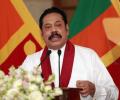
The parliament has approved a no-trust vote against Prime Minister Rajapaksa, speaker of parliament Karu Jayasuriya announced in the House.

President Maithripala Sirisena's new Cabinet was also sworn in and Rajapaksa was named the new minister of finance and economic affairs.

The opposition United National Party leader died of a gun shot injury along with a civilian, police spokesman N K Ilangakoon told PTI.

Maithripala Sirisena was considered so meek and self-effacing that he appeared no threat to anyone. What a mistake his rivals made!
'We would like India to play a much more vigorous role. Of course, there are constraints and inhibitions, but it is still possible for India to play a meaningful and proactive role.'

Speaker Karu Jayasuriya questioned the president's decision to suspend parliament till November 16, saying it will have "serious and undesirable" consequences on the country.

Sirisena's sacking of Wickremesinghe was the culmination of an year of bitter relations between them on several policy matters. The president has been critical of the prime minister and his policies, especially on economy and security.
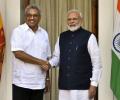
New Delhi is approaching Gota with an open mind, observes N Sathiya Moorthy.
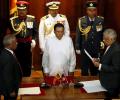
The swearing in ceremony was held inside the premises of the Presidential Secretariat at 9:30 am. President Sirisena administered the oath of office to 66-year-old Wickremesinghe, who has already served three times as the prime minister.
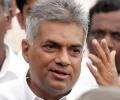
Incumbent Ranil Wickremesinghe is set to take oath as Sri Lanka's new prime minister of a unity government on Tuesday after his United National Party appeared close to a simple majority, with rival Mahinda Rajapaksa admitting defeat in the closely contested parliamentary polls.

Prime Minister Manmohan Singh's decision not to attend the Commonwealth Summit in Colombo was a loss for Sri Lanka as his absence reflected a breakdown of ties between the two countries, the main opposition said on Monday.

Over 15 million voters are eligible to vote in the election being held under electoral districts-based proportional representation system.

Even as the polity find ways and means to address the genuine concerns and fears of the society, the Sri Lankan State apparatus would have to unravel these mystery-questions with convincing answers, and a road-map to the future, says N Sathiya Moorthy.

Maithripala Sirisena, the Sri Lankan president-elect, will be sworn-in on Friday evening following his stunning victory in the tightest-ever presidential race that ended the 10-year-rule of Mahinda Rajapaksa.
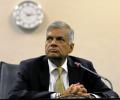
In a Sri Lankan House of 225 members, the cut-off figure comes to 113. With Wickremesinghe side touching 102 and Rajapaksa's team at 101, the three-party Tamil National Alliance with 16 members and the left-leaning Sinhala-Buddhist nationalist Janatha Vimukthi Peramuna with 6 members hold the key. But with the latter declaring that they will not support either formation in a vote count,that leaves the TNA as the deciding factor, says N Sathiya Moorthy.

The country has a fiendishly complicated electoral system that is a combination of population-based proportional representation and party-based national lists, says Aditi Phadnis
Sri Lanka's newly elected president Mithripala Sirisena waves at media as he leaves the election commission in Colombo. Photograph: Dinuka Liyanawatte/ Reuters

Rajapaksa has blamed India, the United States and European countries for his humiliating defeat.
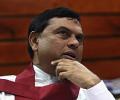
Sri Lanka's Minister for Economic Development, Basil Rajapakse's visit to New Delhi on Thursday for what is described as "regular high level consultations" comes shortly before a scheduled meeting of a Parliamentary Select Committee for Constitutional Amendments on July 9.

Sri Lankans on Thursday voted in large numbers in the bitterly contested presidential election in which incumbent Mahinda Rajapaksa is seeking a record third term against his friend-turned-foe Maithripala Sirisena, with an unusually high voter turnout in Tamil and Muslim areas.

A double-quick analysis of the Lankan election results would show that the relatively narrow victory margin of challenger Maithripala Sirisena was made up by the three minority communities of Tamils, Muslims and Christians, says N Sathiya Moorthy.

Unlike in the presidential polls, victory might not have been complete, at least as yet, for Mahinda Rajapaksa's electoral rivals. While his one-time aide and confidant, Maithripala Sirisena, became president without any issues after defeating him, incumbent Prime Minister Ranil Wickremesinghe, who again may not command an absolute majority in the 225-member parliament, would have to count on his 'national government' concept to carry the day and the nation with him, this time round, says N Sathiya Moorthy.
 © 2026 Rediff.com - Investor Information - Advertise with us - Disclaimer - Privacy Policy - Sitemap - Feedback - About us - Terms of use - Grievances