
The broader NSE Nifty fell 78.75 points, or 0.70 per cent, to close at 11,234.55.

Companies run till now by mostly their promoters are increasingly inducting professionals to head their teams.

Sun Pharma stole the show in the Sensex pack, spurting 3.91 per cent, followed by M&M at 2.87 per cent.

Disappointed with past experience, domestic majors even skip giving any memorandum.

In the Sensex pack, Bajaj Finance and Bajaj Auto ended up to 6.09 per cent higher after posting strong quarterly numbers.

Top gainers in the Sensex pack included Vedanta, ICICI Bank, ONGC, Kotak Bank, Axis Bank, SBI, M&M, Infosys, PowerGrid, HCL Tech, NTPC, Bajaj Finance and Reliance Industries, rising up to 2.72 per cent.

Details on prices sought as 10 generic drugs become up to 83 times costlier in 6 months

Sun Pharma, HDFC Bank, ITC, Infosys, L&T and Reliance Industries among the top gainers.

TCS heads top-10 ranking despite being sole loser; RIL, ITC take second & third place respectively

Market benchmarks Sensex and Nifty soared to new peaks on Tuesday, driven by gains mainly in metal, financial and IT stocks amid firm global cues and sustained foreign fund inflows. Tata Steel was the top gainer in the Sensex pack, surging 4.38 per cent, followed by Bharti Airtel 4.37 per cent, Vedanta 3.50 per cent, Tata Motors 3.03 per cent, HDFC 2.46 per cent and Bajaj Finance 2.39 per cent.After surging to its record intra-day peak of 41,401.65, the 30-share BSE barometer settled 413.45 points, or 1.01 per cent, higher at its all-time high of 41,352.17. Similarly, the broader NSE Nifty rallied 111.05 points, or 0.92 per cent, to its record closing high of 12,165.

Ajit Mishra, vice president, Research, Religare Broking, answers your queries.

Ajit Mishra, vice president, Research, Religare Broking, answers your queries.

Tata Motors was the biggest loser in the Sensex pack, cracking 4.56 per cent. Bajaj Finance, RIL, Yes Bank, NTPC and Tata Steel too fell up to 3.95 per cent.

Sun Pharma could have to withdraw cancer drug as J&J re-enters after temporary eclipse

NTPC was the top gainer among the Sensex stocks, rising by 3.53 per cent. Coal India, ONGC and Sun Pharma also rose up to 2.41 per cent.

SSTL is the second operator after Vodafone that has approached FIPB for raising FDI limit.

Among the index heavyweights, Reliance Industries ended down 1.9% while mortage lender HDFC eased 0.2%. FMCG major ITC ended down 1.3%.

Ajit Mishra, vice president, Research, Religare Broking, answers your queries.

Sun Pharma emerged as the star performer and closed 4.03 per cent up at Rs 675.45, while Cipla rallied 1.58 per cent to Rs 592.60.

Even smaller companies like Torrent Pharma and Alembic file five to 10 ANDAs every year.

Top gainers in the Sensex pack included Vedanta, Coal India, ICICI Bank, PowerGrid, HCL Tech and Bajaj Finance, rising up to 2.65 per cent.

Besides financials, shares of telecom, IT, auto and pharma were in demand.
In line with the overall downtrend in the markets, a majority of large business conglomerates saw their valuations taking a dip.

With the dizzying rise in the number of Covid-19 cases in the country, India Inc has transitioned from a wait-and-watch policy to full-on emergency mode, bringing back remote and flexi work, stringent safety protocols, and allowing only essential travel. Companies - especially in metros like Delhi, Mumbai and Kolkata - that had adopted a hybrid work model during the last few months when the caseload remained low, are either switching back entirely to work-from-home (WFH), or calling skeletal staff to office on select days. Take the case of cigarettes-to-hotels major, ITC, which had been on a hybrid work model over the last few months.

The Sensex was mainly dragged by Reliance Industries, HDFC, HDFC Bank, ICICI Bank and SBI, which lost up to 3.35 per cent.
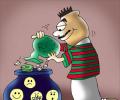
The m-cap of ONGC dipped Rs 13,303.78 crore, while that of Infosys tanked Rs 12,162.32 crore
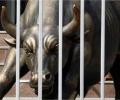
On the gaining side, Hero Moto, SBI, HDFC, HUL and L&T have gained between 1-1.4 per cent.
 © 2026 Rediff.com - Advertise with us - Disclaimer - Privacy Policy - Sitemap - Feedback - About us - Terms of use - Grievances