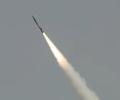
The army said the missile launch was part of "Exercise INDUS" without giving details about the exercise.
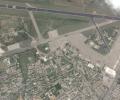
India's strikes on Pakistan damaged runways and structures across at least six airfields, according to a visual analysis by The Washington Post, which experts said were the most significant attacks of their kind in decades of simmering conflict between the two nations.

'Had Haji Pir and/or Skardu been taken, the message would have gone out not just to General Asim Munir and his cohort in the Pakistan army but to the Pakistani people that every terrorist incident in India would lead to substantial loss of territory in PoK.'

'The Indian gung-ho leadership may like to think about it, there should never ever be a doubt in anyone's mind, friend or foe, that Pakistan's operationally ready nuclear capability enables every Pakistani leader the liberty, the dignity and the courage to look straight into the Indian eye and never blink.'
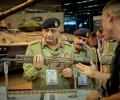
Significantly, these 12 officers would form a major part of the team that the new army chief will inherit, observes Rana Banerji, who headed the Pakistan desk at RA&W, India's external intelligence agency.
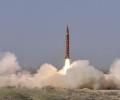
It is capable of delivering different types of warheads to a range of 900 kilometers

Pakistan on Friday successfully test-fired the medium-range Shaheen-III surface-to-surface ballistic missile which can carry nuclear warheads within a range of 2,750 kms, the military said.

Like the Shourya and Prahar missiles, the Pralay is powered by conventional solid fuel, and its payload is designed to carry only a conventional warhead.

Pakistan on Monday successfully test launched a surface-to-surface ballistic missile capable of carrying nuclear and conventional warheads to a distance of 2,750 kilometres, bringing most Indian cities under its range.

Lieutenant General Sahir Shamshad Mirza is the Pakistan army's new chief of general staff, notes Rana Banerji, who headed the Pakistan desk at the Research and Analysis Wing, India's external intelligence agency.
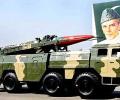
Pakistan military has appointed Lt Gen Zubair Mahmood Hayat as the new chief of the Strategic Plans Division, which manages and secures the country's nuclear arsenal.

Pakistan is determined to safeguard its nuclear assets which are a guarantee of national security, Lt Gen (retired) Khalid Kidwai, who heads the organisation that safeguards the country's nuclear arsenal, said on Monday.
The Dawn of Karachi reported on February 25, that the government of Prime Minister Yousef Raza Gilani has reportedly decided against extending the tenure of Lieutenant General Ahmed Shuja Pasha, who has been the Director General of the Inter Services Intelligence Directorate since October,2008, says security expert B Raman.
Pakistan has raised a 20,000 strong force to provide foolproof security to its nuclear weapons and strategic assets, the military said in Islamabad on Thursday.

How Pakistan army chief General Qamar Javed Bajwa deals with the ensuing reshuffle of lieutenant generals would be interesting to watch, notes Rana Banerji, who headed the Pakistan desk at the Research and Analysis Wing, India's external intelligence agency.
Pakistan will continue the development of its nuclear and missile programmes, which are the minimum level of deterrence required for the country's defence, Prime Minister Yousuf Raza Gillani said on Thursday.Gillani made the remarks during a visit to the Strategic Plans Division, the tri-services body that maintains Pakistan's nuclear arsenal, and the Joint Staff Headquarters at Chaklala in the garrison city of Rawalpindi.

"We have a long history of relations with people of this state. Many professionals from this state were settled in US decades ago and today they are successful and are important players in American life," Mulford pointed out.
The country's institutionalised command and control systems includes 10,000 soldiers who are guarding storage and production facilities for nuclear weapons, said Lt Gen (retired) Khalid Kidwai, the chief of the Strategic Plans Division that is responsible for the security and development of the arsenal.

Pakistan on Wednesday successfully test-fired a new ballistic missile which is capable of carrying both conventional and nuclear warheads up to a distance of 1,300 kilometres.

Senior general refuses to retire, reveals Rana Banerji, who headed the Pakistan desk at the Research and Ananlysis Wing, India's external intelligence agency.

Pakistan on Monday successfully test-fired a nuclear capable ballistic missile with a range of 900 kilometers, days after testing a similar missile capable of hitting targets as far as 1,500 kilometers, bringing many Indian cities under its range.
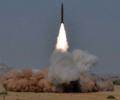
Pakistan on Thursday successfully test-fired a ballistic missile capable of carrying nuclear and conventional warheads to targets as far as 1,500 kilometres, bringing many Indian cities under its range.

The new missile is capable of delivering nuclear and conventional warheads up to 350 km.
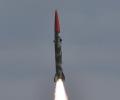
Pakistan on Tuesday successfully test-fired a short-range surface-to-surface ballistic missile Hatf III (Ghaznavi), capable of carrying nuclear and conventional warheads to a range of 290 kilometres, that could cover parts of India.

These promotions will allow General Bajwa to shuffle the deck on the top, but this is likely to be a limited reshuffle, points out Rana Banerji, who headed the Pakistan desk at the Research and Analysis Wing, India's external intelligence agency.

Pakistan military has told a parliamentary committee that India is the only external threat to the country and the situation with regard to ties was volatile in the wake of the suspended Indo-Pak dialogue.
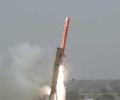
The flight test of the Air Launched Cruise Missile, Ra'ad, which is also known as Hatf VIII, was the seventh since it was first tested in 2007.

The missile, Babur-3, was fired from an underwater, mobile platform and hit its target with precise accuracy,

Pakistan on Thursday said its nuclear assets are completely safe and dismissed the world's suspicions as "baseless" at a meeting of the National Command Authority chaired by Prime Minister Nawaz Sharif.
As many as 17 three star generals will retire before General Bajwa hangs his boots, says Rana Banerji, who headed the Pakistan desk at the Research and Analysis Wing, India's external intelligence agency.

Lt Gen Zubair Hayat appointed as Chairman of Joint Chief of Staff Committee.

With Pakistan moving towards tactical nuclear weapons, there is an increasingly higher risk of nuclear theft, a US think-tank report has warned ahead of the Nuclear Security Summit in Washington later this month.

'Pakistan's security establishment, despite its appallingly immoral approach to conflict, has worked with limited resources to maximise its national defence resources to continue bleeding India,' says Ajai Shukla.

Experts trace the reasons for the 26/11 attacks to the Pakistan's military interest in three key areas: Kashmir, Afghanistan and nuclear armaments.

Indian policymakers must incorporate in their nuclear doctrine a realistic response to tactical nuclear warheads, says Ajai Shukla.
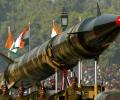
'We have worked to create road blocks in the path of those who thought that there was space for conventional war despite Pakistan's nuclear weapons.' 'Pakistan's nuclear weapons programme is not open-ended and aligned with India only.' 'In this unstable regional environment, one nuclear power is trying to teach lessons to another nuclear power through the medium of small arms and mortar shells on the Line of Control, and bluster.' 'A historic opportunity of a lifetime beckons the leaderships of India and Pakistan to grasp, sit together and explore the possibilities of conflict resolution.'
 © 2026 Rediff.com - Investor Information - Advertise with us - Disclaimer - Privacy Policy - Sitemap - Feedback - About us - Terms of use - Grievances