
What we want from spectrum allocation is access to broadband networks at prices that will result in productivity gains.
Ishan Bakshi studies the Budgets of six states, their expenditure priorities and outlays to understand the trend.
'The government must keep bad news out of the newspapers. If you have news about a fight everyday, it is not a climate where investment takes place.'
Power firms can pass on burden to consumers, stocks rise up to 2%
'This country has become cynical, the country has lost hope. Prime Minister Narendra Modi is getting back hope in this country.' 'We are deconstructing the past which had corruption, inefficiency, policy paralysis, a tottering economy where investors had lost confidence, and people had become cynical. We are changing that, we are bringing confidence back to the people of India.'
'The Modi government believes the industrialist, the capitalist, has to pay for the assets of the government which belong to the people of India.'
The 35-year-old fails to understand how to decide whether a particular scheme should be kept in one's portfolio or not.
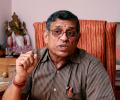
'The UPA's claim of growth at 9.5 percent was absolute nonsense and a fraudulent claim because the country did not grow; it was only statistical growth.' 'I do believe that when there is a determined leader who wants to bring a desired change, the system will begin acting. Today, people think there is policy paralysis, but there is functional paralysis also.' 'When things start moving, people will invest. Many companies are holding cash, many people are not investing. Nobody is making any move. Everybody is waiting for the elections to get over.' Economist and Swadeshi Jagran Manch convenor Swaminathan Gurumurthy in conversation with Shobha Warrier/Rediff.com
.jpg)
Revenue yield on every rupee of investment fell to Rs 1.06 in FY13 from Rs 1.20 in FY08.
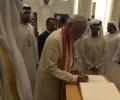
'Here is a man who can steer the country out of the woods. That sense of hope towards Modi was already there. And now that he has actually visited this region, it will go to the next level.' Zafar Sareshwala, a close confidant of Prime Minister Narendra Modi, shares his impressions about the PM's historic visit to the United Arab Emirates.

Corporate Social Responsibility can become a serious tool for improving the lives of millions in any structural and long term way, writes Rajni Bakshi.

There are unprecedented political implications of identification based on 'biological attributes of an individual', such as employed by Aadhaar, warns Gopal Krishna.

Many of the industrialists profiled in the book are no longer riding the wave of success.

Stocks to watch: BHEL, L&T, IRB Infra and Suzlon

The government should now focus on governance and monitoring the supply side to manage inflation, says M V Subramanian.
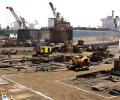
Adani Enterprises plans to invest a total of $25 billion in the next five years.

'The transmission sector is going to be the next sunrise industry.'
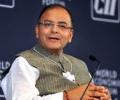
Bharatiya Janata Party leader Arun Jaitley faces a tough electoral battle in his maiden bid to enter Lok Sabha from Amritsar but is unfazed by his "reluctant" heavyweight opponent Capt Amarinder Singh as he claims the groundswell against Congress "adds to my confidence".
.jpg)
Candidates in the current state elections must be made to offer specific promises against which their performance can be measured, says Indira Rajaraman


'Modi is a master of convergence. By his ability to converge and add new features to a non-star idea, he is able to sell it. Like how he has turned Kutch into a tourist destination by selling the salt desert of the Rann as a flat snow desert of the night and roping in Amitabh Bachchan to sell it. In one stroke this has ensured economic returns to the people and on the other hand it has taken care of the national security angle in the sense that the border population in the Rann, which is almost entirely Muslim, is feeling better as now they are much more connected with the mainstream.' Ahead of the launch of his book on the much-debated Modi model of governance, journalist Uday Mahurkar speaks to Rediff.com's Sheela Bhatt.

In an online chat with readers overseas education consultant NNS Chandra addressed queries related to international admissions

Even as the Indian benchmarks, the BSE Sensex and Nifty 50, crumbled over three per cent today, experts are optimistic about the Indian economy and believe investors can still make 30 per cent plus returns in 2015
.jpg)
The power of a nation is directly related to the revenues it realises from its citizens. But India loses a gargantuan Rs 5.8 lakh crore, as the IT department drags its feet over recovering uncollected taxes in time or holding up files in appeal cases, says Mohan Guruswamy.
The Sino-Pakistan relationship remains fundamentally asymmetrical: Pakistan wants more out of its ties with China than China is willing to offer. Today, when Pakistan's domestic problems are gargantuan, China would be very cautious in involving itself even more, says Harsh V Pant.

The euphoria of Ab Ki Baar Modi Sarkar will fade quickly if the Modi government does not raise its game, and focus significant monetary resources and managerial skills on making India's infrastructure truly world-class, says Ram Kelkar.

The shift to gross calorific value-based grading of coal aligned domestic prices with international benchmarks.

Once again an Indian prime minister has realised that with Pakistan and China, things will not move as he wishes.

Short-term gains are always unpredictable.

Once these banks start showing losses, they will not be able to pay dividends to the government nor pay taxes, which will further aggravate the situation for the government as its return on investment as an investor would be very negligible for the next few years, says M V Subramanian.

I-T lens on current account deposits over Rs 12.5 lakh. All the news and more post demonetisation.

Boosted by handsome royalty from oil facilities at Barmer, the Rajasthan government has spent nearly Rs 30,000 crore on various social welfare schemes in the last four-and-a-half years. Chief Minister Ashok Gehlot tells Business Standard's Mayank Mishra that the state's better performance on various socio-economic indices is a result of that. The excerpts:
.jpg)
The toxic brew of fiscal populism, crony capitalism and bad economic management has ensured the collapse of economic growth, industrial stagnation, stubbornly high consumer inflation, declining savings and investment, shrinking employment opportunities, and a dangerously vulnerable external financing situation.

Parekh said divestment can unlock huge funds.
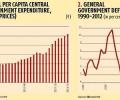
One may fault this government for incompetence, corruption, and delayed action but it cannot be faulted for lacking a vision.
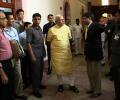
Who are the men the prime minister relies on to execute his impressive agenda?

Following is the full text of Congress vice-president Rahul Gandhi's speech at FICCI's 86th annual general meeting on Saturday:
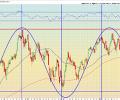
It was the RBI which destroyed our $-job economy. It is for the RBI to resurrect it by instituting news ways of managing the INR, says Sonali Ranade
 © 2026 Rediff.com - Investor Information - Advertise with us - Disclaimer - Privacy Policy - Sitemap - Feedback - About us - Terms of use - Grievances