
The Indian Space Research Organisation on Wednesday placed in orbit seven satellites including Oceansat-2 within a span of 20 minutes, its first successful mission after the abrupt end of the ambitious Chandrayaan-I project.

The Polar Satellite Launch Vehicle PSLV-C15 carrying five payloads, including India's remote sensing satellite Cartosat-2B, successfully lifted off from the spaceport in Sriharikota on Monday.
For carrying the 360-kg Italian satellite, meant for astronomical studies, Indian Space Department's commercial wing Antrix Corporation would receive a fee from the Italian space agency.
ISRO will launch TechSAR, Israel's first synthetic aperture radar imaging satellite.
India on Friday moved a step closer to launch its maiden unmanned moon session when the lunar spacecraft Chandrayaan-I was mated with the polar rocket which is set to blast off on October 22 from the Sriharikota spaceport. Gearing up for the final countdown, Space officials said all operations for the mission are progressing satisfactorily and barring a cyclone threat the PSLV-C11 will keep the date with the country's historic mission on October 22.
India has planned an unmanned scientific mission to moon called Chandayan-I.

India's PSLV-C9 blasted off into space, carrying ten satellites including the country's latest remote sensing satellite CARTOSAT-2A, from Indian Space Research Ogranisation's Satish Dhawan Space Centre in Sriharikota on Monday.Scientists cheered as the Polar Satellite Launch Vehicle, in its thirteenth flight, soared into the clear sky in a perfect lift off at 9.23 am from the second launch pad.Besides the 690 kg CARTOSAT-2A, the PSLV is also carrying Indian Mini Satellite.
Greet the scientists on achieving this major milestone!
The satellite will give India the capability to keep tabs on missile launches in its neighbourhood.
The 44 metre tall four-stage PSLV placed Italian satellite AGILE into orbit at 550 km above the earth.
The PSLV-C8 rocket will make its first commercial launch with an Italian astronomical satellite on board.

AzaadiSAT had around 75 small payloads developed by schoolgirls of 75 rural schools.
ISRO chairman G Madhavan Nair said Chandrayaan-2, to be undertaken by 2010, will have a proper lander, which would land on the lunar surface and try to explore the surface in far more detail.
India on Monday successfully launched Israeli satellite 'Polaris' from the Satish Dhawan Space Centre in Sriharikota by a homegrown Polar Satellite Launch Vehicle, a spokesman of the Indian Space Research Organisation said. This is the second time that a 'core alone' PSLV configuration had put a satellite into orbit. In April 2007, an Italian satellite Agile was put into the orbit, the space agency spokesman said.
European instruments would be included on board India's mission to the moon, Chandrayaan-1, to be launched by India's Polar Satellite Launch Vehicle.
ISRO's Polar Satellite Launch Vehicle-C6, carrying India's remote sensing satellite CARTOSAT-1 and a micro satellite HAMSAT, blasted off from the Satish Dhawan Space Centre in Sriharikota on Thursday.

The two satellites that PSLV will release in the orbit will help the country's mapmakers and amateur radio operators.

President Pranab Mukherjee on Monday congratulated space agency ISRO for the successful launch of rocket PSLV-C23, saying it is a significant milestone in the progress of the country's space capabilities.
ISRO to launch EU satellite, earn $10 million
India will join an elite group of nations with the launch of a new mission to test re-entry technology, which would be a forerunner to developing reusable vehicles like space shuttles.
The 44.5-metre-tall, 295-tonne PSLV-C7 lifted off from the launch pad at 9.24 am.
Chandrayan's operations will be controlled by robots and cover 3.50 lakh kilometre within a period of two years, ISRO chairman G Madhavan Nair said.
The Polar Satellite Launch Vehicle is carrying 1360-kg satellite 'Resourcesat -I'.
The American agency is in talks with ISRO to place its scientific instruments on the Indian spacecraft that will be sent on an unmanned mission to the moon in 2007.

Around 23 minutes after lift-off, the primary satellite got separated and it was followed by six other co-passenger satellites, which were deployed into the intended orbits sequentially, ISRO said.

'Today, when we talk of success of PSLV and GSLV Mk III, we owe it to important inputs that the Prof. Narasimha committee gave'

The space agency had earlier announced that the launch is tentatively scheduled at 09:28 hrs IST on November 25, subject to weather conditions.

Why did ISRO's workhorse Polar Satellite Launch Vehicle rocket fail during its 41st flight?

The Department of Space (DoS) plans to realise entirely-built rockets -- GSLV-Mk III and SSLV -- from Indian industry partners, in addition to PSLV, according to a top official of its commercial arm NSIL.

On Sunday morning, in its mission to place an earth observation satellite and students satellite into the low earth orbit, the SSLV-D1/EOS-02 blasted off precisely at 9.18 am amid cloudy skies from the first launch pad at Satish Dhawan Space Centre in this spaceport.

The polar satellite launch vehicle-C42 launch vehicle carrying the two satellites blasted off from the first launchpad at the Satish Dhawan Space Centre at 10.08 pm.

'When a Project Director is appointed, the whole organization -- including the Chairman ISRO -- works for his success. It is a lesson that has been of abiding value all through the other projects I have worked on,' recalls the late President, one of the earliest pioneers at ISRO.

PSLV C-29 blasted off from the Satish Dhawan Space Centre, about 110 km from Chennai, at 6 pm and released the six satellites one by one into a 550 km circular orbit.
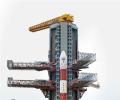
A 48-hour countdown began on Monday for the launch of record 20 satellites, including India's latest earth observation Cartosat-2 Series Satellite, onboard PSLV C-34 from Sriharikota on June 22.

In a major boost to the Indian scientific community, the Mars Orbiter Mission (Mangalyaan), on its maiden tryst with the red planet, has completed 300 days of its journey in space and is just 23 days away from reaching its intended orbit.

Indian Space Research Organisation's second mission of the year to place an earth observation satellite by a GSLV rocket faced a setback as the mission could not be accomplished fully due to performance anomaly in the cryogenic stage of the rocket, the space agency said on Thursday.

I suggest we build a Vigyan Mandir (Temple of Science) with the ambience of a place of worship, so that it becomes a destination for pilgrims. We should embed on its walls bronze plaques describing each scientist mentioned here along with about a dozen of our ancient mathematicians, recommends Professor Kalyan Singhal, historian of science and technology.
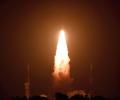
A S Kiran Kumar, chief of ISRO, said the mission was unsuccessful because the satellite housed within the heat sink could not be injected.

In its first multi-orbital launch, India's workhorse PSLV will on Monday inject eight different satellites, including the country's weather satellite SCATSAT-1 and five from other nations, into two different orbits.
 © 2026 Rediff.com - Investor Information - Advertise with us - Disclaimer - Privacy Policy - Sitemap - Feedback - About us - Terms of use - Grievances