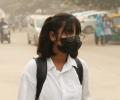
'Pollution acts as an endocrine disruptor.' 'When it acts as an endocrine disruptor it has an effect on the endocrine system of the human body and the effect on the pancreas is an important one.' 'The way you get type two diabetes is due to two defects.' 'One is the pancreas doesn't produce enough insulin.' 'The other physiological defect is insulin resistance.'

According to Central Pollution Control Board's (CPCB) Sameer app, the city's air quality index (AQI) stood at 449 in the severe category at 8 am on Saturday. It was 462 on Friday.

Measures under the GRAP's 'very poor' and 'severe' categories came into effect on Tuesday.

The dramatic reversal in the situation caught people and weather scientists unaware.

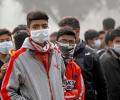
Hazardous pollution has made anti-pollution gear and gadgets a near-necessity, says Khalid Anzar.

The city's air quality index will fluctuate between the higher end of the "poor" category and the lower end of the "very poor" category, it predicted.

A city resident doesn't find Delhi to be livable anymore.

A study pointing that the pollution levels in New Delhi is worse than that of Beijing may have been quoting the data from the worst period of the year but the air quality in Indian cities is progressively getting worse, United Nations climate change chief Rajendra Pachauri said on Tuesday.

As pollution reaching alarming levels in Delhi, Veer Arjun Singh guides you how to protect yourself.
Let's take a look at some of the most polluted cities in the world's biggest economies.

Breathing polluted air for long periods of time can cause more serious problems. Avoid exercising outdoors on bad air days, suggests Dr Varun Gupta.

The eight areas that recorded 'severe' air quality Saturday are Anand Vihar, Dwarka Sector 8, Narela, Punjabi Bagh, Bawana, Mundaka, Vivek Vihar and Rohini.

According to a report by Greenpeace and AirVisual, air pollution will cause around 7 million premature deaths globally next year.
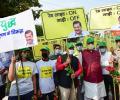
According to the Central Pollution Control Board's mobile application SAMEER, the city recorded an air quality index of 168, which falls in the 'moderate' category, much better than Monday's AQI of 221, which falls in the 'poor' category.

The NGT directed the Delhi govt not to implement the scheme unless it established that it was not counter-productive.
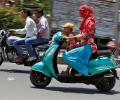
ASG said it would be impossible to accommodate people in public transport if odd-even scheme is made applicable for two-wheelers also.

Delhi recorded an air quality index of 315 at 11:10 am. The last time the air quality hit such a poor level was in February.

The AIBA Women's World Boxing Championships is taking place in an indoor stadium from Thursday through to November 24 but teams are complaining about a toxic smog hanging over the city, caused by seasonal burning of crop stubble and emissions from vehicles and industry.

13 out of the world's 20 most polluted cities are in India. Most shockingly, the latest Central Pollution Control Board statistics reveal that the pollution levels in Gwalior, Raipur and even little known Kashipur are higher than that of Delhi which means we have some of the most polluted zones in the world.

The dense cover of grey haze shrouding Delhi for almost a week, reminiscent of the 1952 Great Smog in London, plunged the city's air quality to the season's worst.

According to the Central Pollution Control Board (CPCB), the 24-hour average concentration of lung-damaging fine particles known as PM2.5 in Delhi-NCR shot up from 243 micrograms per cubic metre at 6 pm on Thursday (Diwali day) to 410 micrograms per cubic metre at 9 am on Friday, around seven times the safe limit of 60 micrograms per cubic metre.

It is believed that the crop residue burning in the nearby states of Punjab and Haryana are contributing to polluting the air.

With CPCB saying that the air quality is not severe now, the SC partially lifted its ban.

Centre for Science and Environment said that Delhi has lost the air quality gains of odd and even scheme.
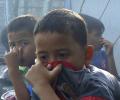
Air toxics emissions are high from older vehicles.

Under the red alert, which is the highest in the four-tier emergency response system created in 2013, all schools have been ordered to be closed, and outdoor construction halted.

The national capital woke up on Tuesday morning to 'severe' air quality under a blanket of thick haze, as pollution levels breached the permissible standards by multiple times.

The redevelopment project of the Central Vista -- the power corridor of the country -- envisages a new triangular Parliament building, a Common Central Secretariat and the revamping of the three-km-long Rajpath from the Rashtrapati Bhavan to India Gate and new residences for the prime minister and the vice president.

The overall Air Quality Index was recorded at 231 on Sunday which falls in 'poor' category.
Air pollution is the third highest cause of death among all health risks in India, ranking just above smoking.

China on Saturday issued a yellow alert for smog as the pollution choked most regions in the country's north with no signs of abating.

22 of the 37 air quality monitoring stations across Delhi recorded the air quality in the severe category on Thursday morning.

According to the System of Air Quality and Weather Forecasting and Research, the overall air quality of the national capital docked at 376 at 8:30 am on Tuesday.

The PM2.5 level (presence in the air of particles with a diametre of less than 2.5 micrometres) touched a new high at 158 as authorities predicted further deterioration of air quality in the coming days.
Exposure to higher air pollution levels for several hours a day can increase insulin resistance in the body and further affect those with diabetes, says diabetologist Dr Manoj Chawla.

Delhi Chief Minister Arvind Kejriwal hopes pollution will not affect the India-Bangladesh T20 International in the city on November 3, emphasising that his government has been taking steps such as the odd-even scheme to improve the air quality.

A thin layer of toxic haze hung over Delhi in the morning and the overall air quality index stood at 313 at 9 am. It continued its upward trend and was recorded at 337 at 1 pm.

'Covid patients have infected lungs and the pollutants will further damage it.'

'If 20,000 people in the stands did not have problem and the Indian team did not face any issue, I wonder why Sri Lankan team made a big fuss. I will need to talk to the secretary and ask him to write to the Sri Lanka Cricket'

With the skies over Delhi clouded with smog, many cast worried eyes on the fate of the first India-Bangladesh Twenty20 International scheduled at the Arun Jaitley stadium on Sunday.
