
Squandering the relief due to rain, Delhi recorded a jump in pollution levels and a smoky haze returned on Monday morning after residents flouted the ban on firecrackers on Diwali night.

Green think tank Centre for Science and Environment (CSE) said the ongoing smog episode is a public health emergency.

The minister said the government will soon come out with air pollution data of major cities.

According to SAFAR, both stubble burning in surrounding states of Delhi and firecrackers are causing deterioration of air quality in the national capital.

As many as 753 violators of the odd-even scheme were challaned on Monday, the 11th day of the car-rationing measure's implementation in New Delhi.
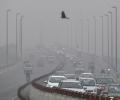
With Delhi recording air pollution levels seven to eight times above safe standards on Monday, the city government announced the return of its flagship odd-even scheme after four years anticipating further deterioration of air quality post-Diwali.

The poisonous haze has been causing significant problems for people with existing respiratory issues, according to doctors.

Less than six months ago, Delhi was gasping for breath. Authorities said air quality had reached "unbearable levels". Schools were shut, flights were diverted, and people were asked to wear masks, avoid polluted areas and keep doors and windows closed. But during the lockdown that began on Mar 22, the concentration of poisonous PM2.5 particles in a cubic metre of air averaged at 44.18, according to a Reuters analysis of government data, indicating a rare "good" rating, the safest level on the scale.

The researchers discovered that just a 4.6 ppb reduction in long-term exposure to NO2 would have prevented 14,672 deaths among those who tested positive for the virus.

Rediff Labs investigates the link between environment and economy in countries around the world.

A CPCB official said a number of factors were responsible for the deteriorating air quality, including vehicular pollution, construction activities and meteorological factors.

The smog reduced the visibility to merely 300 meters in the morning affecting traffic, an official of the India Meteorological Department said.

The results are based on epidemiological data collected up to third week in June 2020 and the researchers say a comprehensive evaluation will need to follow after the pandemic has subsided.

In India, air pollution is most severe in the Indo-Gangetic Plain (northern India), where topography and meteorology concentrate pollution from energy, mobility, industry, agriculture, and other activities, the researchers said.

In 2012, with one million deaths, China reported the highest toll from PM2.5 and PM10 pollution. At the time, India followed, reporting 621,138 deaths, nearly 10 per cent of the global toll associated with outdoor and indoor air pollution

According to senior IMD scientist Kuldeep Srivastava, clear sky or absence of clouds allows sun rays to reach the ground, warming up the air close to the ground which lifts up and clears the pollutants.

The overall air quality index was recorded at 426 which falls in the 'severe' category, according to data by the Central Pollution Control Board.
The sustainable impact of this process is under scrutiny, Tripathi added.

The countries' biggest cities -- Delhi and Lahore -- are fighting a common enemy: Smog.

The report states air quality in Indian households, especially in the rural areas, is lethal due to use of wood or cow dung as cooking fuel coupled with poor ventilation.

Amid a spike in pollution levels in Delhi-NCR, the Supreme Court on Tuesday directed Punjab, Haryana, Uttar Pradesh and Rajasthan to ensure crop residue burning was stopped "forthwith", saying it cannot let "people die" due to pollution.
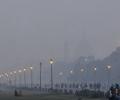
Pollution levels in Delhi during the Diwali period are likely to remain in the higher end of the 'very poor' category in the absence of emissions due to fireworks, the Ministry of Earth Sciences' air quality monitor, SAFAR said.

As visibility remained poor and the city choked due to a haze, the Centre for Science and Environment asked the Delhi govt to roll out stringent plans for controlling winter pollution.

Uttar Pradesh, last year, recorded the most 2,60,028 deaths attributable to air pollution, followed by Maharashtra at 1,08,038 and Bihar 96,967, it said.

The dip in the air quality can be attributed to low wind speed and temperatures which allowed accumulation of pollutants.

No improvement in the air quality in Delhi-NCR is expected for another three days, authorities said on Monday, as the Supreme Court directed the Centre to call an emergency meeting to decide on measures like stopping non-essential constructions, transport and power plants by Tuesday evening.

The spurt in pollutants was caused by a combination of meteorological factors including a drop in temperature, wind speed and mixing height, a layer where air and particulates float, the Central Pollution Control Board said.

The United States embassy's pollution monitor recorded 'hazardous' air quality with the index scoring an alarming 878, which the mission considers 'beyond its air quality index' (AQI), which ends at 500.

Delhi woke up to the season's worst air quality as smoke from Diwali fireworks, coupled with moisture and nearly stagnant wind movement, shrouded the city in a thick cover of smog with respirable pollutants reaching perilous levels.

The city's 24-hour average AQI was recorded in the 'poor' category at 265 on Saturday as residents flouted the ban on firecrackers in parts of the national capital ahead of Diwali, according to Central Pollution Control Board's (CPCB) data.

Production, storage and sale of firecrackers in the capital will be punishable with a fine of up to Rs 5,000 and three years jail under Section 9B of the Explosives Act, the minister told a press conference in New Delhi.
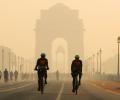
"The overall Delhi's Air Quality Index is in the very poor category with few Delhi locations entering at higher zone but that will be short lived. This is mainly because the extremely calm local surface winds which were prevailing yesterday are likely to increase slightly and may further pick-up by Oct 26," SAFAR said.
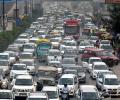
The Delhi government said that it is not ready "to compromise with the safety of women".

'If you keep on irritating the body by allowing all kinds of pollutants to get into it, the body cells are going to get irritated and cancer will come.'

The nationwide 'Janta Curfew' followed by the 21-day lockdown to combat the coronavirus outbreak have led to a significant reduction in pollution in the country, with 91 cities recording air quality in the 'good' and 'satisfactory' category on March 29, a Central Pollution Control Board report has stated. Travel restrictions and the closure of industries have helped reduce the pollution level, it said.

Pollution levels were inching towards 'severe plus emergency' category due to a change in wind direction and rampant stubble burning in neighbouring states

India had 14 out of the world's 20 most polluted cities, the World Health Organization reveals.

Parts of north China will see the worst smog so far this year the National Meteorological Centre said on Saturday.
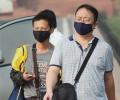
The national capital is facing the worst smog in 17 years, the Centre for Science and Environment had said on Thursday.

Once called India's garden city, this upper middle-class residential area in Bangalore has India's most toxic air, says Devanik Saha, IndiaSpend.com.
