
Following the precision strikes, India reached out to several world capitals and briefed senior officials about its anti-terror actions against Pakistan.

Two 'very smart' leaders of India and Pakistan decided to end last month's conflict that could have turned into a nuclear war, United States President Donald Trump said after holding a rare luncheon meeting with Pakistan army chief Field Marshal Asim Munir at the White House.

As suspense mounted over holding of the Indo-Pakistan National Security Advisor-level talks after both sides hardened their positions on the issue of Kashmiri separatists, External Affairs Minister Sushma Swaraj on Saturday called a press conference in New Delhi.

Pakistan on Saturday said it was not satisfied with India's 'simplistic explanation' on the 'accidental firing' of a missile that landed in Pakistan's Punjab province and demanded a joint probe to accurately establish the facts surrounding the incident.
At a media briefing, ministry of external affairs spokesperson Arindam Bagchi asked Pakistan to focus on setting its own house in order in containing terror networks and said that the international community is well aware of that country's credentials when it comes to terrorism.

Mahmood Ali Durrani, who was sacked as the Pakistan's National Security Advisor after he acknowledged Ajmal Kasab's Pakistani nationality, has insisted that Jamaat-ud-Dawa chief Hafiz Saeed had no role in the 26/11 terror strike and has asked New Delhi not to "push" Islamabad.

After weeks of denying the possibility, Pakistan turned around on its position -- admitting to CNN-IBN that some or all of the terrorists who carried out the 26th November attacks on Mumbai- could have been Pakistani nationals.
India on Saturday said it has a fair amount of intelligence about Pakistan's involvement in the Monday's suicide attack on its embassy in Kabul. "We not only suspect but we have a fair amount of intelligence (on the involvement of Pakistan)," National Security Advisor M K Narayanan told Times Now news channel when asked whether India suspects Pakistan's involvement in the attack.
Pakistan's National Security Advisor Sartaj Aziz has accused India of acting like a regional superpower, saying it was imposing its agenda in violation of the Ufa agreement that scuttled the NSA-level talks. He said Pakistan was not responsible for the cancellation of the first-ever NSA-level talks.
'No dialogue with India can be successful without the Kashmir on the agenda'

While Pakistan termed its decision to allow Jadhav's family to travel to Pakistan to meet him as humanitarian gesture, India has accused it of violating mutual understandings.

A senior minister in Sharif's cabinet told The Express Tribune that the army chief has been pushing for the appointment of Janjua as the new NSA since months, but Sharif preferred Aziz.

At the conference, they were seated across the horse-shoe-shaped table.

Afghan President Hamid Karzai will arrive in Islamabad on Monday on a one-day trip to discuss the frayed ties with Pakistan and seek release of Taliban leader Mullah Abdul Ghani Barader as a confidence building measure.
Tier two cities such as Lucknow, Jaipur, Vijaywada, Bhopal, Chandigarh, Ahmedabad and Panji have also been alerted about possible attacks.

Prime Minister Narendra Modi will visit Pakistan to attend the South Asian Association for Regional Cooperation summit likely to be held in September 2016.

Home Minister Rajnath Singh on Saturday said India "sticks to its stand" that dialogue must be held only on terrorism at the Indo-Pak National SecurityAdvisor-level talks, which are under a cloud over the issue of Kashmiri separatists.

Amid escalating tensions at the Indo-Pak border, Pakistan's national security advisor Sartaj Aziz has said it is "too early" to speculate on the timing of his visit to New Delhi to hold talks with his Indian counterpart as agreed at Ufa.

The sudden arrest and immediate release of Kashmiri separatist leaders who are to meet Pakistan National Security Advisor Sartaj Aziz introduced an intriguing element into the scheduled talks he will have with his Indian counterpart Ajit Doval on terror on next week.

Is Nasir Khan Janjua's appointment as Pakistan's national security advisor the first step in suborning the elected civilian government?
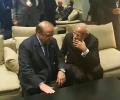
How the two South Asian neighbours will interact with each other in the coming months will be decided by the two prime ministers in Washington.

One of the addresses which have been dropped by the UN Security Council's Al Qaeda Sanctions Committee was found similar to that of a residence of Islamabad's envoy to the UN Maleeha Lodhi.
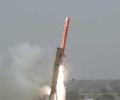
'Fearful of losing strategic advantage, the only option for Pakistan is to rattle its nuclear sabre!' 'Pakistan thereby hopes to play on the worldwide fear of an outbreak of nuclear war in South Asia,' says Colonel Anil A Athale (retd).

'In this Spy versus Soldier game,' says Rajeev Sharma, 'the two sides will size up each other like never before.'

'Why has the rhetoric gone down on the Indian side, Durrani wondered aloud.' 'I said because almost total normalcy and peace had returned on the ground in Kashmir,' recalls Shekhar Gupta. 'The general gave me that career spook's laser look. And he said: "That situation on the ground can change in no time".' 'This was precisely when the Pakistanis began their first incursions into Kargil.' 'Durrani had been retired for five years.' 'But once the ISI boss, you are always in the know.'

Pakistan has made it clear that there can be no talks with India unless Kashmir is on the agenda.
Pakistan National Security Advisor Sartaj Aziz brings to New Delhi a newfound Pakistani confidence, stemming from its leverage in Afghanistan, says Ajai Shukla

Pakistan NSA Sartaj Aziz says he is ready to travel to India but without any pre-conditions
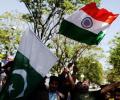
'The talks held in Bangkok, virtually on Indian terms, is an event where Pakistan seems to have blinked first.'
'India should be more confident and let Pakistanis meet Hurriyat leaders. India's main concern is terrorism, and India should talk terrorism. If that means talking Kashmir, so be it. India can't answer terror with terror because we don't have terror factories. India can't answer terrorism with war because we both have nuclear weapons. That leaves talks as the only option,' says Shivam Vij.
'As India and Pakistan observe the 50th anniversary of the 1965 war, the one lesson that ought to have been learned by Pakistan is how vulnerable its heartland is to a sudden attack. The only alternative to this inherent geographic weakness is to have a policy of peace with India. In an extreme scenario, India can destroy Pakistani strategic targets by just artillery shelling, crossing of the border is not even necessary,' Colonel Anil A Athale (retd)

While Prime Minister Modi may pursue the laudable aim of building a cooperative relationship with Pakistan, he and his advisers should never think that concessions (and dialogue is a concession in itself) will change the Pakistan army's approach to India, says Vivek Katju.
Through its early days to the 1980s, Pakistan sought to expand its sphere of Islamic influence through Afghanistan to Central Asia and got Pakistani citizens recruited in the Afghan government institutions in the 1990s when the Taliban were power. Now, it is looking eastward through India to Bangladesh and Myanmar to establish an imaginary caliphate.
 © 2026 Rediff.com - Investor Information - Advertise with us - Disclaimer - Privacy Policy - Sitemap - Feedback - About us - Terms of use - Grievances