
Ahead of trade talks between Indian and United States officials in Delhi, White House trade advisor Peter Navarro said India, which has the 'highest tariffs' of any major country, is 'coming to the table'.
India responds to US President Trump's claim that PM Modi assured him of halting Russian oil imports, stating it is diversifying energy sources to meet market conditions and safeguard consumer interests.
The White House trade advisor's remarks came on a day US President Donald Trump announced that India and the US are continuing negotiations to address the trade barriers.

US Ambassador-designate Sergio Gor emphasizes the importance of the India-US relationship after meeting with Prime Minister Narendra Modi, focusing on cooperation in defence, trade, and critical minerals.

The commerce ministry on Tuesday said the discussions with visiting US Chief Negotiator Brendan Lynch on the proposed bilateral trade agreement were positive and forward looking.
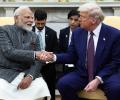
Prime Minister Narendra Modi on Saturday 'deeply' appreciated United States President Donald Trump's 'positive assessment' of the India-US partnership after the American leader hailed the 'special' relationship between the two nations -- remarks seen as an attempt to check the downturn in the ties.
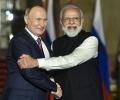
Russian President Vladimir Putin will travel to India in December, Kremlin foreign policy aide Yuri Ushakov said. Putin will meet Prime Minister Narendra Modi on the sidelines of the Shanghai Cooperation Organisation (SCO) Summit in China's Tianjin city to discuss the preparations for his visit to India.

India has rejected White House Trade advisor Peter Navarro's comments on New Delhi for its procurement of Russian crude oil, calling them 'inaccurate and misleading'. The relations between New Delhi and Washington are on a downturn after President Donald Trump doubled tariffs on Indian goods.
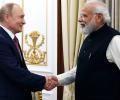
Russian President Vladimir Putin is expected to visit India around December 5 to hold annual summit talks with Prime Minister Narendra Modi to further solidify bilateral strategic ties.

Meeks, a ranking member of the House Foreign Affairs Committee Democrats, on Wednesday (local time) underscored "Congress' support for the US-India partnership," following his meeting with Indian Ambassador to the US Vinay Mohan Kwatra.

'The US values its relationship with India and under the strong leadership of President Donald J Trump and Prime Minister Modi, I am optimistic about the days ahead for both of our nations.'
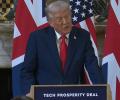
During a visit to the UK, former US President Donald Trump reiterated his claim of intervening to resolve a conflict between India and Pakistan, linking it to trade negotiations. He also discussed tariffs on India for buying Russian oil and the Russia-Ukraine conflict.
Trump administration's chief negotiator Brendan Lynch is arriving in India to hold talks on the India-US bilateral trade deal, which were impacted after the US imposed 50 per cent import tariffs on Indian goods.
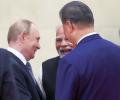
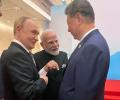
Navarro's remarks came after the public display of bonhomie by the three leaders on the sidelines of the Shanghai Cooperation Organisation (SCO) summit in Tianjin on Monday.

A senior Russian diplomat has called the US pressure on India for its procurement of Russian crude oil "unjustified," expressing confidence in continued energy cooperation between India and Russia despite external pressures.
India's brittle energy security is inextricably linked to two opposing paradigms - fossil fuels, and the transition to green energy. The first powers the present; the second paves the way for Viksit Bharat in 2047.

Indian envoy Vinay Mohan Kwatra discussed fair, balanced and mutually beneficial trade ties with US lawmakers amid ongoing tariff tensions between New Delhi and Washington.

'What we need to watch is how Saudi Arabia's financial assistance will be used by Pakistan. If the funds go to build their military hardware and operations, it should worry us.'

The Congress party has criticized Prime Minister Narendra Modi's description of India and the US as 'natural partners,' citing President Trump's claims of using trade as leverage in India-Pakistan relations. The remarks come amid ongoing trade negotiations and fluctuating relations between the two countries.

National Security Advisor Ajit Doval has travelled to Russia to hold crucial talks on bilateral energy and defence ties and to prepare ground for Russian President Vladimir Putin's visit to India later this year.
"So I think what happens is it's all bravado, because you think it feels good to fight with the biggest client in the world, but eventually your businesses are going to say you've got to stop this and go make a deal with America."
The relations between New Delhi and Washington are on a downturn after Trump doubled tariffs on Indian goods to a whopping 50 per cent, including a 25 per cent additional duties for India's purchase of Russian crude oil.

Vance also hinted that the US may drop additional tariffs on countries if the US make a deal with Russia, and also apply more tariffs on the countries to bring this war to a close.

External Affairs Minister S Jaishankar defends India's purchase of Russian oil, stating it is not the largest purchaser and that the US had previously supported such actions to stabilize energy markets. He also addresses concerns about tariffs and trade relations with the US.

'If nominal growth improves and earnings pick up, Indian stock markets could see a rally next year.'

NSA Ajit Doval has indicated that dates for Russian President Vladimir Putin's visit to India are being worked out during his meetings in Moscow. Discussions also covered bilateral energy and defence cooperation, amidst ongoing concerns over India's procurement of Russian crude oil.
He added that India sells to the US, its biggest "client", "massive" amounts of goods, "but we sell them very little - Until now a totally one sided relationship, and it has been for many decades."
Commerce and Industry Minister Piyush Goyal on Tuesday expressed hope that India will conclude the proposed bilateral trade agreement (BTA) with the US by the fall or November this year. He said that "a little bit" of geopolitical issues overtook the trade matters in the negotiations for the pact between the two countries.
Russia has a "special mechanism" to confront any challenge arising out of the US slapping punitive measures against India for its procurement of Russian crude oil, Russian charge d'affaires Roman Babushkin said on Wednesday.
Notably, US President Donald Trump and his administration have continuously targeted India over its purchase of Russian crude oil. India, on the other hand, has always maintained that India's purchases are based on its domestic needs and economic security.

India, the biggest contributor to world demand for oil, will bring into effect in an overhaul of its drilling policy. This comes after more than a year of preparation and will boost the exploration and development of India's oil and gas sector along with increased participation by foreign drillers
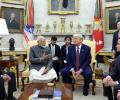
Trade, defence cooperation and regional strategy had long formed the backbone of India-US ties, but the latest rift shows how quickly those pillars can be shaken by personal grievances and political optics.
Crude and gas supply concerns have eased amid reports that Israel and Hamas have struck a peace deal. The International Energy Agency estimates oil demand may drop slightly in calendar 24 but Opec probably has enough pricing power to maintain $80/ barrel Brent prices. Russia's share of India's crude imports remained strong at about 35 per cent in September 2023.
India on Tuesday opened its largest oil and gas bid round, offering 25 blocks covering 1.91 lakh square kilometers mostly in offshore area, as the government looks to boost domestic production to cut imports and help energy security. Petroleum Minister Hardeep Singh Puri launched the 10th bid round under the Open Acreage Licensing Policy (OALP) at the India Energy Week (IEW) in Mumbai.
Notwithstanding the windfall tax placing a cap on profits, oil and gas producers like Oil India (OIL) and Oil and Natural Gas Corporation (ONGC) have done well in the October-December quarter (third quarter, or Q3) of 2022-23 (FY23). ONGC faces the drag of poor results from its subsidiary Hindustan Petroleum Corporation, and in comparative terms, OIL is better off. Standalone net sales in Q3FY23 stood at Rs 5,900 crore - up 57 per cent year-on-year (YoY), up 2 per cent quarter-on-quarter (QoQ).
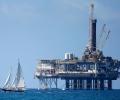
In a significant move, state-run oil producer Oil India Limited (OIL) has finished drilling its first well in the Andaman sea while Oil and Natural Gas Corporation (ONGC) has just started drilling operations in the area, said officials.

618 companies were part of the billion dollar club when the markets reached all-time highs on September 26, 2024. That number has fallen to 500 following a $1 trillion wipeout in India's market capitalisation amid relentless selling by FPIs.
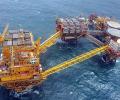
ONGC's overseas arm applied for a sanctions waiver to access $500 million dividend from two Venezuelan projects.

India, the world's third largest oil consuming and importing nation, spent 112.5 billion euro (about Rs 1.5 lakh crore) on buying crude oil from Russia since the start of the Ukraine war, a European think tank said on Thursday. The Centre for Research on Energy and Clean Air (CREA) released a report on payments to Russia for fossil fuels since February 24, 2022. "According to our estimates, since the beginning of the war, Russia earned EUR 835 billion in revenue from fossil fuel exports," it said.

Brokerages expect a further slowdown in Indian firms' revenue and earnings growth in Q4FY25, following low single-digit growth in the preceding three quarters, as factors like weak consumer demand and credit growth linger on.
