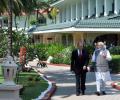
Big ticket defence deals including purchase of missile systems, frigates and joint production of helicopters were sealed on Saturday.

'Both Modi and Xi know that if all that there is to show for Modi's visit -- barely eight months after Xi's India trip -- is a repeat of the same old declarations, there will be a terrible sense of letdown in the public mood resulting in future summits losing credibility. Only the possibility of new ground being broken can justify Modi's trip at this time,' says B S Raghavan.
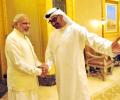
Apart from key bilateral issues, the two leaders also discussed situation in the region, particularly in wake of the increasing threat of terrorism and extremism from various sources including the Islamic State militant group.

Prime Minister Narendra Modi on Sunday thanked France and wrapped up his first visit to Paris that saw the two nations elevate their strategic ties to a new level as they agreed on a deal for 36 Rafale fighter jets and decided to move ahead with the log-jammed Jaitapur nuclear project.
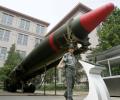
Despite four disarmament section talks and six strategic dialogues between the two foreign ministries, China's intransigence on recognising Indian nuclear status resulted in no confidence building measures in the nuclear field between the two, says Srikanth Kondapalli.

'Despite frequent high-level interactions there has been little traction on substantive issues between India and France,' says Mohan Guruswamy.

'China might soon have to seriously consider whether it prefers an Indo-US hyphenation to a Sino-Indian one.'

'This is the first time the US has formally recognised the threat India faces from terrorist organisations based in Pakistan.'

Prime Minister Narendra Modi and United States President Barack Obama will meet on Sunday, January 25, at Hyderabad House a few hours after the American leader's arrival in New Delhi.

Immediate NSG membership will not help India realise its nuclear ambitions any faster. It could have easily left the process take its own course, instead of running a high-stakes campaign to get in, says B S Raghavan.

In a spontaneous outpouring of grief, thousands of people bid an emotional farewell to former President APJ Abdul Kalam who was on Thursday laid to rest with full state honours in his home town here amid chants of "Bharat Mata Ki Jai".

'Well begun is half done, today there are more hits than misses by the Modi government in its support towards science in India,' says Pallava Bagla.

'President Obama will make a historic visit to India in January, becoming the first US head of State to attend India's Republic Day and the only sitting US president to visit India twice.' 'There's little doubt the relationship has been re-energised, with renewed enthusiasm to take our partnership to the next level.'

Secretary Tillerson met with Foreign Secretary Jaishankar on Friday to discuss the US-India relationship and the agenda for Prime Minister Modi's meetings at the White House on June 26, a State Department spokesman said told PTI.

20 years ago this day, May 11, 1998, India conducted its second nuclear test at Pokharan in Rajasthan. In a fascinating interview on Rediff.com, K Subrahmanyam revealed how Indian PMs reacted to nuclear ambitions.
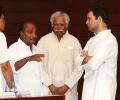
'Antony and I have been friends for over half a century, and I know the man does not tell lies. The problem is that what he believes to be the truth might not actually be true. He may believe that India needs the Congress, and that the Congress in turn needs the Nehru-Gandhi family, but that does not mean that India shares those articles of faith,' says T V R Shenoy.

Amid souring ties, the president visited Beijing for three days. On his return to India, a hope of better ties has arisen, says senior correspondent R Rajagopalan, who travelled with Pranab Mukherjee to the Asian superpower.

R S Sundar, the site director of KNPP, on how the plant is producing 1,000 MW of nuclear power, the largest in the country.

Modi's visit to some developed countries such as the US, Japan, China and Australia were sprinkled with humongous investment figures. But do we have the wherewithal to absorb such big investments?
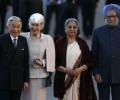
In recent years India-Japan relations have acquired rich economic content and strategic intents. Although the bilateral trade at $18 billion between the two countries is not very impressive and leaves much to be desired, the economic engagement between the two countries is both qualitatively and quantitatively noteworthy. India-Japan defence cooperation, however, has generated a lot interest among the strategic community in the context of rise of China. There has been a lot of speculation about India-Japan strategic partnership to hedge China, says Rup Narayan Das.
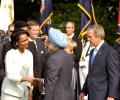
The night before Dr Singh was to meet President Bush, he said he could not sign the agreement.

The growth story of India depends on its achievements in the S&T sector. There is a need to revolutionise the landscape of Indian science and technology and this is only possible if the scientific community is allowed to work 'professionally and scientifically' without burdening them with the baggage of the past, says Ajey Lele.

In spite of irritants and hiccups in the relationship, a few deliverables are expected of the prime minister's visit to China, says Rup Narayan Das.

Moving ahead with their new mantra -- Chalein Saath Saath: Forward Together We Go -- Prime Minister Narendra Modi and United States President Barack Obama on Tuesday vowed to deepen cooperation in every sector for the benefit of global stability and people's livelihoods over the next ten years.
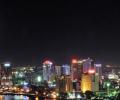
Vietnam is a key player in India's act east policy under Prime Minister Narendra Modi. From India's perspective, a strategic partnership with Vietnam will only deepen political, economic, and security ties and be a bulwark against China, say Melissa S Hersh and Dr Ajey Lele

The two countries also asked all nations to stop cross-border movement of terrorists and asserted that a decisive collective response from the international community without 'double standards and selectivity' was required to combat the threat of terrorism.

Prime Minister Narendra Modi's visit to South Korea is considered essential in strengthening defence ties, enhancing economic cooperation and forging cultural ties between the two countries, says Dr Rahul Mishra
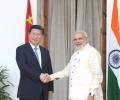
With the continuing stand-off in Ladakh casting a shadow over the Sino-India talks, Prime Minister Narendra Modi on Thursday raised 'serious concerns' over the repeated incidents along the border and sought an early settlement of the boundary question.

The Nobel Prize for Malala may have caused deep divisions across the globe and disturbed the peace, while the award to OPCW, though not without critics, may have served the cause of peace by eliminating a weapon of mass destruction from the face of the earth, says Ambassador T P Sreenivasan.

'The question remains: Was the Obama visit truly a success? Only the future will tell us if the "breakthrough" in the nuclear liability issue will concretise into electricity.' 'As importantly, it will be interesting to watch how India's relations with China will evolve in the months to come.'

The joint statement issued after Prime Minister Narendra Modi and President Barack Obama's first-ever summit is high on intent and ambition. Notably missing from the statement is India's refusal to be America's partner in its war against ISIS.
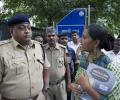
It is regrettable that the IB has tried to devalue the expertise available both within the concerned ministry and in the scientific community by its allegations. Governments and NGOs in many western nations have not been accused of being 'anti-national' when they put their foot down on questionable practices by cash rich agri-business companies, says Rashme Sehgal.
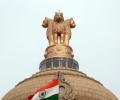
Delhi's inability to open up a new canvas with Pakistan and Sharif is symptomatic of its sluggish thinking. Jyoti Malhotra analyses

Almost every home in this area has a slogan 'Jal, Jangal, Jameen' painted outside. Rashme Sehgal reports for Rediff.com on the four-year battle to save the Mahan forest in Madhya Pradesh.

Why are so many people so reluctant to give up on Arvind Kejriwal? The simple answer is 'Narendra Modi', or rather the fear of Narendra Modi,' says T V R Shenoy.

The city readies itself for the biggest economic, political and social event of the year
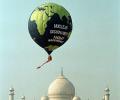
Muzzling NGOs is unbecoming of a democracy. Self-confident democracies encourage, indeed applaud, the involvement of citizens' associations, including NGOs, in social and political decision-making and development planning. Instead, our paranoid government bullies and terrorises them, says Praful Bidwai.
In the near term, the key driver will still be the government's fiscal spending.

Prime Minister Narendra Modi on Thursday address Members of the British Parliament in London where he promised to open more doors of cooperation between the two countries and delved on issues like terrorism and United Nations reforms.

PM Modi addressed the Sri Lanka Parliament on Friday.
 © 2026 Rediff.com - Advertise with us - Disclaimer - Privacy Policy - Sitemap - Feedback - About us - Terms of use - Grievances