
Finance Minister Nirmala Sitharaman has called upon Indian industry to prioritise not just scale but also resilience, better governance, and deeper technological capabilities to achieve the 'Viksit Bharat' goal by 2047.

Finance Minister Nirmala Sitharaman has urged the Reserve Bank of India to accelerate its central bank digital currency initiatives, emphasising the need to sharpen capabilities with the digital rupee amidst rapid advancements in tokenisation, agentic AI, and quantum computing. She also highlighted critical concerns regarding cybersecurity, warning that autonomous AI systems are evolving rapidly and require robust safeguards. Sitharaman proposed a federated industry platform to give India's technology ecosystem a collective international voice.

We know what Mrs Sitharaman and Mr Chaudhary (who may soon be moving out of the finance ministry to head to Lucknow to take charge as president of the Bharatiya Janata Party's Uttar Pradesh unit) look like, but who are the others in these photographs?
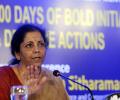
Finance Minister Nirmala Sitharaman announced that India's real GDP grew by 7.8 per cent in the April-June quarter, surpassing the RBI's forecast. She attributed this strong performance to government reforms and agile economic management, reaffirming the government's commitment to expanding economic opportunities.

Union Finance Minister Nirmala Sitharaman called upon 'Gen Z' and 'Gen Alpha' to assume leadership, prioritise the nation, and contribute to its growth, rather than questioning what the country has done for them.

Union Finance Minister Nirmala Sitharaman has accused the TMC government in West Bengal of preventing the implementation of central welfare schemes, depriving the state's residents of benefits such as Ayushman Bharat and PM Kisan.
Finance Minister Nirmala Sitharaman has called for enhanced accountability and safeguards for artificial intelligence, particularly as it integrates into critical sectors like finance. Speaking at the Global Fintech Fest, she highlighted the dual nature of AI, capable of accelerating transactions but also amplifying fraud and cyberattacks. Sitharaman stressed the need for human and institutional responsibility in AI-driven decisions, urging regulators and companies to scrutinise high-risk AI applications. She also proposed a federated industry platform for Indian tech companies to navigate international regulations and ensure tax compliance globally.
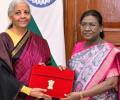
Union Finance Minister Nirmala Sitharaman is well-known for donning saris that speak as powerfully as her budget speech. Each Budget Day, she selects a drape that pays tribute to India's amazing textile heritage and the mastery of its artisans.

Finance Minister Nirmala Sitharaman's biggest challenge will be to find a new growth driver, particularly against the backdrop of a global economy ravaged by heightened uncertainty and fragmentation, financial markets on a precipice, and global commodity prices on a continued uptrend.
Finance Minister Nirmala Sitharaman criticised commentators who express pessimism about India's demographic dividend, asserting that the country's youth are actively driving economic growth and innovation. She also highlighted the dual nature of AI and the need for robust safeguards in emerging technologies like quantum computing to balance innovation with safety.

Finance Minister Nirmala Sitharaman stated that India is likely to sustain economic growth of 7 per cent or more in 2026-27, continuing the pace recorded since the Covid-19 pandemic, despite geopolitical uncertainties and supply-chain disruptions.
A high-level committee, including representatives from banks and payment associations, is set to decide on Merchant Discount Rate (MDR) for UPI transactions exceeding Rs 2,000 to merchants. While person-to-person and person-to-merchant transactions up to Rs 2,000 remain free, the move follows a recent amendment to the Payment and Settlement Systems Act, sparking debate and clarification from the Finance Minister that only certain high-value merchant transactions might incur charges.

A high-level meeting of Union ministers, including Amit Shah, Rajnath Singh, S Jaishankar, and Nirmala Sitharaman, along with National Security Advisor Ajit Doval, was held at the Prime Minister's Office in Parliament to discuss crucial matters.

From a milk abhishek and aarti in Patna and Vadnagar to blood donation camps in Delhi, sand art tributes in Puri and Agartala, and havan pujas in Jammu, BJP leaders and others nationwide honoured the occasion of Prime Minister Narendra Modi's 76th birthday with prayers, service drives and tributes.
A Delhi court refused Union Finance Minister Nirmala Sitharaman's request to prevent AAP leader Somnath Bharti from representing his wife in a defamation case filed against Sitharaman.

A trade body in Jharkhand, FJCCI, has urged the Union Finance Minister to withdraw the proposed 0.4% Merchant Discount Rate (MDR) on UPI transactions above Rs 2,000 for merchants. The body argues that this charge will significantly increase operating costs for businesses, especially MSMEs and retailers, who rely on the current zero-MDR regime for digital payments.

The Congress party has criticised the government's recent notification regarding UPI transactions, alleging it paves the way for users to be charged fees, particularly for transactions above Rs 2,000. The party claims the government lacks transparency and questions if the move is to benefit American firms. The government, however, states that charges are necessary for the system's sustainability and infrastructure upgrades, with the Finance Minister clarifying that Merchant Discount Rate (MDR) applies to merchants, not customers.

Finance Minister Nirmala Sitharaman urged PSBs to become 'cool' and shed their 'government bank' image to attract young customers.

Congress leader Rahul Gandhi has accused the Modi government of quietly paving the way for imposing fees on UPI transactions, alleging it's a surrender to American pressure. The government's recent notification exempts charges only up to Rs 2,000, sparking concerns that higher value transactions and eventually all UPI payments could incur fees. Finance Minister Nirmala Sitharaman, however, clarified that Merchant Discount Rate (MDR) applies to merchants, not customers, and supports digital infrastructure.

Finance Minister Nirmala Sitharaman announced that the Goods and Services Tax (GST) Council's October 7 meeting will focus on 'GST 2.0' process reforms, including e-invoicing and input tax credit rules, while also addressing complex issues surrounding the taxation of the digital economy and cryptocurrency.

Essel Group founder Subhash Chandra has called for an independent audit to examine the group's borrowings, defaults, and repayments, stating that approximately 43,000 crore of its 45,000 crore total debt has been repaid.

Chinese President Xi Jinping notably skipped a gala dinner hosted by Prime Minister Narendra Modi for BRICS leaders and other dignitaries, with sources suggesting he returned to his hotel to rest. Meanwhile, a grand cultural performance, 'BRICS Symphony - One Rhythm, Many Cultures', featuring artistes from member countries, was a highlight of the evening.
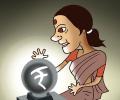
Finance Minister Nirmala Sitharaman clarified that the Merchant Discount Rate (MDR) on digital transactions applies to merchants, not customers, and aims to support banks and fintech in infrastructure investment. She countered Congress leader Jairam Ramesh's claims, stating that a committee will decide on MDR only after Parliament passes the Taxation and Other Laws (Amendment) Bill, 2026, a process currently stalled by parliamentary disruptions.

Union Finance Minister Nirmala Sitharaman announced the government's plan to establish a high-powered committee to examine reforms for the banking sector, aligning it with the vision of a 'Viksit Bharat' (Developed India) and India's next phase of growth.
The Rajya Sabha has passed The Bankers' Books Evidence Bill, 2026, which aims to replace a British-era law and allow digital and virtual records to be admissible as evidence in courts. This legislation aligns with contemporary digital banking practices and extends a uniform evidential framework to various financial entities, including NBFCs and fintech companies. Finance Minister Nirmala Sitharaman highlighted the bill's role in strengthening public confidence and safeguarding customer privacy. The bill's passage, however, saw an Opposition walkout over unrelated issues.

The Congress party has accused the Indian government of imposing new charges on UPI transactions due to pressure from the United States, specifically to benefit American card companies. The opposition party demanded the withdrawal of the decision, calling it "anti-national" and alleging it fills the coffers of US firms while burdening Indian citizens. The government, however, clarified that the Merchant Discount Rate (MDR) charges apply only to commercial transactions above Rs 2,000 and are not levied on consumers, a stance supported by the BJP which accused Congress of spreading "fake news".

'We kept this Budget on a larger plank, rather than on one incident, however serious.'

Finance Minister Nirmala Sitharaman has urged income tax authorities to significantly accelerate the adjudication of taxpayer appeals.
The Payments Council of India has confirmed that Unified Payments Interface (UPI) services will continue to be free for consumers and small merchants, despite a recent Lok Sabha Bill. This clarification addresses concerns about potential charges, emphasising that while a sustainable financial model for UPI infrastructure is being developed, transaction charges will not be passed on to users or small businesses.

Finance Minister Nirmala Sitharaman on Sunday makes history as she presents a record ninth consecutive Budget that is expected to unveil measures to sustain growth momentum, maintain fiscal discipline, and contain reforms that could buffer the economy from global trade frictions, including US tariffs.

Sitharaman took charge of the Finance Ministry on May 31, 2019, and has steered the economy through the COVID-19 pandemic and geopolitical turmoil, making India the fastest-growing major economy in the world.

'Grassroots-level corruption, which disrupts the last-mile work, cannot be ignored in your enthusiasm and drive to get going to complete the project.' 'Like it was in MGNREGA, in some states, it is the case with the Jal Jeevan mission.' 'The last minute levels of corruption can ruin the intent of the project itself.' 'When you see that people can game a particular well-intended and well-crafted project, you need to correct that.'

For the second time in two years, Karnataka minister B Nagendra resigned from the state Cabinet on Friday amid the Opposition heat over his alleged involvement in the Rs 89 crore Valmiki Corporation scam.

Economists highlight that resolving domestic policy bottlenecks, particularly through land reforms and improving the ease of doing business, will be critical for Prime Minister Narendra Modi's 'next-generation reforms' and India's economic transformation towards its 'Viksit Bharat' vision for 2047.

Prime Minister Narendra Modi has called upon citizens to celebrate Independence Day with honour and pride, urging them to take a pledge for a developed India. This appeal comes amidst parliamentary sessions marked by protests from both ruling and opposition alliances.

Prime Minister Narendra Modi on Thursday discussed with a group of senior ministers the prevailing global security situation and how to maintain supply chain uninterrupted despite conflicts in different zones, including the Strait of Hormuz, the Black Sea, the Red Sea, and the Gulf of Aden.

Inflows into foreign currency non-resident (bank), or FCNR (B), deposits have significantly underperformed market expectations, leading to a more than 1 per cent depreciation of the rupee against the dollar this week. Analysts point to fading RBI support measures, tepid interest due to rising global bond yields, and narrowing interest rate spreads compared to 2013 as key challenges.

The Lok Sabha has passed a Bill to amend the Payment and Settlement Systems Act, 2007, authorising the government to permit banks and service providers to levy charges on UPI and other electronic payment modes. This move aims to create a sustainable revenue model for the digital payments ecosystem, shifting from the current exemption of UPI transactions from such charges.

Chandrasekaran's exit is more than a change of chairman. It represents the breakdown of the informal consensus that governed the Tata system under Ratan Tata.

N Chandrasekaran, chairman of Tata Sons, announced he would not seek reappointment when his term ends in February 2027, following a series of departures by senior figures closely associated with former chairman Ratan Tata, including Vijay Singh and Mehli Mistry, amid a deepening power struggle and governance dispute within the Tata Group.
