

The graphic above shows the level of education in households across India along with reasons for discontinuing or never enrolling in an educational institution.
Crisil Research expects retail inflation to rise 60 basis points to 4 per cent this fiscal from 3.4 per cent in 2018-19.

Retail inflation rose marginally to 9.84 per cent in September, mainly due to a hike in food prices, particularly of vegetables.

While overall employment rose from 456 mn to 463 mn between FY11 and FY15, with farm employment falling by 26 mn over the same period, the net addition to employment over the entire four year period was a mere 7 mn.

The substantially increased economic dualism may exert lasting negative influences which could include a reduced potential for economic growth; the persistence of a very weak employment and poverty situation; rising social and political discord; and heightened vulnerability to geopolitical challenges, cautions Shankar Acharya, former chief economic adviser to the Government of India.

The employment rate in the country declined marginally from 39.2 per cent to 38.6 per cent between 2009-10 and 2011-12, the Rajya Sabha was informed on Wednesday.

The statement comes in the wake of two independent members of the NSC, P C Mohanan and J V Meenakshi, quitting the Commission over disagreements with the government on the back-series GDP data and delay in release of labour force survey. Mohanan was also the acting chairperson of the Commission.

The pace of retail price rise in January 2016 is the highest since 6.46 per cent in September 2014.
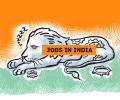
The problem of unemployment is spread across the economy.

At present, 27 per cent quota in government jobs and educational institutions is given to OBCs, provided the annual income of the family is up to Rs six lakh. Those with higher earnings are referred to as the 'creamy layer' and are not eligible for reservation.

With the two members quitting, the NSC now has only two members -- Chief Statistician Pravin Srivastava and NITI Aayog CEO Amitabh Kant.

The NSSO had enumerated 79,306 households in rural areas and 45,374 in urban regions.

The Congress president tagged a Business Standard story which cited a report which said the unemployment rate is highest in 45 years.

The plan includes step-wise expansion of a crucial credit guarantee net, establishment of an unprecedented number of functional clusters and increased government procurement from MSMEs.
.jpg)
Access to private hospitals is a costly affair.
The government's decision to release the reports comes two days after over 200 scholars from across the globe issued a statement demanding release of all withheld reports produced by the NSO, including the household consumer expenditure survey that was junked.

'Crony capitalism will gain due to these Acts.'

Anik Jain, founder and CEO at Symbo, will answer your questions on insurance -- life, health, motor, travel, etc -- on a weekly basis.

Unless we bring about substantive changes, we cannot expect to alter the current situation where low-productivity and low-wage jobs dominate the landscape, the government think-tank observes.

'A growth of above 7 per cent when the fundamentals of the economy are becoming stronger still makes India the fastest growing large economy.'

Costlier fruits and vegetables such as onions and tomatoes pushed retail inflation to a nine-month high of 11.24 per cent in November, making it harder for the Reserve Bank to lower interest rates.

The implication of a slowdown in the financial services sector are very different (eg, likely to affect fewer people directly, and even that affecting those at the top of the income distribution) from that of a slowdown in construction, one of the most employment intensive sectors in the Indian economy (that will affect aggregate demand much more).'
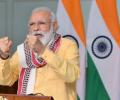
Aakar Patel looks forward to Prime Minister Modi's speech at the bhoomi pujan for the Ram temple in Ayodhya next week. It will be entertaining and stirring, predicts Aakar, and make lots of promises that he most likely won't be able to keep.

In the run-up to the polls, a survey has revealed that better employment opportunities is the single most important issue for citizens and that the government has fared below average in this aspect.
Most economists were of the view that the NSSO should release the data, as any move to withhold it will dent the image of country's statistical system.
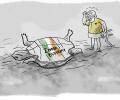
Even in this darkest hour of a crumbling economy and raging disease, there is hardly a murmur of protest against the government, observes Sumit Bhattacharya.

7 million jobs will be created in formal sector in FY18

This survey also shows how things have moved forward since the last large-scale sample survey conducted by NSSO in 2012-13

According to NSSO, more than half of India's working-age population is out of labour force. In 2017-18, the youth unemployment rate was in the range 13.6-27.2 per cent.

It said 33,510 slums were estimated to be in the urban areas of the country of which 41 per cent were notified.

Terming the rise in October retail inflation despite a bumper crop as "disturbing", India Inc said the government must immediately address supply side bottlenecks to bring down the consumer price inflation.
.jpg)
Between FY05 and FY12, rural poverty declined at 2.3 per cent per annum and urban at 1.69 per cent.
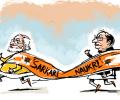
'...because of its permanent nature.' 'If you work for the private sector or for yourself, you are not regarded as being employed,' points out T C A Srinivasa Raghavan.

While players in the financial ecosystem are opening up to the idea of receivables funding for the sector, this market needs a regulator, which a Parliament panel feels only RBI can provide.

The Survey says that present skilled workforce in India is only 2%.

Despite all of the PM's many strengths, it is increasingly clear that he does not necessarily have a coherent and clear worldview on matters of macro policy.
The change in the baseline for IIP and WPI, currently at 2004-05, is expected to bring in more accuracy in mapping the level of economic activity and calculating other numbers like national accounts.
