
The minimum temperature in Delhi was recorded at 28.6 degrees Celsius, according to the India Meteorological Department (IMD).

Delhi's air quality deteriorated significantly on Monday, with areas like Dwarka, Mundka and Najafgarh recording an AQI of 500, the worst this season. The city's overall AQI reached 491, triggering the implementation of the Graded Response Action Plan (GRAP) Stage-IV restrictions in Delhi-NCR. Doctors warned of health risks, urging people to wear N95 masks and avoid outdoor activities. The Supreme Court questioned the Delhi government on its anti-pollution measures and warned against scaling down preventive measures without its permission. Delhi Chief Minister Atishi accused the BJP-led central government of political maneuvering while neglecting stubble burning in states it governs. Meanwhile, the city enforced stricter pollution control measures, including a ban on truck entry and suspension of construction activities. Air purifier sales surged, reflecting the public's concern over the severe air pollution.

India's GDP is likely to grow at 6.5 to 7 per cent in the current fiscal year amid global challenges which may impact exports, said Economic Survey 2023-24 tabled in Parliament on Monday. The growth projected for 2024-25 is lower than the economic growth rate of 8.2 per cent estimated for the previous financial year. The Reserve Bank has projected the GDP growth for the fiscal year ending March 2025 at 7.2 per cent.

As weather patterns grow more unpredictable due to climate crisis, India is taking a giant leap with "Mission Mausam" to improve weather understanding and forecasting through expanded observation networks, better modeling and advanced tools like AI and machine learning.

IMD officials said the maximum temperature in the three districts could go up to 38 degrees Celsius.

The city's 24-hour Air Quality Index, recorded at 4 pm every day, stood at 418, up from 334 the previous day, and it may trigger stringent restrictions under the third stage of the graded response action plan to mitigate hazardous conditions.

All 80 people stuck at Pali waterfall in Goa's Sattari taluka were rescued on Sunday by the state's Fire and Emergency Services and the police, an official said.

Incessant rains with intermittent spells of moderate to heavy showers since Friday morning have slowed down public transport services and traffic in Mumbai.

Intermittent, widespread rains lashed Chennai and other regions of Tamil Nadu on Tuesday and the India meteorological department said the low pressure area over the Bay of Bengal has turned into a well-marked low pressure area and it is likely to become a depression.

The situation in rain-battered Gujarat improved slightly on Thursday as the rainfall activity subsided, but Vadodara and some other parts of the state are still reeling under a flood-like situation due to overflowing rivers while the authorities continue the rescue and relief operations.

Delhi sweltered under intense heat as the Safdarjung observatory, considered the official marker of the national capital, noted a high of 43.8 degrees Celsius, four notches above the normal average.

The landfall process of the severe cyclonic storm Dana was complete on Friday morning and the system took at least eight and half hours to enter the landmass, India Meteorological Department (IMD) said.

After a long and harsh spell of heatwave, Delhi witnessed a pleasant morning on Thursday, with the weather department saying parts of the national capital received light rains.

The government on Wednesday raised the minimum support price (MSP) for paddy by 5.35 per cent to Rs 2,300 per quintal for the 2024-25 kharif marketing season. The hike in paddy support price comes despite the government sitting on surplus rice stocks, but it is significant ahead of elections in states like Haryana, Maharashtra, Jharkhand, and Delhi.

Local people had hoped that all the floodwater would be cleared by Friday but the opposite occurred.

India experienced its second-hottest quarter from June to August this year since 1970, with over one-third of the country's population enduring at least seven days of dangerous heat, according to a new report by a United States-based group of climate scientists and communicators.

As Odisha and West Bengal are bracing for a severe cyclonic storm, governments of both states started evacuating people and while deciding to close educational institutions in vulnerable areas.

The Mumbai civic body and police have advised all people in the city and surrounding areas to stay indoors as much as possible.

India recorded around 16 per cent more rainfall than normal in August, with rainfall over Northwest India recorded at 253.9 mm, the second highest in August since 2001, the India Meteorological Department (IMD) said on Saturday.

At least 10 flights scheduled to land at the Delhi airport were diverted -- eight to Jaipur and two to Lucknow -- due to inclement weather conditions. Airlines also warned of the possibility of more flight disruptions.

Tomato prices have been on the boil for more than a month. Data from major cities show that the spike has been between 125 and 150 per cent at the wholesale level. Soaring vegetable prices, including tomatoes, pushed the retail inflation rate to a nine-month high of 5.49 per cent in September, according to government data. Though reports say prices are expected to come down in the next few weeks after supplies improve from Madhya Pradesh and Himachal Pradesh, how long will the respite last is anybody's guess.
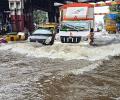
Flight services at Mumbai airport were severely impacted on Monday due to low visibility after heavy rains in the city, leading to runway operations being shut for over an hour and approximately 50 flights being cancelled, sources said.

Spurred by cyclone Remal, the southwest monsoon set in over the Kerala coast and parts of the northeast on Thursday, a day earlier than forecast by the weather office.

The IMD said that rainfall over India in August and September would be around 106 percent of the long-period average of 422.8 mm.

The India meteorological department (IMD) on Wednesday evening issued a red alert for Mumbai and its neighbouring districts, predicting "extremely heavy rainfall".

Heavy rains continued to lash several parts of Kerala on Thursday, leading to waterlogging in the low-lying areas of major cities, including Thiruvananthapuram, Kochi and Thrissur.

Sri Lanka meteorological department predicts better weather in coming days
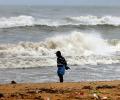
Heavy rains continue to lash several parts of Andhra Pradesh as the severe cyclonic storm 'Michaung' looming over the Bay of Bengal sea close to Andhra Pradesh and adjoining Tamil Nadu coasts is moving closer by the hour to its landfall area.

Among the fatalities recorded on Friday, the maximum 17 were from Uttar Pradesh, 14 from Bihar, five from Odisha and four from Jharkhand, where officials said more than 1,300 people are hospitalised with heatstroke conditions.

Srinagar recorded the maximum temperature of 35.6 degrees Celsius on Wednesday, the highest temperature in the month of July in 25 years since 1999 when the mercury had settled at 37 degrees Celsius, the officials said.

In view of the widespread rains and 'red alert' for extremely heavy showers issued by the India Meteorological Department (IMD) for several districts, control rooms are working round the clock to monitor the situation and help stranded people, he said.

He said scientists have noticed a trend of very deep cloud systems developing over the southeast Arabian Sea, and added that sometimes, these systems intrude into the land, like in 2019.

Western Railway stated that local train services were running normally on Monday morning, however, commuters claimed trains were running late by 5 to 10 minutes.

Flight operations at Chhatrapati Shivaji Maharaj International Airport were suspended twice for a brief period due to inclement weather and low visibility, a source said.


This is the first cyclone in the Bay of Bengal this pre-monsoon season.

Andhra Pradesh Chief Minister N Chandrababu Naidu and his Telangana counterpart Revanth Reddy visited some inundated areas in their respective territories.

As Cyclone Dana barrels toward the coasts of Odisha, threatening to impact nearly half of the state's population, the government is racing against time to execute a massive evacuation plan aimed at relocating about 10 lakh people in several coastal districts to safety. In West Bengal, the cyclone is set to bring heavy rainfall in several southern West Bengal districts, including Kolkata, the India Meteorological Department (IMD) has said.
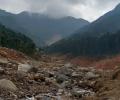
There is a definite attempt to put the landslides on the backburner because news of them and climate change worry Wayanad's tourism and real estate businesses greatly. Whatever I experienced of Wayanad's 2024 by-elections; the July landslides were not a burning issue, observes Shyam G Menon.

India is likely to see above-normal maximum and minimum temperatures in most parts of the country in the March to May period, IMD director general Mrutyunjay Mohapatra said at a press conference.
 © 2026 Rediff.com - Investor Information - Advertise with us - Disclaimer - Privacy Policy - Sitemap - Feedback - About us - Terms of use - Grievances