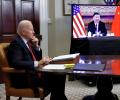
The highly-anticipated summit, which began early Tuesday, is the third engagement between Xi, 68, and Biden, 78, since February.

'The supreme art of war is to subdue the enemy without fighting.' Former RA&W official Jayadeva Ranade explains what China's military reforms mean for the world.

Here's this week of photos that prove we live in a mad world.
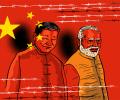
'It is time we Indians stop our internal bickering and present a united front to Chinese machinations,' advises Colonel Anil A Athale (retd).
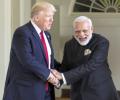
India must be aware that there is no question of the US fighting the Chinese on land. We have to fight our own battles, points out Virendra Kapoor.
The reasons for China's negative response are located in its territorial dispute with India but also to its grand designs of dominating the region from its previous position of being merely a "balancer" between India and Pakistan, points out Srikanth Kondapalli, Professor in Chinese Studies at JNU.

Protesting against enforced disappearances in Balochistan, Abdul Qadeer Baloch, 72, has led a small group that has covered more than 2,000 kilometres on foot, breaking the 84-year-old record set by Mahatma Gandhi during his Dandi march. Hamid Mir reports from Islamabad.

'India need to look beyond the economic prism.' 'China had no qualms in taking the Kashmir issue to the UN Security Council last year -- not once, but thrice -- thus violating Indian sensitivities,' observes China expert Srikanth Kondapalli.

Xi Jinping is winning the war without firing a shot in Sri Lanka, observes Colonel R Hariharan (retd).

On December 10, Kissinger began to encourage the Chinese to take action against India: 'If the People's Republic were to consider the situation on the Indian subcontinent a threat to security, and if it took measures to protect its security, the US would oppose efforts of others to interfere with the People's Republic.' On the 50th anniversary of India's greatest military victory, Claude Arpi recalls how the US suggested that China intervene militarily on Pakistan's side.

We have our own problems for sure and they are not trivial, but for now, our economy is in not too bad a shape, our politics is as personality-driven and authoritarian as that of most countries in the world. We must make the best of what we have and not be excessively unhappy looking at the grass on the other side of the septic tank which may not be greener after all!, observes Shreekant Sambrani.
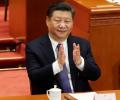
"We should safeguard the sovereignty and territorial integrity of the country and achieve full unification of the motherland. This is the aspiration of all Chinese people. This is also in line with fundamental of the Chinese nation," he said in an apparent reference to Taiwan which China claims as part of it.
Xi has already been elected as general secretary of the ruling Communist Party of China at its once-in-five-year congress in October last year.

New Delhi must clearly demonstrate to Beijing that China will pay a price for its relentless strategic undermining of India, says Ajai Shukla.

The spiritual leader on Saturday addressed devotees speaking to them about the pratices of Boddhisattavas at the Yid GaChosin monastery in Tawang, Arunachal Pradesh.
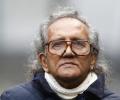
Aravindan Balakrishnan, a 75-year-old Indian-origin man who ran a secretive extremist Maoist cult in London, was on Friday sentenced to 23 years in jail by a UK court for a string of sexual assaults.

'Two years ago, had I been given even a tiny hint that my genes were tipping the scale for the development of a disease that would lock me into my body, unable to move or breath normally on my own, I would have been sad, and probably mad.' 'So now I'm running as fast as I can -- from my wheelchair.' P Rajendran on the amazing but brief life of Rahul Desikan, medical pioneer.

This week's collection of unbelievably unusual images from across the world

A 75-year-old Indian-origin Maoist cult leader was on Friday found guilty of rape, child cruelty and falsely imprisoning his daughter for 30 years by a British court.

Making waves with trade deals worth billions of dollars during his first European tour, President Xi Jinping put up a strong defence of the monopoly of power by the Communist Party of China saying that China had settled for a one-party system after unsuccessful experiments with multi-party democracy.
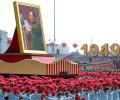
'The leadership is confronted with an economy growing at its slowest pace in 20 years,' points out Claude Smadja.
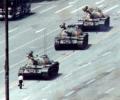
Why omit the Tiananmen massacre from the history of China's Communist party, asks Claude Arpi.
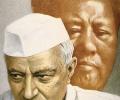
'Hindi-Chini Bhai Bhai? Don't you believe it. I don't trust the Chinese one bit,' Nehru told Gopalaswamy Parthasarathi before he traveled to China as India's ambassador. Asking GP to be ever vigilant, Nehru advised the diplomat to send telegrams on important matters only to him. Many such anecdotes from a long and eventful career as diplomat and bureaucrat crowd the pages of GP: 1912-1995, discovers Uttaran Das Gupta.
'China physically occupies about 45,000 sq km of J&K as claimed by India, including 3,000 sq km captured in the 1962 War and never returned; and 5,180 sq km ceded to China by Pakistan in 1963.' 'It is hard to justify remaining silent about the return of China occupied Ladakh,' observes Ajay Shukla.

Xi ordered country's 2.3 million-strong military to be absolutely loyal to the party, to focus on how to win in wars, to pioneer reforms and innovation, to scientifically manage commanding a unit, to lead troops in accordance with the strictest standards and to take the forefront in complying with laws and regulations.
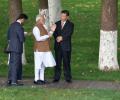
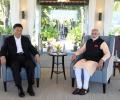
'The meeting marks the first tentative step in the effort to understand whether the two largest Asian nations can co-exist peacefully while realising their aspirations.' 'Caution and watchful wariness will dominate the effort of both sides,' says Jayadeva Ranade, former RA&W officer and China expert.
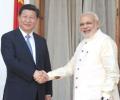
The summit is being seen as an effort by India and China to rebuild trust and improve ties that were hit by the 73-day-long Doklam standoff last year.

He praised the PLA's combat readiness.

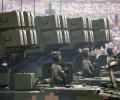
Chinese President Xi Jinping on Sunday said the People's Liberation Army has the confidence and capability to defeat all invading enemies as he inspected a massive military parade at the country's largest military base to mark the 90th founding anniversary of the 2.3-million strong army.

'Xi's assumption of absolute power is neither complete, nor irreversible.' 'Nor is it safe, for Xi, for his party, or for his country more generally.' 'And the government knows this,' says Mihir S Sharma.
The first priority for the new Tibetan administration in Dharamsala should be to look at Tibetan recruitment in the PLA, suggests Claude Arpi.

No new ideas, please, we are Indian. Seventeen years into the 21st century, we are still fixated by the ideas of the 20th century.

'Chinese troops are not geared to fight Indian troops who are battle hardened and acclimatised and are far more hardy.'
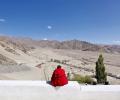
We should have anticipated it on August 5 last year, when we made the big changes in J&K. Amit Shah left nothing to chance when he told Parliament that 'we will bring back Aksai Chin even at the cost of our lives'. 'Then, there were the new maps, objections to the CPEC going through Indian territory, the weather reports.' A broad territorial status quo had existed in Ladakh-Aksai Chin since 1962. India made its intention to change this public, notes Shekhar Gupta.
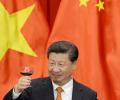
President Xi Jinping was on Thursday elevated as the "core leader" of China's ruling Communist Party, conferring on him a status similar to that of party founder 'Chairman' Mao Zedong that dilutes the three-decade-old collective leadership principle to avoid personality cult.

What's worse than watching someone take a million selfies?
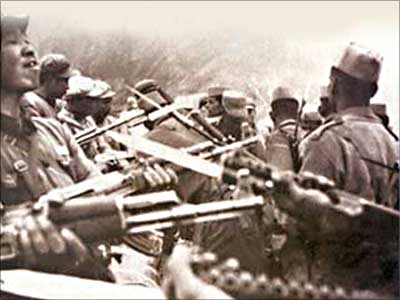
From March 1959 to March 1962, the PLA fought 12 major battles in central Tibet which was seen as an opportunity to train China's soldiers, notes Ajai Shukla.

Thursday's Lok Sabha elections will be a landmark for Tibetan youth as they finally get the right to vote in their adopted homeland, reports Anshul Gupta.

The Chinese air force is now a 400,000-person force that flies some 2,000 combat aircraft -- more than thrice the size of the Indian Air Force.

India was fooled into believing that Communist China wanted a 'negotiated' settlement with the Tibetans; it was never the case, says Claude Arpi.
