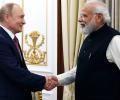
Russian President Vladimir Putin is expected to visit India around December 5 to hold annual summit talks with Prime Minister Narendra Modi to further solidify bilateral strategic ties.
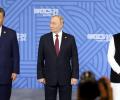
China has expressed its support for Russia's initiative to revive the Russia-India-China (RIC) troika, emphasizing its importance for regional and global security and stability.
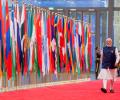
During a special briefing in Tianjin, Misri confirmed that the prime minister will first address the SCO plenary session before meeting President Putin.
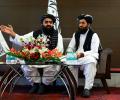
'During the 5-day visit, Amir Khan Muttaqi would have, conceivably, bumped into our powerful security agencies one way or another and some interaction would have ensued, which, in turn, can lead to future dealings.' 'Indeed, this will be the one crucial template of the Indo-Afghan relationship that Pakistan will be monitoring closely,' points Ambassador M K Bhadrakumar.
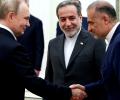
On Monday, June 23, 2025, Russian President Vladimir Putin hosted Iran's Foreign Minister Abbas Araqchi in Moscow.
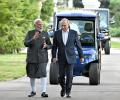
Russian Foreign Minister Sergey Lavrov has confirmed that President Vladimir Putin has accepted an invitation from Prime Minister Narendra Modi to visit India. The visit is currently being prepared, though the dates have not yet been revealed. This visit follows Prime Minister Modi's trip to Russia in July 2024, his first since 2019. The two leaders have maintained regular contact and have emphasized the strength of the Russian-Indian strategic partnership.

Russian foreign ministry spokeswoman Maria Zakharova on Monday denied the media reports of taking Foreign Minister Sergei Lavrov to hospital with a heart condition and called it the 'height of fakery', several media reported.
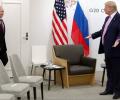
The recent conflict between India and Pakistan was among the issues figured during a phone call between Russian President Vladimir Putin and US President Donald Trump, according to a Kremlin aide.
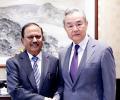
Wang is travelling to India days ahead of Prime Minister Narendra Modi's planned trip to the Chinese city of Tianjin to attend the annual summit of the Shanghai Cooperation Organisation.

New Delhi, while opting not to retaliate yet to the American tariffs, has in recent weeks sought to reinforce its friendship with Moscow, and recalibrate its ties with Beijing rather than surrender to Washington's diktats.
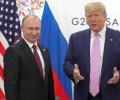
Trump reiterated that he is not negotiating on behalf of Ukraine, but rather aiming to bring the parties to the negotiating table.

Russian Foreign Ministry spokeswoman Maria Zakharova said Lavrov will meet Prime Minister Narendra Modi and Foreign Minister S Jaishankar on Friday.
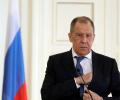
Russian Foreign Minister Sergey Lavrov will be on a two-day official visit to India from Thursday, his first trip to the country since Moscow launched its invasion of Ukraine last month.
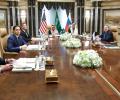
After more than four hours of talks in Saudi Arabia, the US and Russia agreed on four key principles, Rubio said on Tuesday. These include appointing a high-level team to help "negotiate and work through the end of the conflict in Ukraine" in a way that's "acceptable to all the parties engaged."

"The deal is being implemented. We witnessed attempts on the part of the US to undermine this cooperation and make India obey the American orders to follow the American vision of how this region should be developed," Russian Foreign Minister Sergey Lavrov said.

Prime Minister Narendra Modi on Friday conveyed to Russian Foreign Minister Sergey Lavrov that India stands ready to contribute in any way to the peace efforts to resolve the conflict in Ukraine

The talks took place on the sidelines of the G-20 foreign ministers' meeting in the Indonesian city of Bali.

External Affairs Minister S Jaishankar on Wednesday held wide-ranging talks with his Russian counterpart Sergey Lavrov focusing on the Ukraine conflict, bilateral ties and issues relating to the G20 foreign ministers' meeting.

Lavrov said a rupee-rouble payment system for trade with India was put into place earlier and it could be strengthened further.

Pakistan's ambassador to Russia, Muhammad Khalid Jamali, has warned that Pakistan will respond with "full spectrum of force", including nuclear, if it is attacked or its vital water flow is disrupted. The warning comes amid heightened tensions between Pakistan and India following a terrorist attack in Jammu and Kashmir. Jamali also reiterated Pakistan's stance on the Indus Water Treaty, saying any attempt to stop or divert water flow would be considered an act of war. He urged de-escalation, emphasizing the potential danger given both countries possess nuclear weapons. Jamali further called for a neutral investigation into the Kashmir attack, suggesting the involvement of China and Russia. He also highlighted the need to address the root causes of the conflict, pointing to the unresolved Kashmir issue and its potential for resentment.
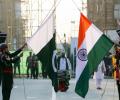
The UN Security Council will hold closed consultations on Monday on the situation between India and Pakistan after Islamabad sought an emergency meeting on the issue. Pakistan, which currently sits as a non-permanent member of the council, requested the meeting in light of rising tensions between the two countries following a terror attack in India. The meeting comes after India's foreign minister spoke with all council members except China and Pakistan, emphasizing the need to bring perpetrators of the attack to justice. The Pakistani envoy has argued that the situation in Jammu and Kashmir poses a threat to regional and international peace and security, justifying the need for a council discussion.
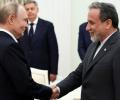
Will Russia's entry deter Trump on his warpath?, asks Ambassador M K Bhadrakumar.

At a joint media briefing with Lavrov, Jaishankar listed issues such as "factors of instability" such as terrorism and its cross-border manifestation and said it remains a "major concern".

India is a great power that determines its national interests and chooses its partners, Russian Foreign Minister Sergey Lavrov has said, describing as "completely unjustified" the "enormous pressure" on New Delhi due to its energy cooperation with Moscow.

'He may respect others, but he is unlikely to admire them'

External Affairs Minister Pranab Mukherjee on Thursday briefed his Russian counterpart Sergei Lavrov on the Indo-US nuclear deal and raised the issues of delay in the delivery of Gorshkov aircraft carrier.
The US move to align with Russia is prompted by fear of a Sino-Russian joint threat. Russia, fully aware of its military vulnerability vis a vis China may cautiously welcome the American move, assesses Colonel Anil A Athale (retd).

Tensions between the United States and Russia have reached new heights amid the ongoing Ukraine conflict, with a series of developments marking a dangerous escalation.
"Our relations with emerging, I would rather say emerged, centres of power in the multi-polar world like India and China will remain the priority in our foreign policy in 2008," Russian Foreign Minister Sergei Lavrov said.

Jaishankar said he was confident that Prime Minister Modi and President Putin will meet for an annual summit next year.
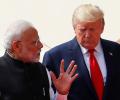
Delhi's appeasement strategy may now translate as more mega arms deals with the US, generating substantial business and job creation in the American economy. Make no mistake, Americans will use it to pressure India, predicts Ambassador M K Bhadrakumar.

Lavrov also noted that the G20 Summit in New Delhi provided a direction towards fairness in global governance and global finance as well.

Russian President Vladimir Putin on Tuesday thanked Prime Minister Narendra Modi for trying to help find a peaceful solution to the Ukraine crisis.

He may have spent his entire adult life in diplomacy, but doctorate in nuclear physics Subrahmanyam Jaishankar's face betrays both fusion and fission of his moods.
Dar also said Pakistan views Russia as an important player in the West, South and Central Asia, and strengthening mutually beneficial cooperation with Russia remains an important priority for Pakistan's foreign policy.

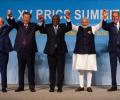
Prime Minister Narendra D Modi with Brazil's President Luiz Inacio Lula da Silva, China's President Xi Jinping, South African President Cyril Ramaphosa and Russia's Foreign Minister Sergei Lavrov at the BRICS Summit in Johannesburg, South Africa.

New Delhi has reached out to Moscow while waiting for a new president in Washington. New Delhi knows well that in international relations, there are no permanent friends or foes, only permanent national interests, points out Dr Rup Narayan Das.

Rubbishing the allegations by the United States on India for a foiled assassination plot against pro-Khalistan radical Gurpatwant Singh Pannun, the Russian Foreign Ministry said that Washington, DC has not yet provided any reliable evidence of the involvement of Indian citizens in the case.

'Disengagement is merely the first step in a lengthy process of arriving at a new normal along the LAC in Eastern Ladakh and the entire land boundary.' 'The Indian government should insist on the restoration of the status quo ante in Eastern Ladakh.'
