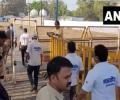
The Archaeological Survey of India (ASI) on Monday submitted its scientific survey report of the disputed Bhojshala-Kamal-Maula mosque complex to the Indore bench of the Madhya Pradesh high court.

The Supreme Court has allowed the Muslim community to offer Friday prayers at a dargah adjacent to the disputed Bhojshala complex in Dhar, Madhya Pradesh, between 1 pm and 3 pm. This directive comes after the Muslim side alleged non-compliance with a previous order for an alternative prayer site, and follows a Madhya Pradesh High Court ruling declaring the complex a temple.

The Supreme Court has agreed to hear appeals challenging the Madhya Pradesh High Court's decision to designate the Bhojshala complex as a Goddess Saraswati temple, a ruling that also quashed Muslim prayer rights at the historic site.
The Archaeological Survey of India (ASI) has informed the Madhya Pradesh High Court that a massive structure dating back to the Parmar kings existed at the Bhojshala temple-Kamal Maula mosque complex, and the current structure was built from the remains of temples.

The Supreme Court has permitted Muslims to offer Friday prayers at a site adjacent to the Bhojshala-Kamal Maula complex in Dhar, Madhya Pradesh, following a High Court ruling that declared the complex a temple. This decision allowed prayers to resume after a previous ASI order was quashed.

The Madhya Pradesh High Court has declared the disputed Bhojshala complex in Dhar to be a temple dedicated to Goddess Saraswati, suggesting the Muslim community seek land elsewhere for a mosque.
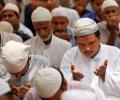
The All India Muslim Personal Law Board (AIMPLB) announced a nationwide movement against the 'deteriorating condition' and social and political marginalisation of Muslims in India, citing concerns over mob violence, demolition drives, and attempts to impose Vande Mataram.
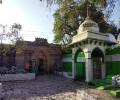
The Madhya Pradesh government has challenged the legal validity of a 1935 order from the former Dhar princely state concerning the religious status of the Bhojshala Temple-Kamal Maula Mosque, arguing it cannot be considered law.
A Hindu party has filed a caveat in the Supreme Court regarding the Bhojshala complex dispute, seeking a hearing before any orders are passed on appeals against the Madhya Pradesh High Court's decision.

The Madhya Pradesh High Court referenced the Supreme Court's Ayodhya verdict principles while ruling on the Bhojshala-Kamal Maula mosque complex case, determining the site to be a temple dedicated to Goddess Saraswati.
A fresh plea has been filed before the Supreme Court challenging a Madhya Pradesh High Court order, which said that the disputed Bhojshala complex in Dhar district was a temple dedicated to Goddess Saraswati.
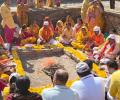
Hundreds of Hindu devotees gathered at the Bhojshala complex in Dhar, Madhya Pradesh, for a 'maha aarti' following a high court ruling declaring the site a temple. Members of the Muslim community protested peacefully by offering namaz at home wearing black bands.
Members of the Muslim community in Madhya Pradesh's Dhar district said they would offer their first Friday namaz at home and wear black bands after the court setback in the Bhojshala case.

The Supreme Court has directed that a separate open space be provided adjacent to the disputed Bhojshala site in Madhya Pradesh's Dhar for offering namaz on Fridays, pending the final resolution of the case. The court emphasised the sensitive nature of the matter and urged both Hindu and Muslim sides to exercise patience.

Over 1,500 police personnel have been deployed around the Bhojshala in Dhar, Madhya Pradesh, ahead of the first Friday since the high court declared it a Vagdevi temple.
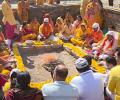
Hindu groups organised a 'victory celebration' at the historic Bhojshala complex in Madhya Pradesh's Dhar district after the ASI granted the community unrestricted access to the monument for worship.

Peace prevailed at the disputed 11th-century Bhojshala-Kamal Maula Mosque complex in Madhya Pradesh's Dhar district on Friday as Hindus performed puja to mark Basant Panchami festival while Muslims offered namaaz within the same premises but at a different location.

Hindus will offer prayers from sunrise to sunset on Basant Panchami while Muslims to offer namaz from 1 pm to 3 pm on Friday.
The Supreme Court agreed to hear on Friday a plea of the Muslim side alleging that the alternative site identified by the Madhya Pradesh government for offering namaaz was located too far from the disputed Bhojshala complex in Dhar.
Aggrieved by the direction, Dhar city's head cleric Waqar Sadiq said they (Kamal Maula Mosque management committee) will challenge the ruling in the Supreme Court.
The security has been stepped up in view of the Friday prayers to be offered by the Muslim community members at the site, a police official said.
However, a division bench of Justices SA Dharmadhikari and Gajendra Singh made it clear the ASI won't be given any more time at the end of this 8-week period.

Hindus offered prayers at the contentious Bhojshala/Kamal Maula Mosque complex in Madhya Pradesh's Dhar district on Tuesday, with a team from the Archaeological Survey of India (ASI) continuing its court-mandated survey.

The ASI team, comprising more than a dozen members, reached the complex in the morning.
The application filed by the Hindu Front of Justice, which is the original petitioner in the case before the Madhya Pradesh high court, and others said that after the April 1 order of the apex court, proceeding before the HC has also virtually stayed.

Hindus consider Bhojshala, an Archaeological Survey of India-protected 11th century monument, to be a temple dedicated to Vagdevi (Goddess Saraswati), while the Muslim community call it Kamal Maula Mosque.
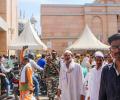
The Act prohibits conversion of any place of worship and provides for the maintenance of the religious character of any place of worship as it existed on August 15, 1947.
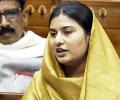
Samajwadi Party leader and Kairana MP Iqra Choudhary has moved the Supreme Court seeking effective implementation of the Places of Worship (Special Provisions) Act, 1991. This move comes amidst several petitions challenging the law's validity, including those filed by the Akhil Bhartiya Sant Samiti and lawyer Ashwini Upadhyay. The Supreme Court, in December 2022, had restrained all courts from examining fresh suits and passing interim orders in pending cases seeking to reclaim religious places. The Act aims to maintain the religious character of places of worship as they existed on August 15, 1947, but the dispute relating to Ram Janmabhoomi-Babri Masjid at Ayodhya was kept out of its purview. The court has listed Choudhary's plea with other pending pleas for February 17.
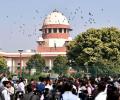
A bench comprising Chief Justice Sanjiv Khanna and Justice Sanjay Kumar also indicated that it may not take up the pending scheduled petitions, heard earlier by a three-judge bench, during the day as it was sitting in a combination of two judges.
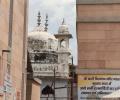
The Supreme Court's 2023 order refusing to stay a scientific survey at the Gyanvapi Mosque complex has sparked claims over several other disputed places of worship across India. This has led to several court cases, including one in Mathura where a survey of the Shahi Idgah Mosque complex was ordered, and another in Ajmer where a claim was made that a Shiva temple existed within the dargah of Sufi saint Moinuddin Chishti. The article also highlights a dispute over the Bhojshala in Madhya Pradesh, which Hindus consider a temple and Muslims consider a mosque. The Supreme Court's order has reignited debates about the Places of Worship (Special Provisions) Act, 1991, which prohibits the change of character of religious places as they existed on August 15, 1947.
Commencing hearing on pleas challenging the constitutionality of the Places of Worship Act, 1991, the Supreme Court asked the Centre to reply to cross-pleas against or seeking implementation of statute.
