
Kwatra termed India's successful launch of an American communication satellite on Wednesday as a 'very important and big day' for partnership between Washington and New Delhi, saying it caps a series of achievements in 2025 in bilateral space cooperation between the countries.

India is set to take its first steps towards its own human space flight when the uncrewed Gaganyaan mission soars to the skies later this year. Private players in the space sector are also gearing up for launching satellites on home-built rockets.

'A solid motor, once ignited, burns until the propellant is exhausted. It cannot simply stop mid-burn,' said a retired senior ISRO official. 'That is what makes this failure puzzling.' Venkatachari Jagannathan reports on the latest PSLV failure.
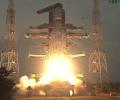
The heaviest communication satellite to be launched from the Indian soil onboard a new generation, homegrown 'Bahubali' rocket was successfully placed into the intended orbit on Sunday, the Indian Space Research Organisation said.
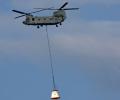
ISRO successfully conducted the first Integrated Air Drop Test (IADT-01) to validate the parachute-based deceleration system for the Gaganyaan mission, demonstrating a crucial step towards India's human spaceflight program.
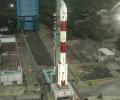
The test conducted on Saturday in collaboration with Thrust Tech India Limited saw the rocket ascend 1.1 km at 5:14:33 PM, a complete success.

From a surge in startups to crewed mission preparations, 2025 marks a transformative year as India eyes $44 billion space economy by 2033.

The satellite, weighing about 4,410 kg will be the heaviest to be launched from the Indian soil and into a Geosynchronous Transfer Orbit (GTO), the space agency said. The satellite will travel onboard a LVM3-M5 rocket, dubbed as 'Bahubali' for its heavylift capability.

The Chandrayaan-2 mission has made the first-ever observation of the effects of the Sun's Coronal Mass Ejection (CME) on the Moon using its onboard scientific instruments. This observation would help understand the lunar exosphere and the impact of space weather on its surface.

Indian Space Research Organisation's 101st mission from Sriharikota, an earth observation satellite onboard the agency's trusted Polar Satellite Launch Vehicle (PSLV) rocket, could not be accomplished on Sunday following a pressure issue in the third stage of the launch vehicle, the space agency said.
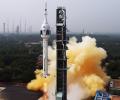
ISRO Chairman V Narayanan announces ambitious space program goals, including landing Indians on the Moon by 2040 and launching the 'Gaganyaan' mission in 2027. The agency is also working on a national space station and uncrewed missions.

Meanwhile, Musk said some parts of the ISS were "simply getting too old and obviously that risk grows over time."

Indian astronaut Shubhanshu Shukla and three others were getting ready for their journey to the International Space Station on board SpaceX's Falcon-9 rocket that is scheduled to blast off from the Kennedy Space Centre (KSC) in Florida on Tuesday evening.
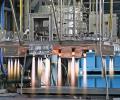
With these successful tests, ISRO has moved a step closer to India's first human spaceflight mission, Gaganyaan.

Indian astronaut Shubhanshu Shukla, currently on the ISS as part of the Axiom-4 mission, has acknowledged ISRO's efforts in ensuring his safe travel. He spoke with ISRO chairman V Narayanan about his well-being and the experiments being conducted on the ISS.

The Indian Space Research Organisation (ISRO) has received approval for the Chandrayaan-5 mission, which aims to study the Moon's surface using a 250kg rover. The mission will be conducted in collaboration with Japan. This follows the success of the Chandrayaan-3 mission, which achieved a soft landing on the Moon's South Pole in August 2023. ISRO is also planning to establish a space station, Bharatiya Space Station, in the near future.
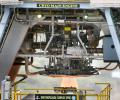
The Indian Space Research Organisation (ISRO) on Saturday said it has successfully conducted the flight acceptance hot testing of the cryogenic engine identified for the sixth operational mission of LVM3 launch vehicle (LVM-M6) at ISRO Propulsion Complex, Mahendragiri in Tamil Nadu.

Indian astronaut Shubhanshu Shukla stands on the cusp of history as he prepares to set off on a space odyssey, marking India's return to space flight 41 years after his idol Rakesh Sharma orbited the earth for eight days as part of Soviet Union's Interkosmos programme.

Opposition parties are expected to announce their joint vice-presidential candidate, potentially leading to a 'south versus south' contest. Meetings and discussions have been held to finalize the candidate, with names from Tamil Nadu being considered. The opposition aims to field a non-political figure with national standing.

Lucknow celebrated the successful return of astronaut Group Captain Shubhanshu Shukla from the International Space Station (ISS). Family, friends, and the community rejoiced as Shukla, the first Indian astronaut to visit the ISS, made a successful splashdown in the Pacific Ocean.
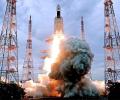
'You can observe a lot of things from space.' 'Another thing is communication, in real time, especially in war-like situations.' 'During Operation Sindoor, we could play our part well.'
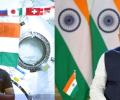
The interaction is planned via a telebridge set up at the U R Rao Satellite Centre in Bengaluru, said the Amateur Radio on International Space Station (ARISS), which facilitates interaction of school students with astronauts on the orbital laboratory.

"If we have to ensure the safety of our country, we have to serve through our satellites. We have to monitor our 7,000 km seashore. We have to monitor the entire northern part continuously. Without satellite and drone technology, we can't achieve that."
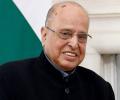
K Kasturirangan, former chairman of the Indian Space Research Organisation (ISRO), passed away at the age of 84 in Bengaluru on Friday. He was suffering from age-related ailments for the past few months. Kasturirangan, who also served as the chairperson of the drafting committee on the New National Education Policy (NEP), was a renowned space scientist and had a distinguished career spanning several decades. He was known for his contributions to ISRO's successful space programs and his role in shaping India's education policy.
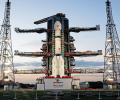
The imaging technology in Nisar can provide very high-resolution data on changes as small as one centimetre in size on the earth's surface.

India took another leap in space infrastructure with the foundation stone laid for a new launch pad at the country's second rocket port in Kulasekarapattinam.
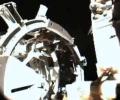
The Indian Space Research Organisation (ISRO) has successfully de-docked the SpaDeX satellites, a significant achievement that clears the path for future missions such as exploring the moon, human spaceflight, and building India's own space station. The de-docking, announced by Union Minister Jitendra Singh, follows a successful docking experiment conducted in January. The SpaDeX mission involved launching two satellites, SDX01 and SDX02, to demonstrate the docking technology in space.
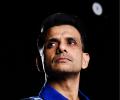
Indian astronaut Shubhanshu Shukla will enjoy a range of Indian dishes, including rice varieties, moong dal halwa, and mango nectar, during his 14-day mission aboard the International Space Station (ISS). He will also have the option to choose from international cuisine, as approved by NASA. ISRO and DRDO have developed the Indian food options for astronauts of the Gaganyaan mission and Shukla will be able to savor them with NASA's approval.

NASA, Axiom Space, and SpaceX are now targeting 12.01 PM (IST), Wednesday, June 25, for launch of the fourth private astronaut mission to the International Space Station, Axiom Mission 4, NASA said.
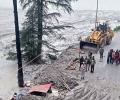
Experts question whether a cloudburst caused the recent flash flood in Uttarkashi, India, citing insufficient rainfall and other potential factors like ice chunks, rockfalls, or landslides.
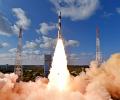
Andhra Pradesh will establish two expansive integrated space cities in Lepakshi and Tirupati, spanning around 33,000 acres.
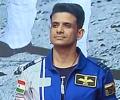
Axiom-4 mission to the International Space Station, piloted by Indian astronaut Group Captain Shubhanshu Shukla with three other crew members, has been delayed and will now be launched from the Kennedy Space Centre in Florida on June 8 at 6:41 pm IST.
Shukla will be the second Indian to travel to space four decades after Rakesh Sharma's iconic spaceflight onboard Russia's Soyuz spacecraft in 1984.

'The launch of Axiom 04 slated for 11th June 2025 for sending first Indian Gaganyatri to ISS is postponed.'
Indian astronaut Shubhanshu Shukla and three others are set to embark on the Axiom Space's fourth human spaceflight from National Aeronautics and Space Administration's (NASA) Kennedy Space Centre in Florida on June 10 and are likely to dock at the International Space Station on June 11 at about 10 pm IST, after a nearly 28-hour journey.
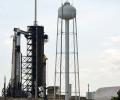
Indian astronaut Shubhanshu Shukla and three others are expected to travel to the International Space Station on June 19, after SpaceX successfully resolved the liquid oxygen leak in its Falcon-9 rocket, the Indian Space Research Organisation (ISRO) announced on Saturday.

On Thursday, NASA announced that it was working with Roscosmos to understand a new pressure signature, after the recent post-repair effort in the aft-most segment of the International Space Station's Zvezda service module.

Following the postponement of the Axiom 4 mission, Group Captain Shubhanshu Shukla's father, Shambhu Dayal Shukla, said that his family is 'mentally' prepared for the mission.
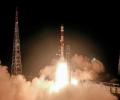
State-run Hindustan Aeronautics Limited has won a bid under which it will receive technology from the Indian Space Research Organisation for the end-to-end commercial production of the Small Satellite Launch Vehicle (SSLV), a first for the industry as India seeks to become a global hub for small satellite manufacturing and launches.
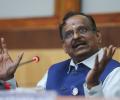
Ahead of Prime Minister Narendra D Modi's meeting United States President Donald J Trump, Russia's ambassador to India and the US charge d'affaires met Indian Space Research Organisation Chairman Dr V Narayanan.
