
The Indian Space Research Organisation (ISRO) on Thursday announced that its lunar mission Chandrayaan-3 will be launched on July 14 from the space port at Sriharikota in Andhra Pradesh.

NavIC consists of a constellation of seven satellites and a network of ground stations and is touted to be more accurate than GPS.
The space agency has redefined the mission in such a way that it will achieve success in the very first attempt.

Only three countries (United States, Russia and China) have successfully landed spacecraft on the airless lunar surface.
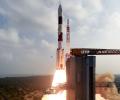
The 2,268-kg GISAT-1 was originally slated to be launched from Sriharikota in Andhra Pradesh's Nellore district, about 100 kms north of Chennai, on March 5 last year but was postponed a day before the blast-off due to technical reasons.

Indian Space Research Organisation's (ISRO's) heaviest rocket LVM3 will launch British start-up OneWeb's 36 broadband satellites from the spaceport in Andhra Pradesh's Sriharikota on October 23, marking the launcher's entry into the global commercial launch service market.

All progress in space should excite us and encourage us to be optimists about a better future for our planet and all of us, asserts Aakar Patel.
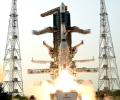
Over 32 missions -- satellites and rockets -- have been planned for the year.

Describing the failure of the GSAT-5P communication satellite launch on Saturday as 'very tragic', India's top space scientists and strategic thinkers said the launch vehicle going up in flames soon after the lift off was 'a major setback' for ISRO. Senior space scientist Professor Yashpal, in his first reaction to the failure of the satellite launch, said, "It is very tragic. I think something has happened in early stages. I have never heard of such a thing."

Friday's mission is the fourth operational flight of LVM3 which aims to launch the Chandrayaan-3 spacecraft into a Geo Transfer Orbit.
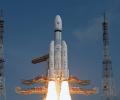
The mission is targeted for launch in the fourth quarter of 2024.
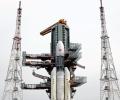
The Indian Space Research Organisation has released the first images of India's heaviest rocket, referred to as "Bahubali" days before it ferries India's Chandrayaan-2 into space. India's most ambitious space mission yet, Chandrayaan-2, which aims to place a robotic rover on the moon, will be launched on July 15 at 2:51 am. Here's all you need to know about the rocket.

'ISRO is resilient enough to spring back and come with a solution quickly.'

The space agency lines up GSLV-III and Chandrayan-II in 2017-18.

Four years after it broke many hearts, Indian Space Research Organisation's Chandrayaan is all set to soar towards the moon in its third expedition on Friday in an attempt to put the country in an elite club of nations that accomplished lunar missions with a soft landing.

The Indian space agency is all set to embark on its most complex mission.

The 43.43 metre tall rocket lifted off at 5.28 pm from the second launch pad at the Satish Dhawan Space Centre in Sriharikota
In a jolt to India's space programme on Saturday, the launch of a communication satellite aboard a home-grown vehicle failed after the rocket exploded midair minutes after the lift-off from the spaceport in Sriharikota.

The landing on the moon near the South Pole, an uncharted territory so far, would be on September 6 or 7, Sivan told reporters, as the Indian space agency is all set to embark on its most complex mission.

A key feature of the satellite is providing mobile communication to India through multi beam coverage facility.
India's second mission to the moon will be launched on Monday at 2.43 pm after its initial launch on July 15 was called off owing to a "technical glitch."

India's heavy-lift rocket GSLV MkIII, carrying communication satellite GSAT-19.

'Today, when we talk of success of PSLV and GSLV Mk III, we owe it to important inputs that the Prof. Narasimha committee gave'

The mission life of the 2,250kg GSAT-7A, built by ISRO, is eight years. It will provide communication capability to users in Ku-band over the Indian region.
India's second moon mission Chandrayaan-2 is all set to be launched on board Indian Space Research Organisation's most powerful rocket GSLV-Mk0III-M1 from Satish Dhawan Space Centre in Shriharikota.
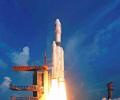
The rocket can put satellites weighing upto four tonnes in space, double the weight that the current GSLV-Mark-II can lift.

The 3,423 kg GSAT-29 carries Ka and Ku band high throughput transponders intended to meet the communication requirements of users, including in the North East and in Jammu and Kashmir.

The rocket is almost 49 meters high -- as much as a 17-floor building. It weighs 415 tons -- as much as the combined weight of 80 full grown elephants.

GSLV-MK III, which uses a homegrown cryogenic engine, has to do at least two more launches before it begins commercial operations, report Raghu Krishnan and T E Narasimhan.
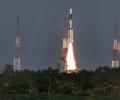
The satellite will enable a full range of services to neighbours including the areas of telecommunication, television, direct-to-home, VSATs, tele-education and tele-medicine.

ISRO Chairman K Sivan said there might by a postponement if the weather was not conducive.

The satellite would provide a thrust to mobile communication through multi-beam coverage facility, the ISRO said.
The Indian Space Research Organisation said that the countdown started at 6.51 am on Sunday.
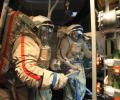
The Gaganyaan project has the objective of demonstrating human space flight capability to Low Earth Orbit with three crew members in orbit and safely recovering them after the mission.
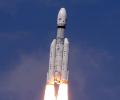
'ISRO takes a very cautious approach.' 'After reaching the moon, the orbit has to be brought down from a single elliptical orbit to a circular orbit while simultaneously ensuring the stability of Chandrayaan 3 and the health parameters of the lander and rover.'
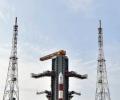
Here are some things you must know about this significant launch and why this satellite is a big deal for India.
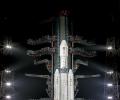
The Indian Space Research Organisation on Thursday launched its first experimental suborbital flight. Here are five things you need to know about the GSLV Mark III mission.

ISRO's first mission in 2023 and SSLV's sequel saw a strange coincidence--it was launched at 9.18 am, the same time its predecessor lifted off from the Satish Dhawan Space Centre here on August 7, 2022 but could not deliver due to orbit anomaly and flight path deviation.

Join us in honouring the scientists for their latest achievement. Post your messages in the message board below.
