

'India has got a unique opportunity to get more and more business from outside as India is cost-effective and reliable.'
A failure analysis committee has been set up to study the recent mishap.
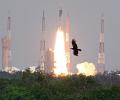
The 44.5-metre-tall, 295-tonne PSLV-C7 lifted off from the launch pad at 9.24 am.

Indian Space Research Organisation has successfully realigned the orbit of its Mars Orbiter Mission 'Mangalyaan' so it is not affected by long-duration eclipse, ISRO Chairman A S Kiran Kumar said.
The BJP hit back accusing the Congress of drawing the issue into political arena.

'It is a blessing in disguise that they could find the glitch before the launch.' 'If this was not found, the entire mission would have been lost.'

If all goes on well, the NISAR satellite will be launched in 2021 from India using the Geo-synchronous Satellite Launch Vehicle (GSLV).

It has already tasted success with the moon mission and Mangalyaan. Is man in space the next frontier for ISRO?

The teething issues concerning the launch of Chandrayaan 2 -- the second lunar mission of the Indian Space Research Organisation -- have been cleared.

'All possible efforts are being made to establish communication with (the) lander,' the ISRO further said in a tweet.
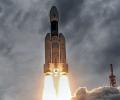
"The duration of manoeuvre was 1,738 seconds. With this, Chandrayaan-2 was successfully inserted into a Lunar orbit," Indian Space Research Organisation said.
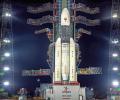
Late on Monday night, in a last-minute revision of schedule, ISRO announced that the launch of India's second lunar mission 'Chandrayaan-2' has been called off due to a technical snag.
The apogee [farthest point] is 36,000km and the inclination of the orbit with respect to the equatorial plane has been reduced from 7.37 degrees to the present 0.32 degrees,
The space agency has set 2020 as the deadline for the first privately built rocket to be launched into space.
NASA said it is looking forward to explore the solar system with its Indian counterpart.

Two de-orbit manoeuvres of Vikram Lander, to bring it further down, have been planned to prepare for its landing in the south polar region of the moon.

The Chandrayaan-2 spacecraft is expected to reach the moon's orbit on August 20 and land on lunar surface on September 7.

The Mars mission is overwhelmingly irrelevant to space science and won't advance the frontiers of knowledge. It will divert attention from the real technological challenges facing the Indian space programme, and will further distort our science and technology priorities, says Praful Bidwai.

"First orbit raising operation of GSAT-6 was successfully completed by firing the Apogee Motor for 3385 seconds at 8:35 pm IST on August 28," the ISRO said.
Godrej and some other firms are frustrated at what they say is the slow execution of projects and lack of government support, which are hampering India's efforts to compete with China and Russia as a cheaper option for launching satellites.

Although Russia, United States and China have achieved a soft landing on the lunar surface, India is aiming at becoming the first one to explore the south pole of the Moon.

There is a huge spurt in demand to launch smaller satellites, those as light as 1 kg, with a lifespan of two to three years. But there aren't enough rockets to carry these, reports T E Narasimhan

One spacecraft will be Indian Space Research Organisation's own Chandrayaan-2, while the other will be from India's first private moonshot Team Indus which is competing in the Google LunarXPrize challenge.

With the Indian Space Research Organisation set to launch the Mars Mission on November 5, Chairman K Radhakrishnan, in an interview with Praveen Bose, talks about the complexities, the challenges and the benefits of the Rs 450-crore mission.

K Sivan has to hasten the effort to bring in private players into satellite and rocket building and replicate India's software success in aerospace.
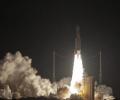
Boosting India's communication services, its latest satellite GSAT-16 was successfully launched on board Arianespace rocket from the spaceport of Kourou in French Guiana in the early hours of Sunday, after a delay of two days due to bad weather.

Dr Rao accelerated the development of rocket technology which led to the successful launch of ASLV and PSLV satellites.

'By pushing PSLV production to industry, the extra ISRO personnel available will be utilised to do projects like the human space mission.'

The primary goal of HysIS, whose mission life is five years, is to study the earth's surface in visible near infrared and shortwave infrared regions of the electromagnetic spectrum.
'In a part of the world where the government tells people what not to eat and what slogans to shout and not shout, it is beneficial to develop a mentality that is science minded and therefore open-minded.' 'That is possibly why the space programme has always had support from all sides of the political divide,' says Aakar Patel.

Scientists also expressed the hope that any technical problem will be sorted out by ISRO, and the mission will be launched successfully.
The nine-second de-orbiting or retro-orbiting manoeuvre was executed at 3.42 am using the onboard propulsion system.
ISRO needs next generation launchers and new facilities to manufacture and launch them.
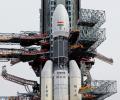
'It is time we Indians learnt to believe in ourselves, and stopped questioning our own capabilities every time a space launch is not a glorious success,' says M D Riti.

ISRO Chairman K Sivan described the GSAT-11 as the "richest space asset" for India.
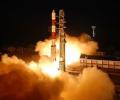
From relying on Russia for its first satellite launch, India is fast becoming a global hub to launch satellites, says T E Narasimhan
