
Two de-orbit manoeuvres of Vikram Lander, to bring it further down, have been planned to prepare for its landing in the south polar region of the moon.

ISRO needs next generation launchers and new facilities to manufacture and launch them.
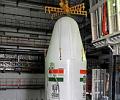
The launch of a Geosynchronous Satellite Launch Vehicle was called off by the Indian Space Reasearch Organisation at the eleventh hour on Monday due to a fuel leak in its second stage -- in a setback to the mission to test its homegrown cryogenic engine -- after its failure three years ago.

The Chandrayaan-2 spacecraft is expected to reach the moon's orbit on August 20 and land on lunar surface on September 7.

The 43.43 metre tall rocket lifted off at 5.28 pm from the second launch pad at the Satish Dhawan Space Centre in Sriharikota

Global analysts say a successful launch of operational GSLV MkII rocket will reduce dependency for ISRO on foreign launchers.
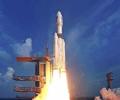
Taking its baby steps towards realising India's ambition to send humans into space, Indian Space Research Organisation on Thursday successfully tested the atmospheric re-entry of a crew module after its heaviest launch vehicle GSLV MK III blasted off from Sriharkota.
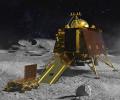
ISRO chairman K Sivan said the proposed soft-landing was going to be a 'terrifying' moment.

Although Russia, United States and China have achieved a soft landing on the lunar surface, India is aiming at becoming the first one to explore the south pole of the Moon.

The last session of Parliament started off on a noisy note as pro and anti-Telangana MPs sparred with each other on the floor of the two houses.

While the Mars mission got wide praise, there were voices which questioned the need for spending Rs 450-500 crore on it when the country is facing hunger and poverty.

There appears to be uncertainty over availability of a lander from Russia even as the 'desi' rocket to launch the space odyssey would take time to become operational.

ISRO Chairman K Sivan described the GSAT-11 as the "richest space asset" for India.

The 3,423 kg GSAT-29 carries Ka and Ku band high throughput transponders intended to meet the communication requirements of users, including in the North East and in Jammu and Kashmir.
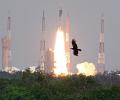
The nine-second de-orbiting or retro-orbiting manoeuvre was executed at 3.42 am using the onboard propulsion system.

Pride is all ours and of those who made a beeline to Halls 3 and 5 that showcased indigenous defence technologies at the Make In India Week.
Asked if the lander was 'damaged' during the 'hard landing", Sivan said: "That we do not know".

The satellite would provide a thrust to mobile communication through multi-beam coverage facility, the ISRO said.
If successful, this would increase capacity to hurl small satellites into space, meeting both local demand and serving global customers.

'We are looking at a joint venture between ISRO and a few companies to assemble the PSLV and launch it from Sriharikota.' 'In a month or two, the vehicle assembly building will be ready.' 'After that, we could see 13, 14 launches a year.'

Indian Space Research Organisation's plan to soft land Chandrayaan-2's Vikram module on the Lunar surface did not go as per script in the early hours of Saturday, with the lander losing communication with ground stations during its final descent.
The ISRO is aiming for a soft landing of the lander in the South Pole region of the moon where no country has gone so far.

A truly 'made in India' satellite that will empower a digital India.

With the launch of GSLV-MK III, slated for April, it will be able to cater to bigger satellites as well.

An industrial house bred in old-school manufacturing values, Godrej & Boyce has displayed unusual agility to become a trusted builder of advanced weaponry, discovers Ajai Shukla.

'India must close the missile technology gap with both China and Pakistan as early as possible, or else the credibility of India's nuclear deterrence will remain suspect,' says Brigadier Gurmeet Kanwal (retd).
Godrej and some other firms are frustrated at what they say is the slow execution of projects and lack of government support, which are hampering India's efforts to compete with China and Russia as a cheaper option for launching satellites.

'India has got a unique opportunity to get more and more business from outside as India is cost-effective and reliable.'
ISRO chairman A S Kiran Kumar talks of what's on and what lies ahead for the Indian space agency.

The Mars mission is overwhelmingly irrelevant to space science and won't advance the frontiers of knowledge. It will divert attention from the real technological challenges facing the Indian space programme, and will further distort our science and technology priorities, says Praful Bidwai.

It has already tasted success with the moon mission and Mangalyaan. Is man in space the next frontier for ISRO?
 © 2026 Rediff.com - Advertise with us - Disclaimer - Privacy Policy - Sitemap - Feedback - About us - Terms of use - Grievances