'A breakthrough in eastern Ladakh leading to disengagement and creation of a buffer zone will obviate the need of military deployment through the winter months ahead,' notes Ambassador M K Bhadrakumar.

"Even though the first Sino-Indian war took place in 1962, the Chinese incursion had started taking place in 1957. The government knew it but it did not inform the public. After five decades, the same thing is happening as the Chinese incursion has been taking in Aksai Chin for long, but we have woken up now," said Ram Pradhan, former Union home secretary and former governor of Arunachal Pradesh.

China has chosen to keep New Delhi guessing, while retaining for itself the option of constantly changing facts on the ground and shifting the LAC westwards -- the strategy called 'salami slicing', notes Ajai Shukla.

'Outside investors don't want to get tangled up in a religious war.'

'If you take pride only in being a nation with nuclear weapons and a strong military, then you think very differently from those nations that take pride in having wonderful universities and academic institutions.'

'It's amazing that a country that claims to be the world's largest democracy is getting into the business of micro-regulating personal and professional lives in this fashion,' says Devangshu Datta.
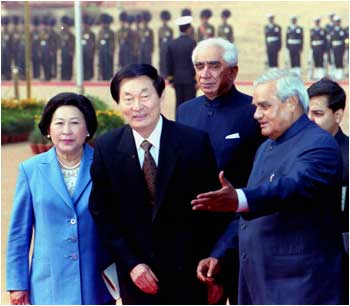
'He knew that a regime which believes that power flows from the barrel of the gun can only be handled from a position of comprehensive strength and not from a position of vulnerability and weakness,' says Rup Narayan Das.

There is a vocal constituency of educated, well-to-do, articulate Indian elites who would rather go with the idea that too much democracy is a liability. That India needs a spell of benevolent dictatorship. Of course, they have never lived under one, points out Shekhar Gupta.
'And this mirror imaging is the most dangerous thing because it leads to tremendous misunderstandings.'

Making waves with trade deals worth billions of dollars during his first European tour, President Xi Jinping put up a strong defence of the monopoly of power by the Communist Party of China saying that China had settled for a one-party system after unsuccessful experiments with multi-party democracy.
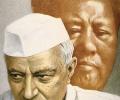
'Hindi-Chini Bhai Bhai? Don't you believe it. I don't trust the Chinese one bit,' Nehru told Gopalaswamy Parthasarathi before he traveled to China as India's ambassador. Asking GP to be ever vigilant, Nehru advised the diplomat to send telegrams on important matters only to him. Many such anecdotes from a long and eventful career as diplomat and bureaucrat crowd the pages of GP: 1912-1995, discovers Uttaran Das Gupta.

'At critical moments an inability to take tough decisions resulted in potentially far-reaching solutions slipping out of our grasp.' 'If similar opportunities come Narendra Modi's way will he act differently?' asks Karan Thapar.
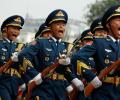
'We are beginning to see that the rest of the world will not simply accept the domination of one power'
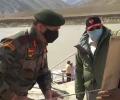
'We should not minimise the seriousness of Chinese encroachments because their perception is different.' 'Nor should we fall into the trap of accepting so-called 'buffer zones' in areas of overlapping claims. We cannot have buffer zones in our own territory,' asserts Ambassador Shyam Saran, a former foreign secretary.

'India, he announced, is a "free, open, inclusive region" committed to the "common pursuit of progress and prosperity".' 'Prosperity yes. But free? Open?' 'Ask the Dalit tanner, the Muslim butcher, the Christian priest who writes pastoral letters.' 'Ask cattle traders of any religion or a Delhiwallah who enjoys a juicy steak.' 'Ask a Muslim who falls in love with a Hindu or vice versa,' says Sunanda K Datta-Ray.
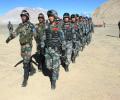
'They have done in Eastern Ladakh what we did in Dokalam in 2017.'

Xi ordered country's 2.3 million-strong military to be absolutely loyal to the party, to focus on how to win in wars, to pioneer reforms and innovation, to scientifically manage commanding a unit, to lead troops in accordance with the strictest standards and to take the forefront in complying with laws and regulations.
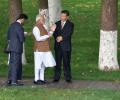
'The meeting marks the first tentative step in the effort to understand whether the two largest Asian nations can co-exist peacefully while realising their aspirations.' 'Caution and watchful wariness will dominate the effort of both sides,' says Jayadeva Ranade, former RA&W officer and China expert.
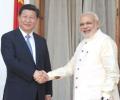
The summit is being seen as an effort by India and China to rebuild trust and improve ties that were hit by the 73-day-long Doklam standoff last year.

The meeting, which comes after the Doklam standoff, is aimed at a working a new paradigm for the bilateral relations for the next 15 years.

'Only when India's adversaries are convinced that India has both the necessary political and military will and the hardware to respond to a nuclear strike with punitive retaliation that will inflict unacceptable loss of human life and unprecedented material damage, will they be deterred,' says Brigadier Gurmeet Kanwal (retd).

'Chinese troops are not geared to fight Indian troops who are battle hardened and acclimatised and are far more hardy.'

'The Kashmir issue has become internationalised after nearly half a century.' 'India, not Pakistan, has done so pro-actively,' says Shekhar Gupta.
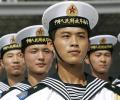
Right from conducting nuclear deterrence patrols in 2015 to its destructive space programme, from its back-tracking on economic commitments to its hardened positions on Sino-India border deal -- its approach with India spells Adversarial with a capital A, says Shehzad Poonawalla

'Curiously, Pinarayi's approach, stressing the imperatives of development, is robustly backed by Nitin Gadkari.'
'I stand next only to Gadkari, one of the few outstanding ministers in the Modi government, in applauding Pinarayi's political courage and vision,' says Ambassador M K Bhadrakumar.

'The potential of one such LAC engagement going out of control and leading to heavy casualties cannot be ruled out,' warns Lieutenant General Syed Ata Hasnain (retd).
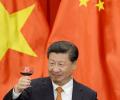
President Xi Jinping was on Thursday elevated as the "core leader" of China's ruling Communist Party, conferring on him a status similar to that of party founder 'Chairman' Mao Zedong that dilutes the three-decade-old collective leadership principle to avoid personality cult.

The Chinese air force is now a 400,000-person force that flies some 2,000 combat aircraft -- more than thrice the size of the Indian Air Force.

Xi, the General Secretary of the Communist Party of China, called the progress China had made under his watch "truly remarkable

'At the previous 18th party congress, Xi vowed to protect China's 'core' interests.' 'As a result, India faced a barrage of serious incidents on the borders with China -- at Depsang, Chumar, Pangong Tso and Doklam.' 'New Delhi will watch closely the political signals emanating from Beijing this week,' says China expert Srikanth Kondapalli.
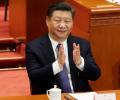
Xi, the most powerful leader in recent decades heading the ruling Communist Party and the military, will now be the first Chinese leader after the founder chairman Mao Zedong to remain in power lifelong.
'The boundary dispute notwithstanding, China has always had leaders who have been, on the whole, positively disposed towards India.' 'Given the centrality of the Chinese Communist Party, we need to strengthen the linkages with the crucial personalities in the highest echelons of the Communist party and political leadership,' notes China expert Alka Acharya.

After many false starts, India may well be at the inflexion point that Deng Xiaoping took China to post-1978. The window of opportunity is wide open right now, says Rajeev Srinivasan.

'There are reports of political dissent mounting on Xi Jinping's handling of the Wuhan fallout.'

'That the two sides allowed such a situation to arise exposed the level of inaction and inefficiency in China-India border management.' 'The Modi-Xi meeting in Xiamen initiated a process to to avert such contingencies in the future.'

For a rising country like China with its sights set on global and regional power, any coming together of the US and India is the worst case scenario. Hence, China is concerned with the emerging equations between New Delhi and Washington, says Srikanth Kondapalli.
'If anyone is able to understand the importance of Modi's endeavours to revive the economy -- even against opposition from sections of his own saffron brotherhood -- it is the former prime minister,' says Amulya Ganguli.

The American efforts to make India a security partner have enhanced India's importance to Chinese decision makers and new recognition of India's importance and achievements are reflected in a much more positive reporting about India in the State-controlled media, says Walter Andersen.

This is the time when the US would need the conceptual strategic thinking of a Henry Kissinger, able to ally diplomatic skills with a well-conceived worldview of what the emergence of a new balance of forces will mean for a US whose ability to shape global events has definitely declined but still exists, says Claude Smadja.

In a rare gesture, China's official media in Beijing on Tuesday extended its biggest coverage to an Indian political event projecting Narendra Modi's takeover as Prime Minister as a harbinger of "big boost" to China-India relations.
