
'it's not just youth in India who are left behind because of their inability to find jobs; nearly two-thirds of Indian women of working ages do not participate at all in the paid labour force.'

'The main problem the country faces is not low GDP growth, but low employment growth.'

Finance Minister Nirmala Sitharaman criticised commentators who express pessimism about India's demographic dividend, asserting that the country's youth are actively driving economic growth and innovation. She also highlighted the dual nature of AI and the need for robust safeguards in emerging technologies like quantum computing to balance innovation with safety.

India remains a young nation, but it will not get younger in future. India has not managed to noticeably improve education. Nor has it managed to create employment opportunities, observes Devangshu Datta.

India has entered a 'demographic sweet spot' with half of its population being under the age of 29. This 'demographic dividend' is likely to last for 2-3 decades and provides the government a unique opportunity to harness the vast potential of India's youth, points out Raj Kishore Mishra, the former civil servant turned development professional.

Rural and urban regions present different labour participation and employment levels. These differences also are not tuned to India exploiting its demographic dividend, says Mahesh Vyas.

India's Chief Economic Advisor V Anantha Nageswaran stated that the country's balance of payments (BoP) pressure is expected to remain a continuous challenge due to rising imports, commodity dependence, high global interest rates, and intense competition for capital.

No country has grown without educating its people. India's shameful lag in primary and secondary education has persisted for several decades, and the crisis in higher education is now threatening a social and political calamity, says Ashoka Mody.

Perhaps half-way through India's demographic transition, what is the outlook for the future?

'... to see that young people are gainfully employed. After that, it will become very difficult as we will start ageing much more rapidly.' 'We have a huge proportion of Gen Z. After 2030, every year, we will start seeing a gradual shift towards a slightly older society.'

'We have to pull 80 million workers out of agriculture and go back to where we were in 2014. That itself is going to be a huge task.' 'We have already lost time, and that is a catastrophe impending.''

The third edition of the Viksit Bharat Young Leaders Dialogue (VBYLD) has commenced with a quiz contest, leading to a national finale in January 2027 where young leaders will present their ideas for a developed India to Prime Minister Narendra Modi. The multi-stage event includes essay challenges, district championships, and state-level dialogues, aiming to foster youth participation in nation-building across various thematic areas.

The falling Total Fertility Rate offers India a chance to become the Pandavas -- fewer in number, but each citizen genuinely empowered, educated, and capable of contributing to a civilisation worth building, asserts Amberish K Diwanji.

Kumar Mangalam Birla urged young people to 'build in India, build for India and build for the world'.

'Applying AI to change the lives of Indians and at population scale -- just like we did with DPI [digital public infrastructure] -- is really where it's going to go.'

'After that the burdens of an ageing population will be upon us, and the share of working age population will shrink.'

AI-driven job disruption, rising debt, shrinking savings and a changing global economy are reshaping India's middle class. Saurabh Mukherjea discusses jobs, entrepreneurship, investing and the future of India's economic growth on THE REDIFF PODCAST.
Less than half of all graduates were employed, with 48.8 per cent reporting some form of work.

'... for two reasons: the poor quality of education, and the low rate of female participation in the labour force.' 'Unless something is done quickly to remedy these problems, India will just have a large population of low-skill, low-wage, males trying and failing to feed their families adequately.'

Cricket's inclusion in the 2028 Los Angeles Olympics is a strategic move by Olympic leaders to tap into India's massive fan base and commercial power, aiming to attract billions of new viewers and strengthen the Games' appeal in key markets.

Dharmendra Pradhan's resignation is significant because it punctures, however slightly, the perception that the Modi government never retreats under pressure. Every long-serving government eventually reaches a point where every institutional failure is identified with the leader himself. Removing the minister may have prevented that political burden from falling directly on Modi. Whether it also resolves the underlying crisis is another matter, notes Ramesh Menon.

'Think of the brain like a machine, and Alzheimer's is like rust.'
'Like a rusty machine breaks down, a rusty brain also breaks down. And when it breaks down, you have memory loss, cognitive issues and so on.'

Underlining that students are the "architects of India's future," President Droupadi Murmu on Friday said the government is taking comprehensive steps to reform public examinations to completely curb paper leaks and unfair means, making the system transparent, secure, and trustworthy.

Education sector experts agree that using the "best technology" was essential to ensure students did not have to sit for an examination all over again because of a question paper leak.

'India cannot speak of a demographic dividend if half its young women are unable to participate in paid work.'

Prime Minister Narendra Modi has urged states to balance the opportunities presented by artificial intelligence with the need to safeguard against social challenges like cyber fraud and drug abuse. He also warned of the risks posed by El Nino conditions, calling for stronger water conservation measures and emphasising the collective resolve towards a 'Viksit Bharat'.

Can change happen? Not unless the changemakers themselves want it since they benefit the most from the status quo, warns Biswajit Dasgupta.

Students, college-goers, competitive exam aspirants, and parents gathered at Jantar Mantar in New Delhi for a protest organised by supporters of the Cockroach Janta Party, expressing deep concerns over recurring examination controversies, result uncertainties, and a perceived lack of accountability within the education system.

Budget 2026 is an intentional and ambitious one - From manufacturing growth to services supremacy, from technology consumption to AI-powered transformation. This is the blueprint for a $7 trillion economy built on intelligence, not just scale.

Internet subscribers, income growth, literacy and dependency ratio are the biggest drivers of growth.

'We will give Rs 25,000 to parents having a second child or more at the time of delivery itself.'

Global risks include a potential delay in the US-India trade agreement, the possibility of a sharp correction in US equity markets, and renewed geopolitical tensions.

On average, Indian women are having fewer children than needed to maintain the population size from one generation to the next, without migration.

'At the first sign of real trouble, that money will move. There will be a run.'

'The more educated a young person is, the higher the chances of him or her remaining unemployed.'

We cannot simply have a 60-65 per cent import dependency in LPG, the bulk of which comes from just one volatile region -- West Asia, points out R Jagannathan.

India is not reaping the benefits of demographic dividends, former RBI governor Raghuram Rajan said on Tuesday, emphasising that there is a need to focus on improving the human capital and enhancing their skill sets. "I think we are in the midst of it (demographic dividend), but the problem is we are not reaping the benefits," Rajan said at a conference on "Making India an Advanced Economy by 2047: What Will it Take" at the George Washington University in Washington DC. "That's why I said 6 per cent growth.
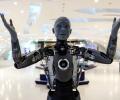
Employers in India are planning to outpace global adoption in certain future technologies as companies operating in the country are heavily investing in technologies like artificial intelligence (AI), energy technologies, robotics, and autonomous systems, said the World Economic Forum (WEF) in its latest "Future of Jobs" report released on Wednesday. The report, released days before the WEF annual meeting in Davos from January 20-25, notes that 35 per cent employers in India think that adopting semiconductors and computing technologies (compared to 20 per cent globally) will transform their operations while 21 per cent employers think that adopting quantum and encryption technologies (compared to 12 per cent globally) will also transform their operations.

'We don't know which bus is coming next. I know for sure whatever bus comes next, it will miss that too.'

A large-scale international study published in the journal, Molecular Psychiatry, has been tracking over 7 lakh individuals and has shown that 34.6 per cent of mental disorders begin before the age of 14 years, 48.4 per cent before 18 years and 62.5 per cent by the age of 25 years.
