
'This revolution has sparked an awakening. Gen Z realises the power it holds.'
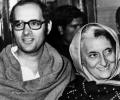
'According to JP, Indira Gandhi was not much of a danger to democracy. He said, it was Sanjay Gandhi and his gang.'

The stage is set for a direct contest between NDA nominee C P Radhakrishnan and joint opposition candidate B Sudershan Reddy for the vice-presidential election. The BJP-led alliance has a clear edge in the poll necessitated due to the sudden resignation of Jagdeep Dhankhar.
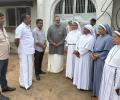
'They have to prove the credibility of their talk; whether they want to focus on the secular face of India, whether they want to focus on democracy and above all freedom of an individual to practice his or her religion.'
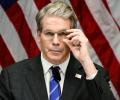
Describing the India-United States relationship as 'very complicated', US Treasury Secretary Scott Bessent on Wednesday hoped that 'at the end of the day, we will come together.'

The Supreme Court has agreed to reexamine the case of a death row convict punished for raping and killing a minor in 2008, focusing on whether sentencing guidelines were properly followed.

Rijiju also hit out at Congress leader Rahul Gandhi, saying that his own party MPs "get uncomfortable" when he speaks in Parliament and are apprehensive that he will do "anap-shanap baatein" and the party will have to bear the consequences.

Police conduct raids at bookshops in Kashmir to seize banned books promoting false narratives and glorifying terrorism, following a government order. The ban and subsequent raids have drawn criticism from authors and political leaders.

He added that India sells to the US, its biggest "client", "massive" amounts of goods, "but we sell them very little - Until now a totally one sided relationship, and it has been for many decades."

The council said it takes serious cognisance of the alleged data manipulation by the CSDS and its attempt to create a narrative to undermine the sanctity of the Election Commission of India (ECI).

Rajya Sabha Chair addresses the issue of expunged proceedings being shared on social media amidst ongoing stalemate between the government and opposition regarding a discussion on Special Intensive Revision (SIR) in Bihar.

Bigg Boss 19 has a healthy mix of characters, mostly GenZ and millennials, but without Bigg Boss's interference, it would be boring to watch some of these wannabes vying for individual fame and attention, expects Divya Nair.

The Supreme Court has granted interim protection to journalist Abhisar Sharma in an FIR lodged against him in Assam over a video post allegedly criticising the state's policies.
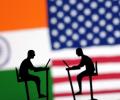
Commerce and Industry Minister Piyush Goyal on Tuesday expressed hope that India will conclude the proposed bilateral trade agreement (BTA) with the US by the fall or November this year. He said that "a little bit" of geopolitical issues overtook the trade matters in the negotiations for the pact between the two countries.
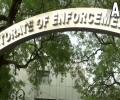
The Enforcement Directorate (ED) conducted searches at multiple locations connected to Tamil Nadu Minister I Periyasamy and his son as part of a money laundering investigation. The probe stems from a Madras High Court order regarding a disproportionate assets case.

'No sane person will ever want to stop this film in Bengal. This is going to heal the Bengali community.'

Opposition INDIA Bloc leaders are considering an impeachment notice against Chief Election Commissioner Gyanesh Kumar over concerns about voter roll revision in Bihar and alleged vote theft. The move comes after the CEC addressed a press conference without addressing the opposition's questions.

The protesters shouted slogans such as KP Chor, Desh Chhod (K P Sharma Oli is a thief, quit the country), "Take action against corrupt leaders".

Monday's protests in Nepal may become the forerunner to many more agitations in future since social media interests and national efforts to regulate them will often be in conflict, alerts Biswajit Dasgupta.
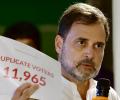
Coming down hard on the Election Commission for its response on 'vote theft' allegations, former chief election commissioner S Y Quraishi on Sunday said the poll body should have ordered a probe into Leader of Opposition Rahul Gandhi's charges instead of 'shouting' at him in a language that was 'objectionable and offensive'.
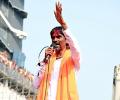
Activist Manoj Jarange is set to launch a hunger strike in Mumbai on August 29 to demand reservation for the Maratha community, despite government attempts to dissuade him. The Bombay High Court has stated that he needs prior permission to protest.

A prankster in Samastipur, Bihar, posed as Donald Trump to apply for a residence certificate, leading the district administration to order an FIR and investigation.
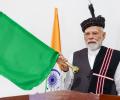
In the last 11 years, India and the world witnessed what he stood for, what he promised and did not deliver, and what he actually stood for and practised without fearing how history would judge him. Modi's tenure has been punctuated with headline-grabbing decisions, symbolic gestures, and stage-managed moments that continue to define his leadership and India's politics, points out Ramesh Menon.

India must evolve its own standards on how democracy must be ranked in a diverse and multi-religious, multi-ethnic, multi-lingual and pluralistic idea called India, suggests R Jagannathan.

Bangladesh's Chief Adviser Muhammad Yunus announced that the next general election will be held in February 2026, marking the first anniversary of the 'July Uprising'.
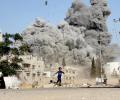
It is high time India ends its silence on the human cost of the Gaza war and takes a principled stand without diluting its relations with Israel. A largely friendless Tel Aviv today needs New Delhi more than the other way around. India's failure now may cost it diplomatically in the long run, cautions M R Narayan Swamy.

The Opposition has claimed that the move will disenfranchise crores of eligible citizens.
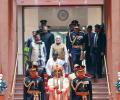
The sengol must revert to where it belongs -- behind a glass case and not figure in ceremonies concerning India's democracy, argues Shyam G Menon.

Union Minister Amit Shah on Wednesday introduced three Bills in Lok Sabha for the removal of prime minister, chief ministers and ministers arrested on serious criminal charges for 30 days, drawing fierce protests from the Opposition as the draft laws were referred to a Joint Committee of Parliament. Three House marshals formed a protective ring around Shah. Even after the House was adjourned, the Opposition members continued with the sloganeering.

The PM's speech from the ramparts of the Red Fort today was " stale, hypocritical, insipid, and troubling", the Congress general secretary said.
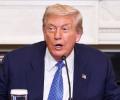
If the US' renewed closeness with Pakistan ends up strengthening Pakistan's military, it will clearly show that Washington no longer wants a strong India and could be ready to let China dominate Asia, notes Colonel Anil A Athale (retd).

The Congress party has accused the Election Commission of India (ECI) of incompetence and partisanship following the Chief Election Commissioner's (CEC) defense of the Special Intensive Revision (SIR) of electoral rolls in Bihar. The party alleges the CEC failed to address concerns about voter list irregularities and is acting in favor of the ruling BJP.
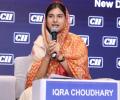
From royalty to a tea vendor-turned-politician's wife and from a first lady to a Bengali actress, the 18 Muslim women who treaded the hallowed corridors of power in the Lok Sabha are an eclectic mix, with each of them having an interesting backstory, but one common thread -- their path to power was always strewn with struggle and hurdles.
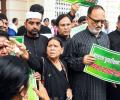
This divergence is likely to intensify political dynamics both within the party and across the state, particularly as the opposition Mahagathbandhan -- comprising the Rashtriya Janata Dal, Congress, and Left parties -- has been aggressively protesting the SIR and demanding its immediate scrapping.

President Droupadi Murmu addressed the nation on the eve of Independence Day, praising the response to terrorism, highlighting achievements in defense self-reliance, and emphasizing unity and progress.

'The moment they fall foul of the party in power, they become unsafe. Then nobody can guarantee their safety.'

Chief Minister Omar Abdullah on Sunday said that the 'unelected nominees of New Delhi locked up the elected representatives' of the people of Jammu and Kashmir after prominent leaders from ruling and opposition parties were not allowed to leave their houses to prevent them from visiting the graveyard of 1931 martyrs in Srinagar.
The Supreme Court is examining the extent to which courts can intervene when governors delay or refuse to act on bills passed by state assemblies. The court questioned the Centre on whether judicial review is barred in cases of gubernatorial inaction, sparking debate on the balance of power between states and the central government.
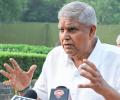
Vice President Jagdeep Dhankhar stated that the Preamble of the Indian Constitution is fundamental and unchangeable, comparing it to parenthood. He also criticized the alteration of the Preamble during the Emergency era, amidst calls for review of certain terms.

The Rajya Sabha was informed about the Ministry of Home Affairs' notification regarding the resignation of Vice President Jagdeep Dhankhar, with immediate effect.
