
The water level of the Yamuna in Delhi breached the danger mark again on Sunday following a surge in discharge from the Hathnikund Barrage into the river after heavy rain in parts of Uttarakhand and Himachal Pradesh.

The Cauvery River Authority, which will meet on February, can change or modify this interim order.
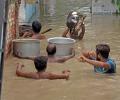
The water level at the Old Railway Bridge crossed the 208-metre mark Wednesday night and rose to 208.48 metres by 8 am on Thursday. It is expected to rise further, according to the Central Water Commission, which has termed it an "extreme situation".

The Supreme Court also asked the supervisory committee to decide on Tamil Nadu's plea in ten days from Monday.

The Yamuna river in Delhi swelled to the highest recorded level in 10 years on Tuesday and is expected to rise further, officials said on Tuesday.

The flow rate at the Hathnikund barrage saw a marginal rise on Tuesday afternoon, oscillating between 50,000 and 60,000 cusecs.

Alluri Sitarama Raju district, which is yet to fully recover from last month's deluge, is once again in the grip of a massive flood threat as discharge in the river crossed 10 lakh cusecs (cubic foot of water flow per second) mark.

The water level of the Yamuna in Delhi, which has been hovering around the danger mark of 205.33 metres for the last few days, dropped below the threshold again on Saturday morning.

The authorities have issued flood alert to the people living in the low lying areas and also along river banks in as many as nine districts.

A dozen people lost their lives in various rain-related incidents in and around Chennai while personnel on fishing boats and farm tractors were engaged in rescuing stranded people on Tuesday.

According to officials, the Ganga was flowing at 463.20 metres following which water filled up in Sangam Ghat, Ramkund, Dhaneshwar Ghat and Fuladi Ghat. There was also a tremendous jump in the water level of the Ganga after 2,000-3,000 cusecs of water was released from the dam of the GVK hydroelectric project built on the Alaknanda river.

The protests, which erupted after the Supreme Court refused to interfere with orders of the Cauvery Water Management Authority and the Cauvery Water Regulation Committee directing the state to release 5,000 cusecs of water to neighbouring Tamil Nadu, have intensified.

Several stalled developmental projects and those waiting Centre's clearances are likely to come up for discussion at the meeting, during which the chief minister is likely to urge the Union ministers and MPs from the state to use their good offices for intervention of the Prime Minister Narendra Modi and the Government of India on the Cauvery issue.
Karnataka was on Tuesday directed to release 2,000 cusecs Cauvery water per day to Tamil Nadu from October 7 to 18 by the Supreme Court.
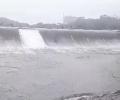
In the wake of heavy rains over the last few days, the Tansa and Vihar lakes, the key sources of potable water for Mumbai, started overflowing on Wednesday, the Brihanmumbai Municipal Corporation (BMC) said.

Jharkhand traffic Police Constable Upendra Kumar Ray -- who was felicitated by senior police officers for his extraordinary contribution in managing traffic -- displays his impressive moustache in Ranchi.

Karnataka Chief Minister Siddaramaiah on Monday hit out at the BJP-led government at the Centre, alleging the delay in giving approval to the construction of the Mekedatu balancing reservoir over the river Cauvery, and accused neighbouring Tamil Nadu of causing "unnecessary nuisance" on the issue.

The Punjab government has ordered the closure of schools till July 13 while in Chandigarh schools are closed till Thursday.

West Bengal Chief Minister Mamata Banerjee Friday held Jharkhand and DVC responsible for the current "man made" flood in the southern part of the state and contended that it was caused due to the unplanned and enhanced discharge of water from dams and barrages in the neighbouring state without information.

Proposals involving Himachal Pradesh and Uttar Pradesh were being pursued since 2019.

Ernakulam district authorities on Tuesday said 350 cumecs of the water from Idamalayar, which reached Periyar river but there was no considerable rise in the water-level.

Delhi is staring at a water crisis amid the rising heat, with the water levels at the Wazirabad pond depleting alarmingly due to less flow in the Yamuna, officials said.

As the storage level touched 3,000 million cubic feet in the Chembarambakkam reservoir as against its full capacity of 3,645 Mcft, authorities on Wednesday began releasing about 1,000 cusecs into the Adyar river as a precautionary measure.
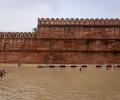
The Yamuna surged to a record 208.48 metres at 8 am, the Central Water Commission said on Thursday, adding that it is likely to rise to 208.75 metres by 4 pm.

The rain ebbed in some places in north India and pelted down in others on Tuesday, with at least seven more people dead and hundreds stranded as raging waters gushed through villages, towns and fields -- from the desert state of Rajasthan to the hills of Himachal Pradesh.

In Punjab, more than 9,000 people were evacuated in Patiala, Rupnagar, Moga, Ludhiana, Mohali, SBS Nagar and Fatehgarh Sahib districts, officials said on Tuesday.

Faced with criticism that water released from its dams in an 'unprecedented' manner led to the flooding of West Bengal, the Damodar Valley Corporation (DVC) on Wednesday said that it discharges water after taking consent of the state government and blaming it for the deluge is not justified.
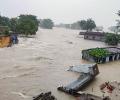
The release of water has affected over 1.50 lakh people and damaged 171 houses, he said, adding National Disaster Response Force personnel have been deployed in the area to rescue people.

Chief Minister M K Stalin inspected several inundated areas here along with top officials including Chief Secretary V Irai Anbu and directed authorities to take swift action to drain flood water.

Modi assured to extend all required assistance to the state to face the situation, the Chief Minister's office said.

Tracing the remaining persons was proving a daunting task as the river remained in spate with over two lakh cusecs of floodwater gushing, sources said.

Better living conditions must be an integral part of all political campaigns. But this will only happen if the public pressures the political class to understand the irreversibility of climate change and make the environment a crucial part of their manifestos.

Following is the chronology of events in the decades-old Cauvery water dispute matter in which the Supreme Court on Friday held that Karnataka will get 284.75 tmcft and Tamil Nadu 404.25 tmcft Cauvery water.

Subsequently, Nivar weakened into a cyclonic storm and further into a deep depression, centered about 50 km west-southwest of Tirupati at 1430 hrs, the India Meteorological Department (IMD) officials said. According to IMD, it is to weaken into a depression during the next six hours.

The main rail and road routes in Andhra Pradesh, connecting the south and east, remained cut off as the Penna river in spate caused heavy destruction on Sunday.

Surplus rain water gushed out of reservoirs while several roads here resembled swollen rivers and four persons were killed in rain related incidents in Tamil Nadu and over 60 houses suffered damage, authorities here said on Monday.

Thirteen teams of the National Disaster Response Force and three of the State Disaster Response Force were deployed in vulnerable districts of the state, a disaster management department report said.
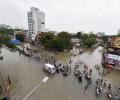
In signs of easing of situation, the water levels of Adyar and Kumbh rivers have fallen considerably following reduced discharge from reservoirs on Thursday night.

Karnataka government on Saturday moved the Supreme court seeking a review of its order directing the state to release Cauvery water to Tamil Nadu even as it faced strident calls from opposition parties not to release the water "at any cost".

Siddaramaiah added that all efforts would be made to provide drinking water to Bengaluru and other places as also for crops.
 © 2026 Rediff.com - Investor Information - Advertise with us - Disclaimer - Privacy Policy - Sitemap - Feedback - About us - Terms of use - Grievances