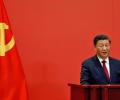
The Chinese Communist Party reaffirmed President Xi Jinping's leadership and backed a major purge of top military officials during a key meeting. The meeting also endorsed a new 5-year plan focused on domestic market resilience and self-reliance.

'The Olympic Spirit has been thrown to the wind in Xi Jinping's China.' 'The International Olympic Committee is ready to kowtow to totalitarian China,' notes Claude Arpi.
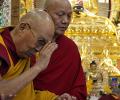
His successor issue is also expected to flare up fresh tensions between Beijing and Washington as China's policy comes in conflict with the US Tibetan Policy and Support Act of 2020, which reaffirmed America's steadfast support for the Dalai Lama and Tibetan Buddhism.
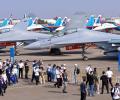
China has announced a 7.2 percent increase in its national defence budget, bringing the total to USD 249 billion for the year. This rise comes amidst China's ongoing efforts to modernize its armed forces, including the development of new warships and fighter jets. The budget increase, exceeding last year's 7.2 percent rise, reflects China's commitment to bolstering its military capabilities. Chinese Premier Li Qiang emphasized the importance of the Communist Party's leadership in guiding the military, with President Xi Jinping at the helm of the Central Military Commission. China's defence spending is now three times that of India's and is viewed by critics as a sign of the country's growing military ambitions.

The Information Support Force was regarded as the revised version of the PLA's Strategic Support Force, established in 2015 by the Chinese military to deal with space, cyber, political and electronic warfare to fight what was described as "informationised wars".

The Central Committee members on Sunday elected a 25-member Political Bureau which picked the Standing Committee members to govern the country.

Chinese President Xi Jinping is all set for an unprecedented third five-year term as he was 'elected' to the powerful Central Committee of the ruling Communist Party on Saturday while several top leaders including Premier Li Keqiang have been left out in the major shake-up at the top.
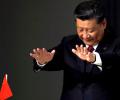
Chinese President Xi Jinping on Tuesday visited an exhibition of the Communist Party, appearing in public for the first time after his return from the SCO summit on September 16, which sparked rumours about his absence from the limelight ahead of next month's key Congress of the ruling party.

Except for Xi, 69, all top officials including the number two leader, Premier Li Keqiang will be replaced in the massive reshuffle to follow in the days to come, which included a new foreign minister replacing the incumbent Wang Yi.
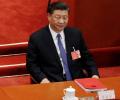
During his four-day tour of the region which started on July 12, Xi met with officials.

Addressing the centenary celebrations of the Communist Party of China at the historic Tiananmen Square, Xi in over an hour-long address also said that integrating Taiwan with the Chinese mainland is a historic mission of the ruling party.

Bracing for leadership changes in the ruling Communist Party of China due for next year, Chinese legislators on Sunday approved plans to change the course of their export-driven economy while firmly ruling out multi-party democracy. "Political development path of socialism with Chinese characteristics is the only correct road for China's development and progress as proved by practice," read a resolution approved by Chinese People's Political Consultative Conference.
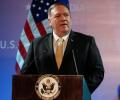
Pompeo, during a Congressional hearing on Thursday, told the members of the House Foreign Affairs Committee that 'the actions are entirely consistent with what they have been signalling to the world for decades you might even argue since 1989, but certainly since General Secretary Xi came to power'.

'Although Hong Kong weathered many a storm and displayed a remarkable resilience to bounce back, the developments in the territory have raised question marks with regard to its future stability and prosperity.' A revealing excerpt from Rup Narayan Das's Hong Kong Conundrum: Pangs of Transition.

The highlight of the occasion, according to officials, is an address to a special gathering in the morning by President Xi Jinping, who cast himself in the mould of Mao Zedong, the founder of the Communist Party of China as it is officially called.
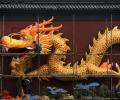
'The world is finally recognising that China is pushing a form of government that many only now are beginning to recognise as problematic'
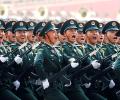
The parade was seen as a muscle-flexing exercise by Beijing.
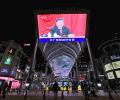
Support from the committee gives Xi an indefinite extension on the reins of power, which will surely result in hawkish and insular policies. It does not bode well for relations with the USA, or with anyone else who does not bow the knee to Beijing, for that matter.

It will be interesting to see whether India-China border tensions figure during the deliberations of PLA deputies to the NPC and CPPCC, notes Jayadeva Ranade, the distinguished China expert and retired RA&W officer.
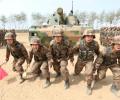
Last year, the country's defence budget was $175 billion.

'India imports 70 per cent of its bulk drugs from China. Are we going to live without antibiotics?' asks Debashis Basu.

By jettisoning the vision of multilateral world in favour of a Han Empire, China has posed a major long term challenge to India. India must stand firm against Chinese expansionism but also keep a door open for future detente by making a clear distinction between Chinese people and the current Chinese leadership, observe Lieutenant General Ashok Joshi (Retd) and Colonel Anil Athale (Retd).
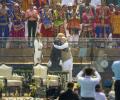
Does an invitation to visit India bring bad luck to majoritarian demagogues? asks Rahul Jacob.
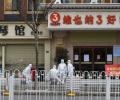
The Wuhan local administration earlier announced that people who are not quarantined and seeking special treatment or stranded in the city can leave in batches.
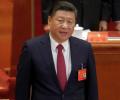
Xi's concept of "socialism with Chinese characteristics for a new era" was added to the party's Constitution

India lacks China's culture of collective discipline, so what will provide the glue for people to cooperate rather than follow their raw survival instincts? asks Ravi Bhoothalingam.

'Clarifying that modernisation of national defence and armed forces should be completed by 2035, Xi Jinping asserted the goal is to make the People's Liberation Army a "world class force" that "can fight and win" by 2050,' points out former RAW officer Jayadeva Ranade.
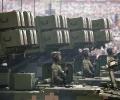
There is growing alarm at the inexorable rise of China, both of its military prowess and its aggressive bullying of other countries plus its subjugation of whole portions of its own population.
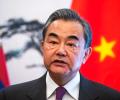
Was Wang Yi'S visit intended to remind India of 1962, asks Claude Arpi?

The removal of the term limit will give Xi a limitless tenure.

The seventh Tibet Work Forum was held in Beijing on August 28 and 29. Delhi should be deeply concerned, at a time India faces a precarious situation in Ladakh, because the TWF also defines China's western border policies, observes Claude Arpi.

The Chinese Communist party has not closed its door of contacts and negotiation with the Dalai Lama, a senior Communist leader wrote recently. Former RA&W officer and China expert Jayadeva Ranade explains what the thinking on Tibet is likely in Beijing.

'Is Xi's China stable?'
'No one can say whether the regime will fall all at once or if its leaders are devising a new solid and competitive -- anything but democratic -- model.' A fascinating excerpt from Francois Bougon's Inside The Mind of Xi Jinping.

'The supreme art of war is to subdue the enemy without fighting.' Former RA&W official Jayadeva Ranade explains what China's military reforms mean for the world.
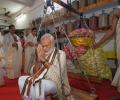
'The return of India to its own civilisational values can never endanger freedoms as pluralism is the bedrock of our culture,' assert Lieutenant General Ashok Joshi (retd) and Colonel Anil A Athale (retd).

Xi ordered country's 2.3 million-strong military to be absolutely loyal to the party, to focus on how to win in wars, to pioneer reforms and innovation, to scientifically manage commanding a unit, to lead troops in accordance with the strictest standards and to take the forefront in complying with laws and regulations.

The Politburo Standing Committee -- the most powerful body in China -- is unveiled, but in a break from Communist party convention, no successor to Xi Jinping is named.

He praised the PLA's combat readiness.
 © 2026 Rediff.com - Advertise with us - Disclaimer - Privacy Policy - Sitemap - Feedback - About us - Terms of use - Grievances