
Chinese President Xi Jinping on Sunday said the People's Liberation Army has the confidence and capability to defeat all invading enemies as he inspected a massive military parade at the country's largest military base to mark the 90th founding anniversary of the 2.3-million strong army.

Making waves with trade deals worth billions of dollars during his first European tour, President Xi Jinping put up a strong defence of the monopoly of power by the Communist Party of China saying that China had settled for a one-party system after unsuccessful experiments with multi-party democracy.

Xi, the General Secretary of the Communist Party of China, called the progress China had made under his watch "truly remarkable
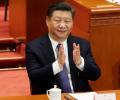
Xi, the most powerful leader in recent decades heading the ruling Communist Party and the military, will now be the first Chinese leader after the founder chairman Mao Zedong to remain in power lifelong.
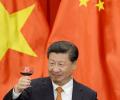
President Xi Jinping was on Thursday elevated as the "core leader" of China's ruling Communist Party, conferring on him a status similar to that of party founder 'Chairman' Mao Zedong that dilutes the three-decade-old collective leadership principle to avoid personality cult.

'He still has to deal with party norms and traditions and has been careful to follow the order of seniority,' points out Claude Arpi.

China's obsession with exports and electronics assembly can also be attributed to having learned from the Singaporean textbook.

'The "Hollandisation" of British policy may not bring the expected gains as the future may show,' says Claude Arpi.

Will China's new military reforms endanger Xi Jinping's rule?

In the second and final part of his column, Col Anil Athale says the fight between forces of Indian nationalism and Macaulayism aided and abetted by West is going to be long, hard and dirty. The outcome will decide whether India becomes a superpower or continues to wallow in the swamp of underdevelopment.
 © 2026 Rediff.com - Advertise with us - Disclaimer - Privacy Policy - Sitemap - Feedback - About us - Terms of use - Grievances