
Top per capita producers are the wealthy nations of Europe.

Let's have a look at 20 slowest-growing cities in the world.

Official websites of some states haven't been updated for years
The national poverty rate is 14.7 percent.
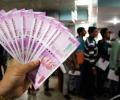
'This is not without risk because extraordinary steps taken in exceptional times have the habit of becoming habits until the next crisis intervenes,' warns T N Ninan.
The remote Himalayan region of Tibet is witnessing impressive economic growth and the region's per capita gross domestic product has touched an all-time high at $997 in 2004, a senior regional leader has said.
New Yorker Aseem Chhabra is entranced by two Dilli restaurants, one a landmark, the other a new eatery in town.

The 50-share NSE Nifty ended flat, up by 9.85 points, or 0.09 per cent, at 10,399.55.
Delhiites splurge more than their cousins in other cities, with a large percentage of their income spent on conveyance, house rent and entertainment.\n
Naveen Jindal, Chairman and Managing Director of Jindal Steel and Power Ltd (JSPL), has topped the executive pay charts for listed companies in India.

One in five students drop out from school.
Food insecurity and hunger are rooted in bad policies, faulty design, poor governance and a lack of political will.

'In India, we are very far away from the per capita incomes of the West. And so the need to support many more people with much more money will come sooner in India than in other nations,' says Aakar Patel.

China's economy picked up pace notching up 7.4 per cent year on year growth in the first half of 2014, the National Bureau of Statistics (NBS) said on Wednesday.

India's water future remains very bleak. The monsoon season, which once extended to 4 months, is now down to less than 30 days of heavy rain.
Energy consumption in Saudi Arabia is witnessing an unprecedented growth, prompting a wave of investments expected to reach $133 billion (502.5 billion Saudi riyals) for various power generation and water projects in the next decade, organisers of an industry event said.

Plans to enter the Southeast Asian market through acquisition.
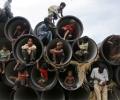
India is poorer than the world average and so naturally has a greater percentage of poor people and a lower percentage of rich people. Yet using absolute numbers, India has more of almost everything, which is misleading, says Debraj Ray and Maitreesh Ghatak.

Construction companies will make money building detention centres. Information technology companies will make money on the enumeration of the CAA, NRC and NPR, notes Devangshu Datta.

'What Jaishankar says is simplistic.' 'The past does not matter that much.' 'If we think that it does it is because we are not good enough at running the nation competently today and are searching for excuses why,' argues Aakar Patel.
India is home to one third of the world's poor, yet the government claims that poverty has fallen.

With its rising energy needs, India has emerged as the fourth largest energy consumer of the world after the US, China and Russia.
The government is likely to infuse additional capital of Rs 20,000 crore in the public sector banks next financial year to meet Basel III global capital risk norms.
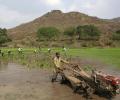
Much of the rural recovery story is based on the premise of agriculture doing well. Even if it clocks a growth of 2.5-3 per cent this year, it is still just around 15 per cent of the overall GDP. The non-farm sector, which constitutes a bigger portion of the overall rural economy, is now hampered by disruptions and lockdowns.

'Personally, I have reached that stage where I think material things can't give you any satisfaction.'
Demonetisation was not a good idea and the time should have been utilised instead to fine-tune the Goods and Services Tax before it was introduced, said Gita Gopinath, John Zwaanstra Professor of International Studies and of Economics at Harvard University, in an interview with Advait Rao Palepu.

Among households headed by someone who entered the US since 2000, only one-fourth were owned.
Though Indian-Americans have the distinction of being the highest-per capita income group among ethnic communities, they lag far behind their European counterparts when it comes to owning a house in the US.
Expenditure on food articles as a proportion of monthly expenditure is decreasing.
India's monstrous public distribution system ensured that the government, and not private players, became a huge hoarder of food grains.

India is already importing 80 per cent of oil and 25 per cent its gas requirements.

Beside manufacturing, deceleration was also witnessed in sectors like agriculture, construction and electricity, gas and water supply.
Take a look at the 25 best countries for doing business.
The Confederation of Indian Industry on Monday proposed a 5 per cent cess to develop railway infrastructure and exuded confidence that 7-8 per cent GDP growth was achievable in the next decade.

A comprehensive solution involves a complete overhaul of our education and training model.

21st century may have witnessed expansion of higher educational institutions, but who can afford it? Sushree Panigrahi & Jeet Singh look at the numbers.

The Parli assembly seat in Beed district will again see his daughter Pankaja Munde and nephew Dhananjay Munde lock horns for supremacy.
 © 2026 Rediff.com - Advertise with us - Disclaimer - Privacy Policy - Sitemap - Feedback - About us - Terms of use - Grievances