
'Pakistan does not have the capacity to fight a war with us. They do not want to fight a war. It does mischief as per its policy of 'bleed India through a thousand cuts'

Chief of Defence Staff Gen Anil Chauhan identifies China border dispute as India's biggest national security challenge, followed by Pakistan's proxy war. He also highlighted regional instability, future warfare scenarios, and dealing with nuclear-armed adversaries as major concerns.
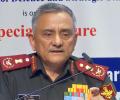
Pakistan's decision to talk to India on May 10 stemmed from realisation that it will suffer more if its operation continues, Gen Chauhan said.

The Pahalgam massacre highlights the evolution of terrorism into a multi-domain challenge. India's response must similarly evolve -- from tactical retaliation to comprehensive strategic deterrence. To establish a credible and sustained deterrent, India must also carry out continuous kinetic operations, both overt and covert, suggest Sakshit Raina and Rahul Mishra. To establish a credible and sustained deterrent, India must also carry out continuous kinetic operations, both overt and covert, suggest Sakshit Raina & Rahul Mishra.

Unless each attack drone can be neutralised, India will be literally deploying elephants to stamp out ants -- and the ants may still survive! points out N Sathiya Moorthy.

Indian agencies have been engaged in countering Pakistani cyber-attacks on social media platforms for a very long time. But just like the fight against the coronavirus, only through the active participation of ordinary citizens that this war on fake news can be won, suggets Colonel S Dinny (retd).

Pakistan is trying to bleed India through a thousand cuts and the country's economic establishments are running the risk of being attacked, a top government official said on Tuesday.
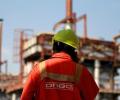
At a time when crude oil and natural gas prices are sky-high, public sector behemoth ONGC's haphazard planning and mismanagement in developing showpiece deep-sea KG-D5 block is costing the nation over Rs 18,000 crores due to the delayed output of oil and gas, government officials said. ONGC was originally to start gas production from the Cluster-II fields in block KG-DWN-98/2 (KG-D5) in June 2019 and the first oil was to flow in March 2020. But these targets were quietly shifted to end-2021 because of deferments in awarding the fragmented work packages of the project, two officials with direct knowledge of the matter said on condition of anonymity.
.jpg)
Throughout a quarter century of proxy war, India has shown tremendous restraint in the face of grave provocation. It is inconceivable that any other nation would have refrained from launching trans-LoC operations to eliminate terrorist training camps and interdict known routes of infiltration, says Brigadier Gurmeet Kanwal (retd).

India failed to extract the 'price' from Pakistan for its Kargil misadventure.
The price could have been military in terms of loss of territory/soldiers/equipment or destruction of terrorist training infrastructure. Giving a 'face saving' option to Pakistan proved disastrous for the future, asserts Colonel Anil A Athale (retd).

The projectile, fired by some unidentified people, hit the Saanjh Kendra adjoining the Sarhali police station on the Amritsar-Bathinda highway on Friday night.
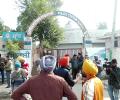
A National Investigation Agency team, which reached the spot on Saturday evening, was also carrying out its investigation by visiting the spot, they said.
Vicky Nanjappa analyses the threat that illegal immigrants from Bangladesh are posing for country
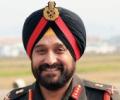
The army on Friday made it clear to Pakistan that it cannot keep the tap of exporting terrorism to India open and hope for confidence-building measures with it.

"There are floods. Large number of leaders try to portray militant groups in a good way. A number of militant groups have sent their elements to Balochistan and Sindh for helping people affected by floods," Lt Gen Singh said.
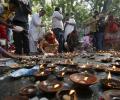
'There is no point in just saying, 'hum wapas bhej denge (we will send Kashmiri Pandits back)'.'

'If the jihadi infiltration attempts are assisted by the Pakistan army, the Indian Army will retaliate strongly.'

'After Uri, the current government took public ownership of surgical strikes.' 'The question they need to ask themselves is did this bring about a change in Pakistan's behaviour towards us? The answer is no.' 'If there had been a change, then Pulwama would not have happened.'
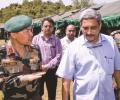
'China is likely to help Pakistan in keeping the fire burning in J&K to bleed India for its own interests.' A fascinating excerpt from Lieutenant General K Himalay Singh's Making of a General: A Himalayan Echo.

'Nobody is going to fight India's war.' 'India has to fight its own war against the rogue State and the evil forces nurtured by it.'
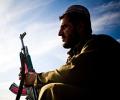
Pakistan-based Lashkar-eTayiba and its front group Jamaat-ud-Dawa, enjoying backing of the military, have not only grown far stronger since the Mumbai terror attack in 2008, but are also trying to acquire weapons of mass destruction, in addition to developing air and sea power, a new book says
In a strong indictment of Pakistan, Germany said on Thursday that groups like Lashkar-e-Tayiba were a creation of the Inter-Services-Intelligence and Islamabad will have to satisfy India that it was acting against the terror outfit if it wants to improve relations with its neighbour.
New Delhi should constantly bear in mind that despite Major General Mahmud Ali Durrani's soft-spoken approach, crucial decisions on relations with India, particularly on terrorism-related issues, will remain in the hands of the Punjabi-dominated Pakistani military
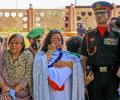
'The Delhi-Washington stalemate can end only if India's concern over trans-border terrorism is addressed.' 'The Indian security establishment expects a spike in terrorist attacks in the months ahead.' 'And there is every likelihood that India may retaliate against Pakistan at some point,' observes Ambassador M K Bhadrakumar.

'The Indian response in confining our action to our side of the LoC set a dangerous precedent,' argues Colonel Anil A Athale (retd).

Pakistan's military can go to any length to inflict harm on India, so don't write off the possibility of an ISI-IS alliance, says Rajeev Sharma.
'Offensive operations to capture objectives across the LoC to eliminate terrorist launch pads and deny the use of the most dangerous routes of infiltration, are likely to be limited to brigade-level attacks.' 'These limited operations are unlikely to escalate to war across the international boundary,' says Brigadier Gurmeet Kanwal (retd).

'Pakistan's security establishment, despite its appallingly immoral approach to conflict, has worked with limited resources to maximise its national defence resources to continue bleeding India,' says Ajai Shukla.

'Pakistan will try to escalate covert operations through terrorism,' says Dr Shalini Chawla.

'China any day would prefer to team up with India and dump Pakistan once the resolution of the border dispute becomes an accomplished fact.'

'Part of the problem lies in the US failure to stay focused on the goal of convincing Pakistan to crack down on terrorists that attack India.'
'We need to be in a perpetual state of aggression, and able to swiftly change the goal posts to keep Pakistan in a state of imbalance,' argues Sanjeev Nayyar.
'The devious minds across the border will test us to the hilt, but in the course of that will offer us opportunities for which we must be prepared,' says Lieutenant General Syed Ata Hasnain (retd), who commanded the Uri Brigade, the Baramulla Division and the Srinagar-based Chinar Corps.

India is not making a choice of war over peace. Rather it is at war, a war thrust on it by a sick militaristic State, says Sankrant Sanu.

'Pakistan has responded with appropriate contempt -- hrowing our national dignity into the waste paper basket.'

'By beheading an Indian soldier, the Pakistan army has demonstrated its proclivity for barbaric medievalism.' 'The strategies adopted and the punishment inflicted by India must be made progressively more stringent with every new act of terrorism till the cost becomes prohibitive for Pakistan,' says Brigadier Gurmeet Kanwal (retd).

'Since India has to live next to Pakistan, it can't remain under permanent blackmail.' 'A predictable consequence of these fundamental shifts is the fraying of the principle of strategic restraint.' 'It hasn't been junked. But the threshold has been shifted to provide India much greater room for retaliatory action,' says Shekhar Gupta.

'We should hit Pakistan, continue to prepare for surgical strikes, continue to punish Pakistani posts in the proximity of the LoC and we should start adopting counter terrorist measures.' 'That should be India's action without escalating it to a full-fledged war.'
India must watch for signs after Peshawar that Pakistan is waking up to the dangers of Islamism, muses Ajai Shukla
 © 2026 Rediff.com - Investor Information - Advertise with us - Disclaimer - Privacy Policy - Sitemap - Feedback - About us - Terms of use - Grievances