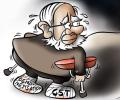
While GST and insolvency laws are among the major achievements of the Modi government, the list of failures include demonetisation, toxic banks, manufacturing hiccups and most prominently bizarre job creation figures. Mihir S Sharma takes a look at the four years of Modi government.

The need to allow government shareholding in public sector banks to come down below 51 per cent

The government package for public sector banks, announced last Friday, has been welcomed by the stock market with the PSU banking index booking smart gains.
'The one sector where there is still a sense of crisis is banking, but the government has regrettably set its face against privatising any of the government-owned banks,' says T N Ninan.

Budget 2015 has blessed the banking sector.

India's ailing banks need immediate attention.

'The PCA framework was revised and tightened in April 2017, but there was no discussion in any board meeting. The government does not know the rationale behind revising the framework and how the RBI arrived at it. Similarly, there was no discussion in the board meeting on the revised NPA framework,' said an official.

'The entire government-owned banking system (excluding SBI) is now in the red.' 'But worse is to come,' warns T N Ninan.

investors will look to the new governor to continue the banking sector clean-up with the same urgency as Mr Rajan, who was targeting fully cleaned-up and provisioned balance sheets by March 2017

Given that it is only a temporary breather for PSBs, the government now needs to look at the harder options.


The government must set up a Bank Investment Company to shrink its role in PSBs, if we are serious about tackling the two persistent issues - lax corporate governance practices and discretionary decision-making, says Shyamal Majumdar.
'And who sold this belief?' 'Public-spirited individuals' like Subramanian Swamy.' 'Independent public servants' like Vinod Rai. 'Anti-corruption activists' like Kiran Bedi. And 'outspoken television anchors' like Arnab Goswami,' says Mihir S Sharma.

Bankers seem to be pleased with the government for keeping its promise of not interfering in operational matters, but are apprehensive about the intense scrutiny of their functioning.

What was the RBI doing, what was the PNB top management doing, what were the auditors doing, asks Debashis Basu.

The proposed IFC disrupts existing regulatory structures.

Political funding of elections has led to the rise in black money in the economy.

'Let's walk on two legs: Facilitate better resolution under the present system and set up PARA as well by transferring loans amounting to, say, Rs 1 lakh crore.'

The central bank dashed hopes of any steep interest rate reduction.

On government's last week's announcement of revamping of PSU banks, Fitch Ratings said the move is "credit positive, but risks remain".
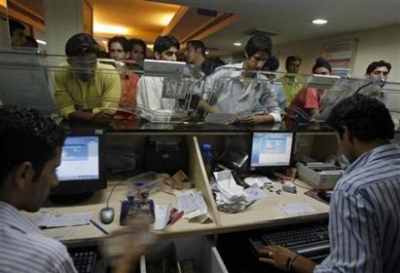
Private banks are assumed to be more efficient at intermediating between depositors and investors.

From the roll-out of GST to H1B visa problems, the government needs to quickly deal with various disruptions.
The next general election is more than three years away. Yet, the Centre appears to be reluctant to take any bold move that might annoy influential sections of the electorate.

Many bankers say the move will have a serious impact on the chain of command of nationalised banks and that it would only enable the government to dish out favours to a few of their own men.

Above normal monsoon forecast and strength in Asian equities lifted sentiments.
The NPA of the public sector banks rose to 6.03% as of June 2015.

The problem of stressed assets needs to be addressed with effective recovery.

The court said a 'scam was created when there was none'.

Will Arundhati Bhattacharya be the RBI's first woman governor? Or will Urjit Patel succeed Raghuram Rajanas RBI governor when his term ends on September 4?

Mihir S Sharma outlines why this year's Union Budget does not respond to the needs of India's economy, or attempt to frame the economy's future.

'The world is going to be more insular.' 'What India needs to do is develop the domestic market for domestic consumption.' 'The emphasis has to be on Bharat as against India.'

The principal challenge for Rajan's successor is to work with the Bank Board Bureau and the finance ministry to complete these processes of banking reform.

"I am an academic and I have always made it clear that my ultimate home is in the realm of ideas," Rajan said in a letter to staff.

What is required from government is intellectual framework.

Rajan tells RBI colleagues he will be returning to academics

'This has to be seen in the context not only of the legacy we inherited, but also of global economic weakness.'
'If after inheriting the very bad situation we have reached this level despite consecutive years of drought and no growth in the world economy, it is no accident.' 'It is a result of the sound macro economic policies followed by this government.' 'We have eschewed populism and stuck to a path of fiscal prudence.'

The clean-up process begun by the Reserve Bank of India runs the risk of spiralling out of control.

Indian cricket, it seems, pays overwhelming obeisance to a vapid, old adage: The more it changes, the more it remains the same.

Banks in India must have a modern approach, suggests a panel comprising of banking bigwigs.

Finance Minister Arun Jaitley presented the Union Budget.
 © 2026 Rediff.com - Investor Information - Advertise with us - Disclaimer - Privacy Policy - Sitemap - Feedback - About us - Terms of use - Grievances