
T N Seshan believed that toughness at every level is needed to keep the flock under him strictly duty bound, recalls Dr K S Parthasarathy, former secretary, Atomic Energy Regulatory Board.

The first unit of Kudankulam Nuclear Power Plant, which attained criticality on July 3 will reach its maximum capacity of 1000 MWe by November end, according to S Sundar, project site director.

Rocket Boys offer an overwhelming experience to me and many others who saw Homi Bhabha in action at Trombay, observes Dr K S Parthasarathy, former Secretary, Atomic Energy Regulatory Board.
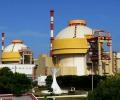
Power generation at the Kudankulam Nuclear Power Plant in Tamil Nadu has been temporarily suspended for the second time in about a week in order to undertake mandatory tests, official sources said on Wednesday.
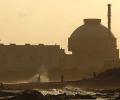
The first unit of the Kudankulam Nuclear Power Plant was synchronised with the southern power grid on Tuesday, marking a major milestone in power generation of the ambitious Indo-Russian nuclear collaboration in Tamil Nadu.
After years of deadlock on liability issue, India and Russia have signed an agreement for building units 3 and 4 of the Kudankulam Nuclear Power Plant project at a cost of Rs 33,000 crore.
The Supreme Court on Monday sought response from the Centre and Atomic Energy Regulatory Board on implementation of safety guidelines issued by it for the Kudankulam Nuclear Power Plant in Tamil Nadu.
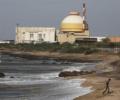
A petition has been filed in the Madras High Court against commissioning of the Kudankulam Nulcear Power Plant on the ground that authorities had not complied with all the directions issued by the Supreme Court while giving the green signal to the controversial project.

The reactor will start its initial production of 400 MW electricity within 20 days, Union Minister V Narayanasamy said.

A pact between the NPCIL and Westinghouse to build six power reactors in Andhra Pradesh is unlikely to be signed.

GE Healthcare has already filed five global patents for its design.

A radiation scare at Delhi's Indira Gandhi International Airport forced the suspension of cargo operations, but nuclear regulator and Delhi authorities said there was no leak of radioactive substance from a consignment unloaded from a Turkish Airlines plane.
The entire area has been cordoned off and National Disaster Management Authority has also been informed about the incident.

The Kundankulam Nuclear Power Plant attained its full generation capacity and became the first nuclear plant in the country to generate 1,000 MW of power on Saturday, its site director R S Sundar said.
Civil nuclear projects in the country would be subject to Indian laws including on issues of civil liability, National Security Adviser Shivshankar Menon said on Friday dismissing reports of attempts to dilute the liability clause in contracts proposed with United States firms.
'Decisions on nuclear power have so far been taken by a small select group, primarily interested in profiteering from their actions, stating 'secrecy' as necessary from the national security point.' 'This argument is false, because we are dealing with the 'civilian' nuclear power sector, which is open even to the IAEA,' says Dr A Gopalakrishnan, former chairman of the Atomic Energy Regulatory Board.

With the spectre of nuclear terrorism growing, the international community is concerned about the security of India's nuclear facilities. The worry has grown since 2010, when radioactive Cobalt-60 surfaced in a New Delhi scrapyard, killing one person and hospitalising eight others.

On Dr Homi J Bhabha's 110th birth anniversary, Dr K S Parthasarathy shares some personal memories of the legendary nuclear scientist.

Nehru's faith in science and technology, his genuine respect for Bhabha, and their burning ambition worked synergistically to place India on the nuclear map of the world. Atomic energy developed and prospered because of Nehru's vision fulfilled by Bhabha's mission, recalls K S Parthasarathy, former secretary of the Atomic Energy Regulatory Board, on the occasion of India's first prime minister's 119th birthday today.

The government must justify why we need to buy foreign reactors when we have developed up to 700 MWe unit-size pressurised heavy water reactors, a design which can be easily extended to 900 to 1000 MWe unit size. Why can't the 'Make in India' philosophy apply to indigenous nuclear reactors, more than 18 of which have been designed, built, and being operated by Indian engineers, asks Dr A Gopalakrishnan.

Those worried say Kakrapar was lucky to have witnessed leakage of heavy and light water from the coolant channel without any serious damage to fuel bundles in the reactor.
Sustained campaign forces NPCIL to issue statement on Kakrapar fuel leak. But there is still not clarity on what went wrong.
'The leak is likely to continue for some time before it becomes stable, but this is something that NPCIL, who is the plant operator, will have to do. For this, we have to plan very carefully.'

'Can we forgive the pathologist who wrongly labelled a healthy person as a diabetic patient for receiving the favour of the referring physician and possibly for a few thousand rupees?' 'The delinquent homeopath who caused a cataract in a child by giving terribly wrong drug must go to jail.' 'How can we permit a gynaecologist to practice her/his specialty if s/he tinkers with the faith of the patient in an abhorrent way?' 'Paying money does not guarantee good healthcare. The private healthcare system largely treats patients as revenue generators,' crusading doctor Dr Arun Gadre tells Dr K S Parthasarathy.
Scientists are puzzled by what caused the mysterious nuclear leak at the Kakrapar Nuclear Power Plant in Gujarat last year, reveals Pallava Bagla.
'We need uranium to fuel our reactors. Our scientists and engineers have been handling uranium safely since 1967. They must not feel disheartened by the activities of well motivated local or foreign agencies.'
Overall, data and its analysis used in the reports prove that members of staff of DAE, like others, are prone to cancer and suicides! No more, no less! Sensational reports have the potential to do infinite damage to our nation's nuclear energy programe and create unwanted fear, says Dr K S Parthasarathy.
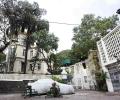
Every blade of grass and grain of sand in Mehrangir has a story to tell: The story of how one of the greatest sons of India lived here, planned and executed from here a technological and scientific enterprise which became the envy of the world. The government must save Mehrangir for future generations, says Dr K S Parthasarathy.
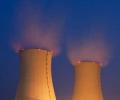
'When the cause of the leak is identified, is the AERB going to order a shutdown of all the other pressurised heavy water reactors in the country to fix the underlying problem?'

While nuclear engineers cheer KNPP's first full operation, on nine other sites which house atomic reactors, scientists spend sleepless nights.

India's nuclear establishment is continuing its march of folly at the expense of safety in the false belief that atomic power is the energy of the future. It's not. Nuclear power is in relentless global decline, says Praful Bidwai.
 © 2026 Rediff.com - Advertise with us - Disclaimer - Privacy Policy - Sitemap - Feedback - About us - Terms of use - Grievances