
'The government, supposedly manned by wise and experienced officers, was all at sea, unable to act cohesively, and with restraint. Each agency was out to score brownie points.'
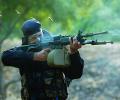
'The era of conventional wars is almost over in the Indian context.' 'In such a scenario, special forces could play a decisive strategic role in the spectrum of conflict.'

An insecure political class, with little knowledge of the military, has unquestioningly internalised the fear that a powerful tri-service chief would threaten democracy, says Ajai Shukla.
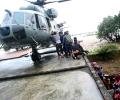
Thousands of defence personnel are working overtime to rescue lakhs of people still stranded in the floods in Jammu and Kashmir.
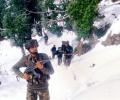
The army of the future needs a system of transparency and research. An open sociology of the army is a democratic necessity. An openness of information is a necessity of the army of the future fighting the next peace and next war on behalf of society, says social scientist Shiv Visvanathan.
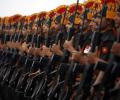
Internal simmering in the army has come to a boil after the government tries to retain a discriminatory promotions policy.

'A veiled secret of India's defence and strategic culture is the lack of a serious interest in them by the political class. The Indian National Defence University would fill this void,' feels Lieutenant General Anil Chait (retd).

When Rediff.com's Archana Masih and Rajesh Karkera set course from the foothills of the Himalayas to the Arabian Sea, they could not think of a better place to begin their journey than the stately campus that has given India some of its greatest military heroes.

The Pampore attack 'has the stamp of LeT written all over it.'
'They are exactly like the so-called fidayeen of the 1999-2003 phase, when J&K witnessed a surge in suicide attacks on various important garrisons,' says Lieutenant General Syed Ata Hasnain (retd), who served as the General Officer Commanding 15 Corps in Kashmir.

'General J S Aurora, the commander of the Indian forces in the East, asked General Sagat Singh to withdraw his troops who were on the move to Dacca -- but he refused.' 'He said, "Jaggi, over my dead body".' 'Therefore, I say the creator of Bangladesh was General Sagat Singh.'

'I believe Modi mentioned Balochistan only to embarrass Pakistan and also divert attention toward the situation in Kashmir.' 'I think from now on, India intends to raise Balochistan whenever Pakistan brings up Kashmir or upsets them on the issue of terrorism.' 'Balochistan is the least developed of Pakistan's four provinces. It is the least educated and least economically developed. People are agitated that a region so rich in mineral resources and a sea-port is still so poor.' Baloch political analyst Malik Siraj Akbar on why the province wants freedom from Pakistan.

No account of the 1962 war could be complete without Maxwell's authoritative analysis. Which is why we are reprinting this article which was run on Rediff.com in June 2001.
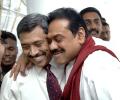
Gotabaya Rajapaksa
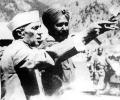
Let us hope that what happened in 1962 will never happened again, prays Claude Arpi

On the title page of the Top Secret Report, Henderson-Brooks quotes the Chinese tactician Sun Tzu: 'Know yourself, know your enemy: A hundred battles, a hundred victories', says Claude Arpi, highlighting where the Indian Army and government failed to counter the Chinese attack in 1962.

Lieutenant General J F R Jacob, Chief of Staff, Eastern Army Command during the 1971 war, revealed how, armed with only a draft surrender document and an aide, he made the Pakistani army led by Lieutenant General A A K Niazi surrender.
Lieutenant General J F R Jacob, Chief of Staff, Eastern Army Command during the 1971 war, revealed how, armed with only a draft surrender document and an aide, he made the Pakistani army led by Lieutenant General A A K Niazi surrender.
Lieutenant General J F R Jacob, Chief of Staff, Eastern Army Command during the 1971 war, revealed how, armed with only a draft surrender document and an aide, he made the Pakistani army led by Lieutenant General A A K Niazi surrender.
Lieutenant General J F R Jacob, Chief of Staff, Eastern Army Command during the 1971 war, revealed how, armed with only a draft surrender document and an aide, he made the Pakistani army led by Lieutenant General A A K Niazi surrender.
Lieutenant General J F R Jacob, Chief of Staff, Eastern Army Command during the 1971 war, reveals how, armed with only a draft surrender document and an aide, he made the Pakistani army led by Lieutenant General A A K Niazi surrender.
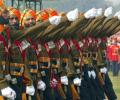
The average Indian soldier remains as hardy as before but he is certainly confused with the pace of change occurring all around him. It is here that the leaders -- the officers -- will have to adapt themselves to the new reality, says Nikhil Gokhale
 © 2026 Rediff.com - Investor Information - Advertise with us - Disclaimer - Privacy Policy - Sitemap - Feedback - About us - Terms of use - Grievances