
The Delhi high court on Thursday commuted to life term the death penalty awarded to Ariz Khan following his conviction in the sensational 2008 Batla House encounter in which decorated Delhi Police Inspector Mohan Chand Sharma lost his life.

Ariz Khan, who has been awarded death penalty for the murder of Delhi Police Inspector Mohan Chand Sharma in connection with the sensational 2008 Batla House encounter case was allegedly associated with the Indian Mujahideen.

The court will also rule on Khan's appeal against the trial court verdict that said his offence fell under the "rarest of the rare category", warranting the maximum sentence and that he be "hanged by the neck" till death.
A Delhi court Monday awarded death penalty to Ariz Khan for the murder of decorated Delhi Police Inspector Mohan Chand Sharma in connection with the sensational 2008 Batla House encounter case, saying the offence fell under the 'rarest of the rare category' warranting the maximum sentence.
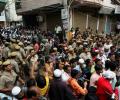
While convict Ariz Khan was awarded the death penalty by a trial court, Shahzad Ahmed was sentenced to life imprisonment in the case.

Earlier in the day, the high court upheld a trial court order convicting Khan of the murder of the slain inspector but refused to confirm the capital punishment.

Inspector Sharma of the Special Cell of Delhi was killed during the 2008 Batla House encounter in Jamia Nagar in south Delhi.

A Delhi court has ordered framing of charges against banned terrorist organisation Indian Mujahideen's (IM) co-founder Yasin Bhatkal and several of its operatives, including Mohammed Danish Ansari, in a case of conspiring to wage war against India in 2012.
The politics of polarisation became part of the political landscape of the national capital after the Batla House encounter.

After the setback of their arrest of their chief Yasin Bhatkal, top Indian Mujahideen operatives are now looking for his replacement.
Two suspected terrorists, wanted by the Delhi police in connection with their alleged involvement with the Batla House case, were understood to have found a safe haven in Uttar Pradesh.

The answers will come -- hopefully! -- when the film releases on August 15, feels Syed Firdaus Ashraf.

He was a member of Azamgarh (Sanjarmur) module of the IM and was based in Nepal where he was teaching at a school.

The National Investigation Agency on Wednesday filed its charge sheet in a Delhi court against five suspected operatives of terror outfit Indian Mujahideen for their alleged involvement in hatching a conspiracy to carry out terror strikes in the country.

The film makers agreed to put certain disclaimers and delete some scenes in the movie which were objected to by Khan and Ahmed.
'It is possible that these terrorists took advantage of the chaos and escaped in the melee.'

'The operation was planned in a manner so as not to alert the terrorists.' 'Every precaution was taken to keep it low-key so as not to alert the terrorists and surprise them and arrest them.'

After the arrest of Yasin Bhatkal, Mirza Shahnawaz Baig has been strengthening the Azamgarh module to plan Indian Mujahideen's next move. Vicky Nanjappa reports

The Indian Mujahideen's module in Azamgarh, Uttar Pradesh, comprises the most motivated and best-trained operatives of the terror group, says Vicky Nanjappa

The Indian Mujahideen follows the same pattern as its creator, Lashkar-e-Tayiba.

Lone suspected Indian Mujahideen operative Shahzad Ahmad was today convicted in the 2008 Batla House encounter case by a Delhi court for murdering a police inspector and assaulting other officers.

Indian Mujahideen co-founder Yasin Bhatkal and his aide Asadullah Akhtar were on Monday refused bail in connection with a September 2008 Delhi serial blasts case by a court in New Delhi which allowed the plea of police seeking 15 days time to complete its probe against them.

Given the nature of his job, a terrorist heading an underground organisation usually grooms a successor who is prepared to take over in case of his boss's arrest or demise.
 © 2026 Rediff.com - Advertise with us - Disclaimer - Privacy Policy - Sitemap - Feedback - About us - Terms of use - Grievances