
The heaviest communication satellite to be launched from the Indian soil onboard a new generation, homegrown 'Bahubali' rocket was successfully placed into the intended orbit on Sunday, the Indian Space Research Organisation said.

The European space agency would be asked to launch the INSAT-4A and INSAT-4B spacecraft.

'With India's growing capabilities in the space sector, this creates promising opportunities for enhanced collaboration and market access.'

Speaking at a joint press event with Macron, Modi, who is in Paris on a two-day official visit, said a roadmap to strengthen India-France strategic ties over the next 25 years was being prepared with bold and ambitious goals on the anvil.

The 3,357-kg satellite, which was deployed from the lower passenger position of Ariane-5 launch vehicle (VA 251) into the geostationary transfer orbit, is configured on ISRO's enhanced I-3K Bus structure to provide communication services from Geostationary orbit in C and Ku bands.

The GSAT-31 is a 'high power' communication satellite going to serve and replace some of the satellites that are going to expire soon.

The 3,357-kg satellite is slated to blast off from the Ariane Launch Complex at Kourou, a French territory located along the northeastern coast of South America, at 02:35 hrs IST. "GSAT-30 is to serve as a replacement to INSAT-4A spacecraft services with enhanced coverage", ISRO said.

Weighing about 5,854 kg, GSAT-11 would play a vital role in providing broadband services across the country, and also provide a platform to demonstrate new generation applications.

Arianespace launch vehicle Ariane-5 VA-231, carrying GSAT-18 along with co-passenger Sky Muster II for the Australian operator nbn (National Broadband Network) was scheduled for launch at 2am on Wednesday.

It also carries equipment for meteorological data relay and satellite based search and rescue services being provided by earlier INSAT satellites.

ISRO Chairman K Sivan described the GSAT-11 as the "richest space asset" for India.

GSAT-18, which aims at providing telecommunications services for the country by strengthening ISRO's current fleet of 14 operational telecom satellites, was launched into a Geosynchronous Transfer Orbit about 32 minutes after the lift-off.
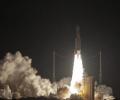
Boosting India's communication services, its latest satellite GSAT-16 was successfully launched on board Arianespace rocket from the spaceport of Kourou in French Guiana in the early hours of Sunday, after a delay of two days due to bad weather.
India's latest communication satellite GSAT-8 was successfully launched on Saturday by Arianespace from Kourou in French Guiana to give a boost to direct-to-home services in the country.
India's advanced communication satellite GSAT-10, the heaviest built by the country, was launched in the early hours of Saturday on board Ariane-5 rocket from Europe's spaceport in French Guiana.
India's 3,400-kg communication satellite GSAT-10 is now ready to be shipped to the spaceport at Kourou in French Guiana for launch by European space consortium Arianespace in two months, according to Indian Space Research Organisation Chairman, K Radhakrishnan.
Seeking to position India as a cost-effective destination for satellite-building and commercial launch services, Indian Space Research Organisation has forged partnerships with France-based 'EADS Astrium' and European space consortium 'Arianespace'.

India's advanced multi-band communication satellite GSAT-7, launched from French Guiana by European space consortium Arianespace's Ariane 5 rocket on August 30, has been successfully placed in the geosynchronous orbit with an altitude of about 36,000 km above earth's surface.
The anomaly was found in the 'water deluge system' that is intended to reduce the acoustics level for the safety of the launch-pad
Though it was originally intended to be the last launch for the INSAT 4B by Arianespace with the future satellites planned for launch from the Satish Dhawan Spaceport in Sriharikota, India is expected to launch INSAT 4G from an acquired launcher.
The launch of Ariane-5, which will carry India's indigenously-built 3,025 kg INSAT-4B geostationary satellite and Skynet 5A of EADS Astrium, is set for between 3.55 am and 4.28 am on Sunday.
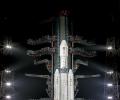
The Indian Space Research Organisation on Thursday launched its first experimental suborbital flight. Here are five things you need to know about the GSLV Mark III mission.

The Mars Orbiter Mission (MOM) is among the most-tracked satellites in the world, according to N2YO, which provides a web-based real-time satellite mapping website.
GSLV-MK III, which uses a homegrown cryogenic engine, has to do at least two more launches before it begins commercial operations, report Raghu Krishnan and T E Narasimhan.

INSAT-3D, developed by the Indian Space Research Organisation and its Space Applications Centre, is designed to provide meteorological observation and monitoring of land/ocean surfaces.

Hit by inclement weather, the launch of India's latest communication satellite GSAT-16 was deferred for the second time after it was rescheduled to be put into space in the early hours on Saturday by Ariane 5 rocket from the space port of Kourou in French Guiana.

'The service we are offering is for all telcos and not just Bharti.'

A high power satellite, GSAT-15 is being inducted into the INSAT/GSAT system. GSAT-15 carries a total of 24 communication transponders in Ku-band as well as a GPS-Aided GEO Augmented Navigation (GAGAN) payload operating in L1 and L5 bands.
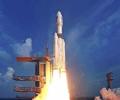
If successful, this would increase capacity to hurl small satellites into space, meeting both local demand and serving global customers.
The 'context' of the launch of GSAT-15 highlights that India has much ground to cover in the transponder arena while in satellite navigation arena ISRO's progress has been satisfactory, says Ajey Lele.

'The India-France relationship has been that of the elites of two countries, who appreciate each other's philosophical traditions -- whether it is ancient Indian civilisation and Sanskrit texts or the French tradition of Rene Descartes, Albert Camus, (Jean-Paul) Sartre... This is a drawback. It doesn't create the buzz, the excitement necessary for a relationship. We need more people-to-people contact, especially among students,' says former Ambassador to Paris, Rakesh Sood.
 © 2026 Rediff.com - Advertise with us - Disclaimer - Privacy Policy - Sitemap - Feedback - About us - Terms of use - Grievances