
'Absolutely gutted,' he posted on Instagram.

While it is expected that the JD-U, a major ally of the Bharatiya Janata Party, will support the Waqf Bill, two JD-U MPs, Union Minister Lalan Singh and party Working President Sanjay Jha met Union Home Minister Amit Shah in Delhi on Tuesday.

Maharashtra Navnirman Sena chief Raj Thackeray on Wednesday asked what was the need to "impose" Hindi on students and appealed to schools in Maharashtra to foil the government's "hidden agenda to deliberately create a language divide".

A total of four trials of two sets each will be held and the best three scores will be considered for arriving at the Final Average Score (FAS) to select the squad for the Olympics.
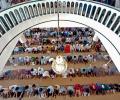
The All India Muslim Personal Law Board (AIMPLB) has urged Muslims to wear a black armband on their right hand during Juma prayers on the last Friday of Ramzan as a mark of protest against the Waqf (Amendment) Bill. The AIMPLB has been vocal in its opposition to the Bill, calling it "controversial, discriminatory and damaging." The organization has planned nationwide protests against the Bill, with large sit-ins scheduled in several cities.

Errors in filing income-tax returns frequently lead to scrutiny notices, additional liabilities, or delayed refunds.

The house of the BJP Minority Morcha's Manipur president, Asker Ali, was set on fire by a mob allegedly for supporting the Waqf Amendment Act. The incident happened at Lilong in Thoubal district on Sunday night. Ali had expressed his support for the Act on social media on Saturday. An irate mob gathered outside his residence around 9 pm, vandalised it and later set it on fire. Following the incident, Ali posted a video on social media, apologising for his earlier statement. He also expressed opposition to the Act.

Tamil Nadu Chief Minister and DMK president M K Stalin announced that his party will file a case in the Supreme Court against the Waqf Bill passed in the Lok Sabha. The opposition AIADMK expressed solidarity with the DMK's stance, while the BJP members staged a walkout from the Assembly in protest. The CM argued that the amendment was passed at the behest of a few allies despite opposition from majority parties and that it is an attack on the Constitution and religious harmony. The DMK claims the bill threatens the autonomy of the Waqf Board and the Muslim minority population.

The Centre on Wednesday told the Supreme Court that nobody can claim right over government land and it is legally empowered to reclaim properties which are declared waqf by using the waqf by user principle.

Banerjee said she will protect the minority people and their property.

The Web portal of the Organiser, the RSS mouthpiece, published an article (withdrawn later) that the Christian community holds many acres of land, far more than Waqf property.'

India has rejected remarks by Bangladeshi officials on violence in West Bengal, asking Dhaka to focus on protecting the rights of its minorities instead of indulging in "virtue signaling." The statement comes in response to comments made by Bangladeshi officials regarding the developments in West Bengal. India's spokesperson pointed out that Bangladesh has failed to contain attacks on minorities, especially Hindus, in the country and urged Bangladesh to focus on protecting the rights of its own minorities.

The Delhi High Court has directed Customs officials to ensure that old and personal jewellery of travellers, including ornaments being worn by them during travel, are not unnecessarily detained at airports and they are not harassed. The court was hearing a batch of more than 30 petitions raising issues on the procedure for detention of goods belonging to the tourists travelling to India, of both Indian and foreign origin, by the Customs department.
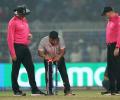
ICC has effected a notable change in playing conditions, as per which the umpires henceforth will only assess the side-on replays for stumping without considering the caught-behind scenario during the Decision Review System (DRS) referrals.

Trump's comments have been met with fierce criticism, with Rep. Daniel Goldman labeling it an "escalation in his clear effort to take over the government and dismantle our democracy." Goldman urged Congressional Republicans to oppose Trump's ambitions.
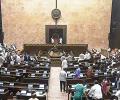
The Rajya Sabha, India's upper house of parliament, witnessed its second-longest sitting in history on Thursday, lasting until 4:02 am the next day. The House convened to clear the Waqf (Amendment) Bill and approve the statutory resolution on the imposition of President's Rule in Manipur. The longest sitting in Rajya Sabha history occurred on September 17, 1981, when the House sat until 4:43 am to pass the Essential Services Maintenance Bill.

'There's no transparency in work (of the Wakf Board), in property transactions (of the Waqf).'

Referring to the enactment of the Chhattisgarh Auxiliary Armed Police Force Act, 2011 which created a trained force to aid and assist the security forces in maintaining law and order in the state, the bench said in its view it cannot be said to be an act of contempt of the order of 2011 passed by this court.

Protests against the Waqf (Amendment) Act turned violent in Cachar district of Assam on Sunday, with protesters throwing stones at police and the police using batons to disperse the crowd. The incident occurred in Berenga area of Silchar town where around 300-400 people protested without permission. The Cachar district administration imposed prohibitory measures across the district under Section 163 of the Bharatiya Nagarik Suraksha Sanhita (BNSS) to prevent further unrest. The order prohibits gatherings of five or more people without permission, carrying weapons, organizing protests, and traffic disruptions.
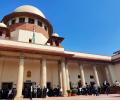
A bench of Justices Sanjiv Khanna and Dipankar Datta posed the question to former Rajya Sabha MP Subramanian Swamy and lawyer Vishnu Shankar Jain, who sought deletion of the words "Socialist" and "Secular" from the Preamble of the Constitution.

Ghanashyampur Primary School in Dhulian, Murshidabad district, West Bengal, reopened on Wednesday after a six-day closure due to violence in the area. The school had been shut since Friday noon after violence erupted on April 11 during a protest against the passage of the Waqf (Amendment) Act in Parliament. Several houses and properties were ransacked and set ablaze by a mob, leading to fear and disruption in the locality. While some guardians are still hesitant to send their children to school, teachers are optimistic that attendance will increase in the coming days.
Leaders of several INDIA bloc parties met the Election Commission over the Special Intensive Revision of electoral rolls in Bihar and raised concerns over its timing, alleging that over two crore voters of the state may be disenfranchised by this mammoth exercise being done just ahead of assembly elections.

Boundary catches involving 'bunny hops', or multiple airborne touches outside the rope, have been deemed illegal by the Marylebone Cricket Club, with the new ruling set to be integrated into ICC's playing conditions this month and the MCC's laws from October next year.

The verdict will have far-reaching implications for judicial service aspirants.
'Muslims in Bihar under Nitishji's rule are safest than anywhere else.'

India's doping woes came to the fore once again with the country topping the World Anti-Doping Agency's 2023 testing figures among countries which analysed 5,000 or more samples even as the sports ministry promised an "aggressive clean-up" and an amended Anti-Doping Act after addressing objections from the WADA.

Congress MP Mohammad Jawed and AIMIM president Asaduddin Owaisi have challenged the validity of the Waqf (Amendment) Bill, 2025 in the Supreme Court, arguing that it violates constitutional provisions. The petitions claim the bill imposes arbitrary restrictions on Waqf properties and their management, undermining the religious autonomy of the Muslim community. They also allege that the bill discriminates against Muslims by imposing restrictions not present in the governance of other religious endowments. The bill was passed in the Rajya Sabha and Lok Sabha, with the petitioners arguing that it introduces limitations on the creation of Waqfs based on the duration of one's religious practice, mandates inclusion of non-Muslim members in Waqf administrative bodies, and shifts key administrative functions to government officials, thereby diluting the autonomy of Waqf management.

A chance meeting between Jammu and Kashmir Chief Minister Omar Abdullah and Union minister Kiren Rijiju at the Tulip Garden in Srinagar has sparked a political storm, with opposition parties accusing the National Conference of laying out a red carpet for the BJP leader in the aftermath of the Waqf Amendment Act. While NC sources termed the interaction as a purely coincidental encounter, opposition parties like the PDP and Peoples' Conference condemned the meeting, accusing the NC of surrendering to the BJP. The Waqf (Amendment) Bill, passed by Parliament last week, aims to streamline the management of Waqf properties with provisions to safeguard heritage sites and promote social welfare.

At least six students have been injured in the incident and they are currently undergoing treatment at the government hospital Hisar, the sources said.

The Supreme Court of India has agreed to hear on May 6 the pleas of the Kerala government against the governor over the delay in approving bills passed by the state assembly. The court will consider whether the issues raised in the Kerala petition are covered by a recent judgment on a similar plea by Tamil Nadu, which set timelines for governors and the President on granting assent to bills.

Bhimrao Ramji Ambedkar, the architect of the Indian Constitution, is also credited with the creation of the Election Commission of India. An amendment he brought to the Constituent Assembly led to the establishment of the Election Commission as an independent body responsible for conducting elections. Ambedkar's amendment consolidated election authority into a centralized body, headed by a chief election commissioner appointed by the President, rather than separate commissions for the Centre and states. This article delves into the historical context and the importance of Ambedkar's contribution in establishing the Election Commission of India.

The Awami League leaders were charged with committing crimes against humanity over the deaths of hundreds of people during last year's anti-government protests by a student platform. The protests resulted in the ouster of Hasina's 16-year-long regime on August 5.

Dismissing allegations that Indian phacosrmaceutical companies copy products of Swiss firms, Commerce and Industry Minister Piyush Goyal on Tuesday said it is a long-standing myth and India respects intellectual property rights and never steals technology from others. He said that Swiss pharmaceutical companies have not shown even a single instance that Indian companies have illegally copied any of their trademarks or patents or copyrighted technology.

Pakistan football has been run by a FIFA appointed Normalisation Committee since June 2019 which was tasked with holding elections and cleaning up parallel groupings in the football set-up but it has failed to execute these plans properly.
Prime Minister Narendra Modi hailed the passage of the Waqf (Amendment) Bill in Parliament as a "watershed moment" in the country's quest for socio-economic justice, transparency and inclusive growth. He said the legislation will particularly help those who have long remained on the margins, thus being denied both voice and opportunity. Modi stated that the Waqf system was synonymous with lack of transparency and accountability, especially harming Muslim women, poor Muslims and Pasmanda Muslims. He added that the legislation will boost transparency and safeguard people's rights, ushering in a more modern and socially just framework. The prime minister thanked all members of Parliament and the public for their contributions to the legislation.

Hours after the Waqf (Amendment) Bill was passed in Parliament, 50 individuals embroiled in land disputes in Kerala's Munambam joined the BJP, hoping for a resolution to their claims. The residents, who have been protesting for 174 days, allege that the Waqf Board is claiming ownership of their properties. BJP leader Rajeev Chandrasekhar assured them of the party's support and a meeting with Prime Minister Narendra Modi to express gratitude. The BJP capitalized on the Catholic Church's support for the legislation, accusing the Congress and the Left of appeasement politics. The opposition, however, questioned the impact of the bill on the Munambam issue.

With the regulatory approval from the US Department of Energy in its kitty, Indian multinational conglomerate L&T is planning to focus on manufacturing small modular reactors (SMRs) to play a leading role in the commercialisation of nuclear energy in India.

Shiv Sena (UBT) chief Uddhav Thackeray has slammed the BJP over its stance on the Waqf Amendment Bill, accusing the party of a "fraudulent" approach and of trying to take away land for its industrialist friends. He also dared the BJP to remove the green color from its party flag if it disliked Muslims. Thackeray's comments come after the bill was passed by the Lok Sabha on Thursday.

The Islamabad high court is set to hear the petitions requesting the suspension of sentences to Khan and his wife Bushra Bibi in the 190 million Pound Al-Qadir Trust case on June 11.

The accused, Raja Rahuvanshi's wife, Sonam Raghuvanshi, Raj Singh Kushwaha, Akash Rajput, Vishal Singh Chauhan and Anand, were then brought back to the Shillong Sadar Police Station.
