
The navy finds itself fighting for relevance, with navy planners lamenting that its share of the budget has dropped dramatically.
India joins exclusive club of US, Europe, Russia and China.
Modi's hardline policy towards Pakistan and J&K has created numerous leverages and bargaining positions that New Delhi can bring to the bargaining table and translate into concessions, argues Ajai Shukla.

Airbus' $99 million payout puts a new light on Eurofighter's 'unsolicited bid' to the Modi government, reducing the cost of the Typhoon fighter by 20 per cent, making it in retrospect significantly cheaper than the Rafale.

'Ajit Doval has done a splendid job in handling the Pathankot attack and certainly helped save heavy destruction of critical air force assets,' says Abhay Jere.

French sources say Hollande was motivated to speak out after an Indian media report revealed that the Reliance Group had part-funded a film venture by his domestic partner, French actress Julie Gayet.
The IAF has insisted it hit its targets. If that is indeed true, then the lack of obvious damage could mean it has used a different bomb -- possibly procured secretly from Israel.
Armed with rockets and missiles, these helicopters can rain fire on the enemy in rarefied altitudes.

In rebranding the F-16 into the F-21, Lockheed Martin appears to have accepted what many have warned it for years: That the IAF would never buy a fighter whose very name is associated across India with the Pakistan Air Force which has operated the F-16 since the 1980s.
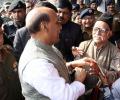
Has the army confronted China, equipping itself with emergency purchases that have been largely paid for by pensioners, asks Ajai Shukla.

India to go ahead with S-400 missile deal with Russia, but declines project to develop a fifth-generation fighter aircraft.

Until last month more than two-thirds of the Indian Army was deployed against Pakistan. Of 14 army corps, just four-and-a-half faced China, while more than twice that number was ranged against Pakistan.
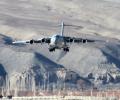
The unstated aim of a well-publicised airlift operation of this kind is to demonstrate India's ability to rapidly move troops and equipment over long distances.

The AFT was intended to reduce military related cases in civil courts. Instead, the backlog in defence-related cases has increased from 9,000 to 16,000 after the AFT's creation.

HAL will build each Su-30 at just Rs 4.25 billion. The IAF is paying Rs 11.25 billion per Rafale, excluding the price of weapons and logistics.
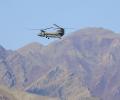
For both India and China, the most likely option -- and the most challenging -- appears to be a freezing of the status quo.
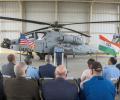
Its advanced Longbow radar picks up enemy armoured vehicles and then destroys them with anti-tank missiles, air-to-surface rockets or a chain gun that sends 625 rounds per minute ripping into the targets.
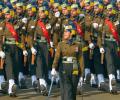
'Today's India is fearless and is on track to be a great power. But this is definitely not happening without women, who form 48 per cent of our population.'

Costing Rs 500 billion, the INS Vishal will be the Indian military's single most expensive defence platform.
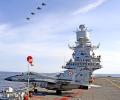
There is concern about the poor state of readiness of the navy's 140 warships which face severe shortages in sonar equipment, helicopters and torpedoes.
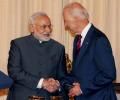
Prime Minister Modi needs to call Biden next month and clearly say: 'Mr President, the threat from China is clear and present. We, in New Delhi, have determined it to be an urgent national priority to outfit our submarines and aircraft carriers with nuclear propulsion and we want to cooperate with America on this programme",' advises Ajai Shukla.
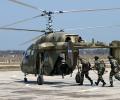
Russian Helicopters has scored another billion dollar home run by winning the Indian Navy's tender for 111 'naval utility helicopters'.
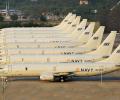
Boeing also won a $4.5-billion contract for 10 C-17 Globemaster III transport aircraft, and will soon start delivery of $3 billion contracts to supply 22 AH-64E Apache attack helicopters and 15 CH-47F Chinook heavy lift helicopters., reports Ajai Shukla.
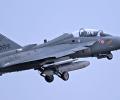
'It would be a travesty if the Malaysian air force likes the Tejas, but decides against it because it sees the IAF reluctance to back the fighter.'

Is it Rs 300 billion or Rs 66 billion or Rs 33.12 billion?

This is perhaps the most authoritative portrayal so far of Indian air power as a threat to China.

Access to India's defence market must be made conditional -- available only to those who are ready to make a long-term commitment in India, argues Ajai Shukla.

'We have to cut down on manpower to make more for equipment,' Indian Army chief General Bipin Rawat tells Ajai Shukla.
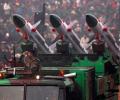
Defence experts want defence expenditure to be at 3% of GDP, which they consider minimum to counter the two-front threat from China and Pakistan, internal insurgencies, and dominating a 7,500 km coastline and the Indian Ocean beyond. What Arun Jaitley has given India this Budget is 2.16% of GDP, observes Ajai Shukla.

The SpyLite aerial system will help our soldiers in border flashpoints like Doklam and in encounters with terrorists in Kashmir.
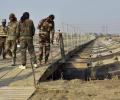
Army gave three good reasons why it could not build the bridges for Ravi Shankar's event. Defence ministry overruled the army's objections, reveals Ajai Shukla.
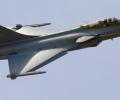
'There is no secrecy clause to the price (of the aircraft).' 'There can be secrecy on the capability of the nuclear payload of aircraft and things like that, but the price is hardly a secret.'

If the new request for 18 more fighters translates into a contract, the Sukhoi-30MKI fleet size will go up to 14 squadrons, or 290 fighters.
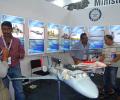
In 2014, the prime minister criticised the communication gap between DRDO scientists, who remained ensconced in their laboratories, and the soldiers on the borders, says Ajai Shukla.

Admiral Puri says it would be wasteful to buy a foreign helicopter, pay for transfer of technology, and develop manufacturing capability in an Indian private sector strategic partner when all this already exists with HAL.

The Indian Army, placing traditional weapons above high-technology, says that equipping the army's 800-plus combat units with a Battlefield Management System would cost an unaffordable Rs 500 billion to Rs 600 billion, reveals Ajai Shukla.
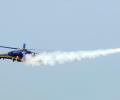
The Light Combat Helicopter will enable the army to provide fire support to soldiers at altitudes of 15,000 to 20,000 feet, where the oxygen-depleted air prevents them from carrying weaponry heavier than their personal rifles and light machine guns.

China has chosen to keep New Delhi guessing, while retaining for itself the option of constantly changing facts on the ground and shifting the LAC westwards -- the strategy called 'salami slicing', notes Ajai Shukla.
A Court of Inquiry investigating the February 1 crash that killed two pilots is confronting the worrying possibility of a glitch in the flight computer that kicks in without warning, causing the aircraft to behave unpredictably.
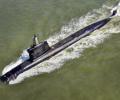
There were 35 defects that still remained to be resolved. Of these, 29 could not have been resolved during the monsoon since they required testing in absolutely calm seas. Nor is the Khanderi being commissioned with a full complement of its primary weapon, the torpedo.
