
The US Department of Defence has restored the name of the US Indo-Pacific Command to the US Pacific Command, reversing an eight-year-old decision. This change honours the command's deep historical roots, established in 1947, while its vast area of responsibility, extending to India's western border, and its mission remain unchanged.

The latest announcement was made by the US Defence Secretary Jim Mattis during the change of guard ceremony at Joint Base Pearl Harbour wherein Admiral Phil Davidson replaced Admiral Harry Harris as Commander, US Indo-Pacific Command or IndoPacom.

Admiral Samuel J Paparo, Commander of the US Indo-Pacific Command, lauded India's military restraint during Operation Sindoor and emphasized the growing India-US defence partnership aimed at maintaining peace and security in the Indo-Pacific region.

In the Indo-Pacific's new era -- where perception shapes reality faster than treaties -- the real entrapment is not of China or the United States. It is the test Japan has set for itself -- and whether partners like India, acting as balancers rather than accelerants, can help ensure that the story ends in stability, points out Varun Arya.

India and Australia have signed significant agreements covering civil nuclear energy, maritime security, and critical minerals, reinforcing their partnership's role in ensuring a peaceful Indo-Pacific. The pacts facilitate uranium supply from Australia to India and enhance cooperation in defence, cyber, and critical technologies.

Top commanders of the Indian Navy will discuss the implications of the West Asia crisis on India's energy security and review operational readiness at a three-day conference.

Prime Minister Narendra Modi was accorded a grand welcome on his arrival in Jakarta on Monday, with Indonesian Air Force fighter jets escorting the PM's aircraft upon entering Indonesian airspace, marking a ceremonial welcome.

'The flip side of this is that he won't hesitate to call out India if he thinks its policies are hurting US economic interests or border US foreign policy goals.'

Successful interceptor, anti-ship, MIRV and hypersonic technology tests have strengthened India's position among a select group of advanced missile powers.

Prime Minister Narendra Modi and US President Donald Trump exchanged pleasantries and held a brief conversation at the G7 summit, their first in-person encounter in 16 months, setting the stage for high-stakes bilateral talks amidst continuing strain in India-US relations.

For the foreseeable future, the most likely outcome remains continuation of the status quo. Taiwan will remain self-governing without formally declaring independence, while China continues to apply sustained pressure short of war, predict Krishnan Srinivasan and Manoj Mohanka.

The United States Central Command confirmed that the USS Rafael Peralta intercepted an Iranian-flagged ship, enforcing a maritime blockade against Iran. The US military is prepared to resume major combat operations if ordered by the President.
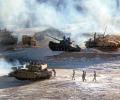
While tensions have eased at several friction points and mechanisms for managing the boundary have been reactivated, underlying differences persist. Disputes over naming practices in Arunachal Pradesh, continued infrastructure development on both sides, and unresolved questions regarding patrolling rights indicate that the structural gap remains, notes Dr Kumar.

US Special Representative Sergio Gor met with Sri Lankan President Anura Kumara Dissanayake to discuss strengthening bilateral relations and Sri Lanka's stance on the Middle East crisis. The visit occurs amidst regional tensions and US efforts to secure trade routes in the Indo-Pacific.
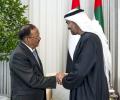
India is the only significant power that all parties trust, or at least do not distrust, notes former defence secretary Ajay Kumar.
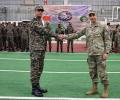
'When our soldiers trained side by side, we demonstrated to the world that our partnership is strong, enduring and prepared to meet any challenge.'

According to the report, the Pentagon is deploying the USS Tripoli ARG, along with the 31st Marine Expeditionary Unit (MEU), part of its own strike group.

India's historical focus on its continental borders has overshadowed its maritime ambitions, but that is changing quickly, notes Ajai Shukla.
A top American military commander has said that the US is watching the situation very closely after Indian military strikes on terror targets in PoK and Pakistan's Punjab province. The United States Indo-Pacific Command (USINDOPACOM) is one of six geographic Unified Combatant Commands of the United States Armed Forces, headquartered in Hawaii. Earlier on Wednesday, US President Donald Trump said he wants India and Pakistan to stop the conflict, saying if he can do anything to help, he will be there. Foreign Secretary Vikram Misri told reporters in New Delhi on Wednesday that the Indian military carried out a measured, non-escalatory, proportionate, and responsible strike to dismantle terrorist infrastructure in Pakistan to deter and to pre-empt any further terrorist strikes.
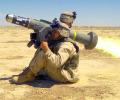
The US has approved the sale of Excalibur Projectiles, Javelin Missile System and related equipment totalling over 90 million dollars to India.

The Indian armed forces, especially the Navy, are building partnerships in the Indo-Pacific region for peace and security, as well as humanitarian assistance and disaster relief, he said.
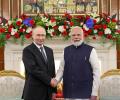
Luckily for us, a Russia that is desperate to stay relevant in an emerging multipolar world finds in India a reliable geostrategic partner. The Russian proximity to India also keeps China from exploiting its economic dominance vis a vis Russia, points out Colonel Anil A Athale (retd).

Defence Minister Rajnath Singh arrives to visit the United States Indo-Pacific Command headquarters and the Pacific Fleet in Hawaii.

India has joined the US-led 'Pax Silica' alliance, aimed at building a resilient supply chain for critical minerals and artificial intelligence, marking a significant step in strengthening bilateral ties and fostering economic security.

Although the pact would focus mainly on the Pacific and the South China Sea region, any action designed to deter China with or without New Delhi's active participation is a welcome move, notes Commodore Venugopal Menon (retd).

United States Secretary of State Marco Rubio on Thursday (local time) hailed India as 'one of the top relationships that the US has in the world today' during the Senate confirmation hearing for Sergio Gor, US President Donald Trump's nominee for US Ambassador to India.
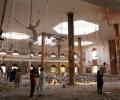
In 2025, India launched Operation Sindoor, a multi-domain combat mission against Pakistan in response to cross-border terrorism. The operation involved precision strikes, military retaliation, and diplomatic measures, marking a significant shift in India's security policy.
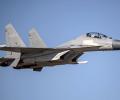
A Chinese fighter jet performed an unsafe manoeuvre after it came as close as 20 feet within a United States military aircraft over the South China sea, The Hill reported on Thursday citing the US Indo-Pacific Command.
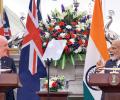
India and New Zealand have signed a pact to institutionalize their defence ties and vowed to boost cooperation in the Indo-Pacific. Prime Minister Narendra Modi raised concerns about anti-India activities by some illegal elements in New Zealand with his Kiwi counterpart Christopher Luxon. The two sides also signed six agreements to enhance cooperation in areas including education, sports, agriculture, and climate change. They also agreed to prepare a roadmap for cooperation in the defence industry sector and explore early implementation of cooperation in the digital payments sector.
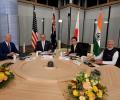
Saturday's Quad meeting in Delaware is taking place against the backdrop of China's assertive behaviour in the South China Sea, its sabre-rattling in the Taiwan Strait and increasing footprints in the Pacific and Indian Ocean, asserts Rup Narayan Das.

Vice Chief of the Army Staff Lt Gen S K Saini will embark on a four-day visit to the US beginning Saturday to explore ways to further deepen military cooperation between the two countries. The visit comes ahead of the third edition of the two-plus-two dialogue between India and the US which is slated to be held in India later this month.

The high-voltage Malabar exercise featuring the navies of all four Quad countries -- India, the US, Australia and Japan -- began on Thursday off the coast of Guam against the backdrop of a resolve by the four nations to solidify cooperation for a free and open Indo-Pacific in view of China's rouge behaviour in the region.

Chief of Defence Staff Gen Bipin Rawat on Wednesday asserted that any possible terrorist activity flowing out of Taliban-controlled Afghanistan and finding its way into India will be firmly dealt with, and suggested that the Quad nations should boost cooperation in the global war on terrorism.

The next edition of the high-voltage Malabar naval exercise begins from August 26 to 29 off the coast of Guam amid mounting global concerns over China's growing military muscle-flexing in the Indo-Pacific region.

'India is a top-tier security partner for Australia and we continue to prioritise practical and tangible cooperation that directly contributes to Indo-Pacific stability.'
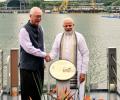
A beautiful rendition of 'Vaishnav Jan To Tene Kahiye', a favourite bhajan of Mahatma Gandhi, was sung on the occasion.

'...it should not delude itself into thinking that India's security or its great-power ambitions will be advanced by those partnerships.'
'Instead, what India should focus on is on riding out the next three-and-a-half years of Trump's presidency with minimal damage to itself.'
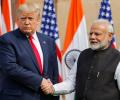
The China threat continues to resonate in the strategic partnership between India and the USA, points out Rup Narayan Das.

The Indian Navy has appointed the first woman commanding officer in a naval ship in sync with its philosophy of 'all roles-all ranks' for female personnel, Navy Chief Admiral R Hari Kumar said on Friday.

'If Washington has to balance Chinese power, she will have to turn to the third biggest power in the world which is India.' 'The United States and India will have to work together in order to keep Chinese ambitions in check.'
