The Chinese authorities have been rapidly building defence infrastructure along the Line of Actual Control, indicating that they are preparing for a long period of tension with India, points out Jayadeva Ranade, the former senior RA&W officer and China expert.

'The PLA has continued to do exercises and drills and recently carried out air exercises with fighter jets.'

The activists demanded countries withdraw from the event they have called the "Genocide Games", which they say are being used to burnish China's reputation.

'The General appreciated the importance of history in understanding modern conflict.' Tibetologist Claude Arpi recalls his meetings with General Bipin Rawat.

The exercise was aimed at validating joint plans for strategic airlift of specialised forces employing IAF's fixed and rotary wing platforms by landing and dropping in designated areas for undertaking kinetic actions, they said.

Boston Celtics' Kanter sparks backlash in China after comments on Tibet, Xi.

'Unless India ups the ante, Beijing will continue to believe its transgressions are cost free and will feel encouraged to do more of the same.'

The three wushu fighters from Arunachal Pradesh were issued stapled visas instead of stamped ones, India's foreign ministry said.

Celebrate the Year of the Rabbit with sartorial elegance.
The resolution condemns additional Chinese provocations, including China's use of military force to change the status quo along the Line of Actual Control, construction of villages in contested areas, publication of maps with Mandarin-language names for cities and features in the Indian state of Arunachal Pradesh, and expansion of Beijing's territorial claims in Bhutan.
The United States has recognised that territory (Arunachal Pradesh) for a long time (as an integral part of India), White House Press Secretary Karine Jean-Pierre said.
China's Ministry of Civil Affairs on Sunday released standardised names of 11 places for Arunachal Pradesh, which it calls "Zangnan, the southern part of Tibet".
New Delhi's reaction came in response to Beijing announcing Chinese names for 11 more places in Arunachal Pradesh which the neighbouring country claims as southern part Tibet.

He also said 'Akhand Bharat' was true but divided Bharat was a "nightmare".

It took India and the Indian Army to show to the world that enough is enough and to challenge the neighbourhood bully, he said.

Dr Lobsang Sangay entered the United States White House on Friday -- a historic feat. This is the first time in the last six decades the head of the Central Tibetan Administration (CTA) has been invited into the White House, the CTA said in a statement.
'Over the years, India has taken great strides in many fields, especially in the context of science and technology. Yet even as external disarmament is necessary, inner disarmament is no less important'

A powerful senatorial committee on Wednesday is set to consider a bipartisan resolution to recognise Arunachal Pradesh as an integral part of India, pushing back against China's military aggression to change the status quo along the Line of Actual Control.
Blinken also underlined that diplomacy is the only way to definitively end the Russian conflict in Ukraine.

'It is not a matter of fixing the military problem up there in the Himalayas and the retreat of the two militaries.' 'India has to find a way to correct the racist and very patronising views of India in the Chinese mind.'
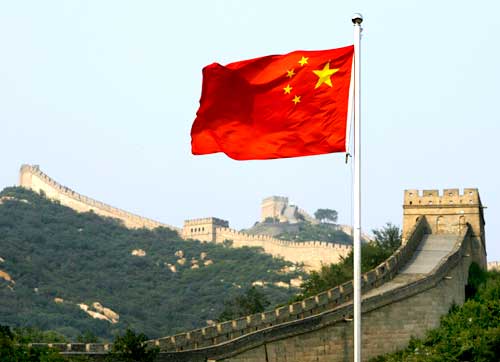
Bhutan firmly abides by the one-China principle meaning Taiwan and Tibet are part of China and stands ready to work with China for an early settlement of the boundary issue and advance the political process of establishing diplomatic relations, it said.

'Tibetans will participate in future conflicts with India (in all probability, some were already present in Galwan).' 'As nobody in India would like to have a deadly fight with Tibetan soldiers and officers, the issue needs to be closely followed,' observes Claude Arpi.
'Modi warned China, therefore they have come to the talks.' 'Nothing will come out of these talks.'

China will use airpower to support Pakistan from the start of a war. China will use the opportunity to at least take Ladakh. Its growing navy will prevent India from blockading or attacking the Makran Coast. And thanks to Chinese weapons, Pakistan keeps expanding its forces, observes Ravi Rikhye.
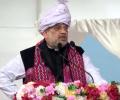
China on Monday criticised Home Minister Amit Shah's visit to Arunachal Pradesh, stating that it violated Chinese sovereignty over the area, a claim outrightly dismissed by India.

The Chinese inference is that if the Chinese visa is embossed on an Indian passport, held by Indian citizens from Arunachal Pradesh, it may be tantamount to recognising Indian sovereignty over Arunachal Pradesh, states Rup Narayan Das.

'We must understand that the LAC is a political issue for China, so any action on the LAC will keep India focussed on the LAC which gives China the opportunity for any adventurism in the Indian Ocean.'
Gen Wang is the fourth commander to head the Western Theatre Command after the eastern Ladakh standoff began in May last year.

Zhang Jiao, after realising her dream of witnessing Argentina soccer great Lionel Messi lift the World Cup every match he plays from now on is "precious".

Bagchi said this when asked to comment on remarks by a Chinese diplomat that the situation in the India-China border areas is stable.
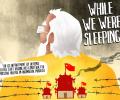
Dominic Xavier wonders if the Pentagon's claim that China has built a village in Arunachal Pradesh is true, was the government caught napping?

The Indian Army has shown it can face down the PLA, but is too often held back by a political leadership that lacks boldness, asserts Ajai Shukla.

The Arunachal Pradesh government has launched an ambitious plan to build 50 mini hydropower projects along the border with China for electrification of remote villages that are facing challenges of poor connectivity and mountainous terrain.

Why is China's supreme leader promoting Han Chauvinism so aggressively, asks Claude Arpi.

At this time, sixty years ago, Brigadier John Parshuram Dalvi and a majority of his men were captured as prisoners of war by the Chinese during the 1962 war. His son Michael Dalvi, 77, has preserved his father's memory and the story of the gallant men of the 7th Infantry Brigade with honour.

'At school, on August 15, the Indian flag was raised. There was no national anthem at that time and we sang Rise India Thy Millions Lead,' recalls military legend Major General Ian Cardozo (retd).
The first priority for the new Tibetan administration in Dharamsala should be to look at Tibetan recruitment in the PLA, suggests Claude Arpi.

Tawang wears its history -- and also its present -- with ease. The flourishing town, with restaurants selling everything from noodles to dosas and locals returning home to new business prospects, shows little sign of the tension building up at the border about 40 km away to the north.
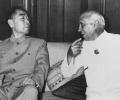
'The war of 1962 exposed the hollow intellectual foundations of Nehruvian foreign policy, especially vis-a-vis China and that is why it was such a shock.'

Lt Gen Kalita also stated that the Army is constantly monitoring the activities across the border and is well prepared to meet any emerging challenges.
