
Glimpses from Donald Trump and Xi Jinping's ceremonial Beijing engagement capture diplomacy, symbolism and statecraft at historic Chinese landmarks.

Delhi must now purge the delusional hopes of being a 'counterweight' to China in the US calculus, argues Ambassador M K Bhadrakumar.

The Beijing summit may have reduced immediate diplomatic uncertainty, but it did not resolve the deeper structural contest between the United States and China. That contest appears likely to define the coming decade, notes Varun Arya.

US President Donald Trump will visit China from May 13 to 15 at the invitation of President Xi Jinping. The visit occurs amidst global tensions, including the war in West Asia and trade disputes between the US and China. Discussions are expected to cover China-US relations, world peace, and economic issues.

'Every year we import approximately $70 billion worth of gold -- closer to $72 billion in 2025-2026, an all-time record.' 'There is no parallel for this anywhere in the world. And this love for gold will not disappear overnight.'

A public exchange of open letters between Congress leaders Mani Shankar Aiyar and Shashi Tharoor reveals a significant rift over foreign policy, particularly concerning Israel and the Sabarimala temple issue.
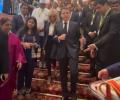
French President Emmanuel Macron's recent state visit to India concluded with a tribute video featuring the title track from the Hindi blockbuster 'Dhurandhar,' sparking widespread social media buzz.

Alliances fight wars effectively only when they share an endgame. If Israel acted without US knowledge, then the military alliance is operating without real coordination at the level of strategic targeting. Neither picture is reassuring in a war that is no longer regional in its consequences. Prem Panicker continues his must read daily blog on the Gulf War.

Trump, 79, made a lively entrance in Malaysia's capital, dancing to the rhythm of drums on the airport tarmac near Air Force One, his energetic moves drawing smiles from onlookers.
'India today feels enough is enough and we need to teach Pakistan a lesson.' 'Unless compelled, Mr Modi will think 10 times before taking the extreme step.'
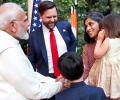
Prime Minister Narendra Modi and US Vice President JD Vance have expressed satisfaction with the progress made in negotiations for a bilateral trade agreement. The two leaders met in New Delhi and discussed a range of bilateral issues, including cooperation in energy, defense, strategic technologies, and other areas. They also exchanged views on regional and global issues of mutual interest.
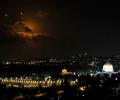
India also advised its citizens to avoid all non-essential travel to Iran.
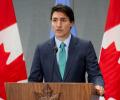
Canadian Prime Minister Justin Trudeau is 'sociologically and politically' an 'idiot' who has never truly understood that the vast majority of Sikhs are quite secular in their outlook and want nothing to do with Khalistan, according to a former Canadian minister.
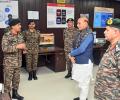
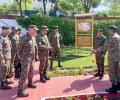
Defence Minister Rajnath Singh announced that India's defence exports have crossed a record Rs 21,000 crore, a significant jump from Rs 2,000 crore a decade ago. He set a target of achieving defence exports of Rs 50,000 crore by 2029. Singh highlighted the importance of mastering frontier technologies in the face of evolving warfare, emphasizing the role of military training centers in preparing soldiers for future challenges. He also underscored the government's commitment to strengthening integration and jointness among the three services, aiming to enhance the armed forces' ability to face challenges together.
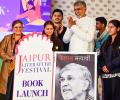
The dramatic moves of Donald Trump, which have shaken up the global order, dominated the discussion. A sense of bewilderment prevailed, but there was also expectation that President Trump would settle down to a more traditional style of governance after a time of shock and awe, observes Ambassador T P Sreenivasan, an attendee at literary festivals in Calicut, Jaipur, Kochi, Sharjah and Thiruvanathapuram.

Prime Minister Narendra Modi, whose selfie with Chinese Premier Li Keqiang grabbed eyeballs across the globe, on Sunday, extended his 'selfie diplomacy' to Mongolia by clicking one with President Tsakhiagiin Elbegdorj.

'Canada doesn't want to de-escalate and neither does India. There is war when one party wants it, but peace is won by both parties.'

Just before commencing his formal address at the Indian Institute of Technology in Chennai, the first of his functions, Howard expressed grief over the bomb blasts and offered Australia's condolences to the families of the victims.
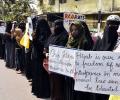
India and Indians can ignore Pakistan, but that cannot be said of other nations in the neighbourhood, where New Delhi's 'Neighbourhood First' policy constantly reverberates. Four of the eight SAARC member-nations are Muslim -- Afghanistan and Pakistan, Bangladesh and the Maldives. The rulers decide the nation's India or anti-India policy in the first two, and street-opinion contributes to the same in the latter two, points out N Sathiya Moorthy.

The fundamental construct of India's neighbourhood policy still needs to be what Vajpayee postulated, Manmohan Singh embraced, and Modi energised. It's just that we need to junk domestic politics and excessive religiosity, while acquiring much humility and a renewed respectfulness towards our neighbours, recommends Shekhar Gupta.

'In today's world, it is difficult for public pressure to work against a country like India.'

You don't want to fight and do trade at the same time. Meanwhile, diplomacy is going on and sometimes solutions to difficult situations do not come in haste, Jaishankar asserted.

On the night of July 5, the Tigers launched their first kamikaze operation. Miller took the wheels of the explosive-packed truck, smiled at everyone as he turned the ignition key and drove it slowly towards the Sri Lankan military camp. A few moments later all of Jaffna heard a thunderous explosion that brought the complex crashing down in clouds of dust. Miller had given birth to a deadly tactic that Prabhakaran would employ time and again with devastating consequences to Sri Lanka -- and India. A fascinating excerpt from M R Narayan Swamy's must read new book, The Rout Of Prabhakaran.

Nepal witnessed political turbulence in 2022 that dramatically turned rivals into allies and throned former guerrilla leader Pushpa Kamal Dahal 'Prachanda' as the prime minister for a third time, as Kathmandu made efforts to balance ties with immediate neighbours India and China with high-profile talks and visits.

Here are some of the glimpses of the celebrations.
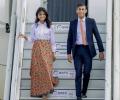
Emphasising that various issues are on agenda at the G20 under India's leadership.
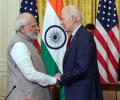
'For the first time since I've been following Indian politics, one heard voters talking about India's role on the world stage and the fact that, due to Modi's leadership, India was once again a great power.'

Speaking at a seminar in New Delhi, Madhav stressed that culture and religion have been the major aspect of ties between India and Southeast Asia

'The MEA, hopefully, made it clear that the Indian PM can't be seen in Xi Jinping's company when China has, for all intents and purposes, annexed over 1,000 sq kms of Indian territory in eastern Ladakh, and essentially that the Wuhan spirit and the Mamallapuram spirit have turned into vinegar.'

Prime Minister Modi made a strategic blunder of Nehruvian proportions -- presuming no war can happen now, and the Chinese won't be a military threat and risk their economic interests, observes Shekhar Gupta.
In a first visit by an Indian head of state to China in a decade, President Pratibha Patil on Wednesday left for Beijing. Besides Beijing, the six-day state visit will take the President to Loyang, where she will inaugurate the famous White Horse Buddhist temple, and Shanghai, where she will visit India and China Pavilions at the Shanghai Expo 2010 and address members of the India-China business forum.

43.2 million people follow the Indian premier on the social media platform.

BJP would observe the next 10 days -- from Sunday to September 17, the birthday of the PM -- as 'seva parva'.
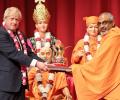
'It is never a good idea to let the broad population determine policy that is the domain of experts and specialists,' notes Aakar Patel.
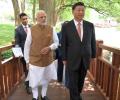
'India's preference today seems to be to exploit the deepening chill in relations with China to breathe new life into its meandering partnership with the US,' argues Ambassador M K Bhadrakumar.

She faced off against former disciple-turned-defector Suvendu Adhikari in a very different contest. It's not land acquisition, but an ego clash that has acquired, tragically, communal overtones, explains Kanika Datta.

'China was a relationship from which Mr Modi had expected the most it seems.' 'It showed in a string of summits, and somewhat breathless celebration of Xi Jinping.' 'It was hasty and simplistic,' observes Shekhar Gupta.

'The sooner Pakistan and India face these geopolitical realities, the better it will be for their own security and prosperity,' observes Ambassador M K Bhadrakumar.
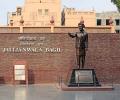
The manifesto also commits Labour to constitute a judge-led inquiry into Britain's "injustices of the past", including a public review of the country's role in Operation Blue Star -- referred to as the "Amritsar massacre".
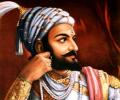
Shivaji made sure that his soldiers respected the sanctity of mosques and the Quran Sharif to ensure that his fight against the Mughals did not become fight against Islam, explains Colonel Anil A Athale (retd).
