
ISRO Chairman S Somanath had recently said the most critical part of the landing will be the process of reducing the velocity of the lander from 30 km height to the final landing, and the ability to reorient the spacecraft from horizontal to vertical direction. "This is the trick we have to play here," he said.
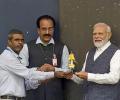
'Perhaps the government should explain how the same scientific temper, which authored a precise landing for Chandrayaan-3, finds the periodic table and the theory of evolution not good enough for inclusion in the educational curriculum,' asserts Shyam G Menon.

Lander Module of Chandrayaan-3 spacecraft comprising the lander and rover has successfully separated from the Propulsion Module, Indian Space Research Organisation said on Thursday.

Around 23 minutes after lift-off, the primary satellite got separated and it was followed by six other co-passenger satellites, which were deployed into the intended orbits sequentially, ISRO said.

The spacecraft will now prepare for separation of the lander module -- comprising the lander and rover -- from the propulsion module.
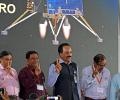
Ex-ISRO chairman G Madhavan Nair said the scientists at space agency have achieved this historic success by getting a salary one-fifth of the scientists in the developed world.
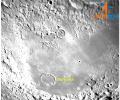
If any factor regarding the lander module appears unfavourable, then the landing will be shifted to August 27, said the Space Applications Centre-ISRO about Chandrayaan-3 on Monday.

Engineers at the National Institute of Ocean Technology in Chennai have already designed the steel sphere that will house the aquanauts for their journey, he said.

After the successful deployment of Chandrayaan-3's lander and rover on the moon, Indian Space Research Organisation (ISRO) is hoping that their mission life will not be limited to one lunar day or 14 earth days, and that they will come back to life when the sun again rises on the Moon, to carry on with the experiments and studies there.

Former National Aeronautics and Space Administration (NASA) Official Mike Gold has said Chandrayaan-3's success is a triumph of Indian innovation, human capital and the capabilities that will take India even further.

In a giant leap for its space programme, India's Moon mission Chandrayaan-3 touched down on the lunar south pole at 6.04 pm on Wednesday, propelling the country to an exclusive club of four and making it the first country to land on the uncharted surface.

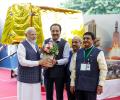
The four astronauts are -- Prashanth Balakrishnan Nair, Angad Prathap, Ajit Krishnan, and Shubhanshu Shukla -- Modi said at the Vikram Sarabhai Space Centre (VSSC) at Thumba near the Kerala state capital.

The Indian Space Research Organisation on Sunday faced a blip in its plan to tap the small satellite launch vehicle market, as an anomaly in the placing of the satellites by the rocket led to deviation on its path thereby becoming 'no longer usable', Chairman S Somanath said on Sunday.

ISRO will now conduct further testing of VELC and its eventual integration with the Aditya-L1 spacecraft, it said in a release.

The heaviest rocket of the Indian Space Research Organisation -- LVM3-M2/OneWeb India-1 -- blasted off from the Sriharikota spaceport on Sunday to place 36 broadband communication satellites into the Low Earth Orbit (LEO) for a UK-based customer.

Singh also said a final decision on the launch of India's sun mission 'Aditya-L1', scheduled for September 2 at present, will rest on the prevailing cosmic aspects.

Chandrayaan 3 follows the Chandrayaan 2 mission which did not achieve the desired soft landing on the surface of the moon in 2019, disappointing the scientists.

What some of our leaders were up to on Tuesday, November 8, 2022.

ISRO aims to send humans into space on a Low Earth Orbit of 400 km for a three-day mission and bring them safely back to earth.

Meet Indian Space Research Organisation scientist Ningthoujam Raghu Singh, who was one of the bright sparks responsible for sending Chandrayaan-3 to the moon.

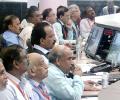
People gathered in educational institutions, offices, city squares and religious places to watch the Indian Space Research Organisation's live telecast of Chandrayaan-3's final descent to the uncharted surface of the lunar south pole.

More and more women are making their presence felt in jobs related to sciences, technology, and engineering across organisations.

So, if ISRO is able to revive them as the Sun rises on the Moon again, information that is derived from experiments that could once again be conducted by the Chandrayaan-3 payloads would be a "bonus".

India is now on the Moon and the success of the lunar mission has sounded the bugle for the emergence of a developed nation, Prime Minister Narendra Modi said on Wednesday as Chandrayaan-3 landed successfully on the lunar surface.

ISRO, in a tweet, said EOS-04 was placed into an intended sun synchronous polar orbit of 529 km altitude at 6.17 am.

The mission objective is to ensure data continuity of ocean color and wind vector data to sustain the operational applications.

On Sunday morning, in its mission to place an earth observation satellite and students satellite into the low earth orbit, the SSLV-D1/EOS-02 blasted off precisely at 9.18 am amid cloudy skies from the first launch pad at Satish Dhawan Space Centre in this spaceport.

'We have all the technologies available, but it should be converted to something that can be commercially viable.'
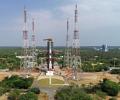
Days after landing on the Moon, India will aim for the Sun on Saturday with its maiden solar expedition, as ISRO's trusted PSLV will carry the Aditya L1 mission on a 125-day voyage to the Sun.

India's Mars orbiter craft has completed eight years in its orbit, well beyond its designed mission life of six months. Plans on a follow-on 'Mangalyaan' mission to the Red Planet, however, are yet to be firmed up.
August 23, the day the Chandrayaan-3 lander touched down on the lunar surface, would be celebrated as 'National Space Day'.
Leading scientists and experts said this monumental accomplishment not only marks India's indelible imprint on lunar exploration but also demonstrates the prowess of human collaboration, determination, and cutting-edge technology.
India's first privately developed rocket -- Vikram-S -- is set for launch in a sub-orbital mission with three payloads between November 12 and 16, Hyderabad-based space startup Skyroot Aerospace announced on Tuesday.

The successful launch of the maiden solar mission of the Indian Space Research Organisation came on the heels of the historic lunar landing mission - Chandrayaan-3.
'The benchmark was set by Dr Sarabhai.' 'If there is a problem, everybody would be encouraged to come up with a solution.' 'The final solution will be the result of all the inputs.' 'This is passed on through time.' 'Even today, you see that nobody wants to take particular credit on a success.'

'We hear about Chanda Mama from our childhood.' 'I am excited by the idea of seeing it with my eyes.'

India will become the fourth country to master the technology of soft-landing on the lunar surface after the US, China and the erstwhile Soviet Union.
'You declare a date, time and place for the landing two months in advance and exactly at that moment, it touched on the moon.'

They also said that they have asked the current chairman of ISRO S Somanath to take a decision on the false claims made in the movie.

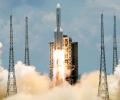
The 6-metre tall launch vehicle Vikram-S is named after Vikram Sarabhai, the father of the country's space programme and lifted off at 11.30 am.
